How to Use AI to Improve Your Resume Without Making It Sound Generic
AI can make a resume cleaner, sharper, and easier to tailor. It can also turn a perfectly good resume into something that reads like it rolled off the same assembly line as everyone else's — same phrasing, same hollow adjectives, same "results-driven professional" energy. If you've ever run your resume through a chatbot and gotten back something that sounds like a stranger wrote it, you already know the problem this article is about.
The goal isn't to have AI write your resume. The goal is to use an AI resume workflow to help you uncover stronger evidence of what you've actually accomplished, and then say it more clearly than you could on your own. Used that way, AI becomes an editor and a thinking partner. Used the wrong way, it becomes a generic-content machine wearing your name at the top of the page.
This guide walks through exactly where AI helps, where it doesn't, and how to keep your professional voice intact while still getting a resume that's tighter, more specific, and more likely to survive a recruiter's six-second scan.

What an AI Resume Should — and Shouldn't — Do
Before you open a chatbot and start typing, it helps to know what you're actually asking it to do. An AI resume tool is genuinely good at pattern recognition, language cleanup, and comparison. It is not good at knowing your career, and it has no idea what you actually did last Tuesday, let alone what you accomplished in 2022.
What AI Can Improve
AI is useful for the mechanical and structural side of resume writing. It can tighten clarity, catch grammar slips, cut wordiness, and rework a paragraph of responsibilities into scannable bullet points. It's also strong at spotting repetition — if you've used "responsible for" four times without noticing, AI will notice. And when you give it a job description alongside your resume, it can flag keyword alignment and help you reorganize sections so the most relevant information sits near the top, where a recruiter's eyes actually land first.
What AI Should Not Replace
What AI cannot do is supply the substance. It doesn't know your actual experience, and it has no way to verify a measurable accomplishment unless you hand it the number. It can't exercise your judgment about which project mattered most, and it shouldn't be trusted to invent your career narrative or your voice. Most importantly, AI has no built-in mechanism for factual accuracy — it will happily generate a plausible-sounding achievement that never happened if you let it.
The line to hold onto: an AI-assisted resume should still sound like a particular person who has done particular things — not a composite of every resume the model has ever seen.
Start With Your Real Experience
Here's where most AI resume attempts go wrong before they even begin. Someone opens a chatbot, types "write me a professional resume," and hits enter. That prompt gives the AI almost nothing to work with, so it fills the gaps with the only thing it has: generic professional language pulled from thousands of other resumes. The result reads fine on the surface and says almost nothing underneath it.
A better AI resume process starts in the opposite direction — with evidence first, generation second.
Gather Your Career Evidence
Before you ask AI to touch a single sentence, spend twenty minutes pulling together your raw material: old resumes, the original job descriptions for roles you've held, performance reviews, project notes, and any awards or recognitions. Add anything with numbers attached — sales figures, productivity improvements, budgets you managed, the size of a team you supervised, a process you streamlined, certifications, technologies you've used, and outcomes for customers or clients. This is the unglamorous part, and it's also the part that actually determines whether your resume ends up sounding like you or sounding like a template.
If you're validating your target role or comparing your experience with current occupation requirements, the U.S. Bureau of Labor Statistics is a useful authoritative reference for occupational and labor-market information.
Turn Responsibilities Into Accomplishments
Once you have that material, the transformation becomes obvious. Compare these two lines:
| Version | Resume Example |
|---|---|
| Weak | "Responsible for managing customer accounts." |
| Stronger | "Managed a portfolio of 85 business accounts and reduced average response time by 22% by restructuring the customer-support workflow." |
The second version isn't better because it's longer or more polished — it's better because it's specific. AI can absolutely help you find the clearer phrasing and identify where a sentence is hiding a stronger accomplishment underneath vague language. In a real resume, however, the "85 accounts" and "22%" must come from you. AI can help express a genuine achievement; it should never manufacture one.
Use AI to Strengthen Resume Bullet Points
Once you have real evidence on the page, the next job is turning it into bullets a recruiter can absorb in seconds. The useful mental model is Task → Action → Result: what needed to happen, what you did about it, and what changed because you did it.
Instead of asking AI for "better resume bullets" — a prompt so vague it invites vague output — try something with guardrails built in:
"Review these resume bullets for clarity and impact. Keep every fact, number, responsibility, and accomplishment accurate. Do not invent achievements. Identify where the bullet could better communicate the action and result."
That single instruction changes everything about the output, because it tells the model its job is editing, not authorship.
Here's what that looks like in practice. The figures in the examples below are illustrative; use your own verified numbers and outcomes in a real resume:
Original: "Managed email marketing campaigns for the company."
AI-assisted revision: "Managed weekly email campaigns reaching 25,000 subscribers and improved click-through rates by 18% through audience segmentation and subject-line testing."
Notice what actually happened there. In a real resume, the candidate must supply the subscriber count, the percentage, and the tactic; those figures are illustrative here, not facts to copy. AI's contribution is structural: pulling genuine specifics forward and cutting the filler around them. That distinction — AI sharpens, you supply — is worth keeping in mind through every section of this article.
Tailor Your Resume to a Specific Job
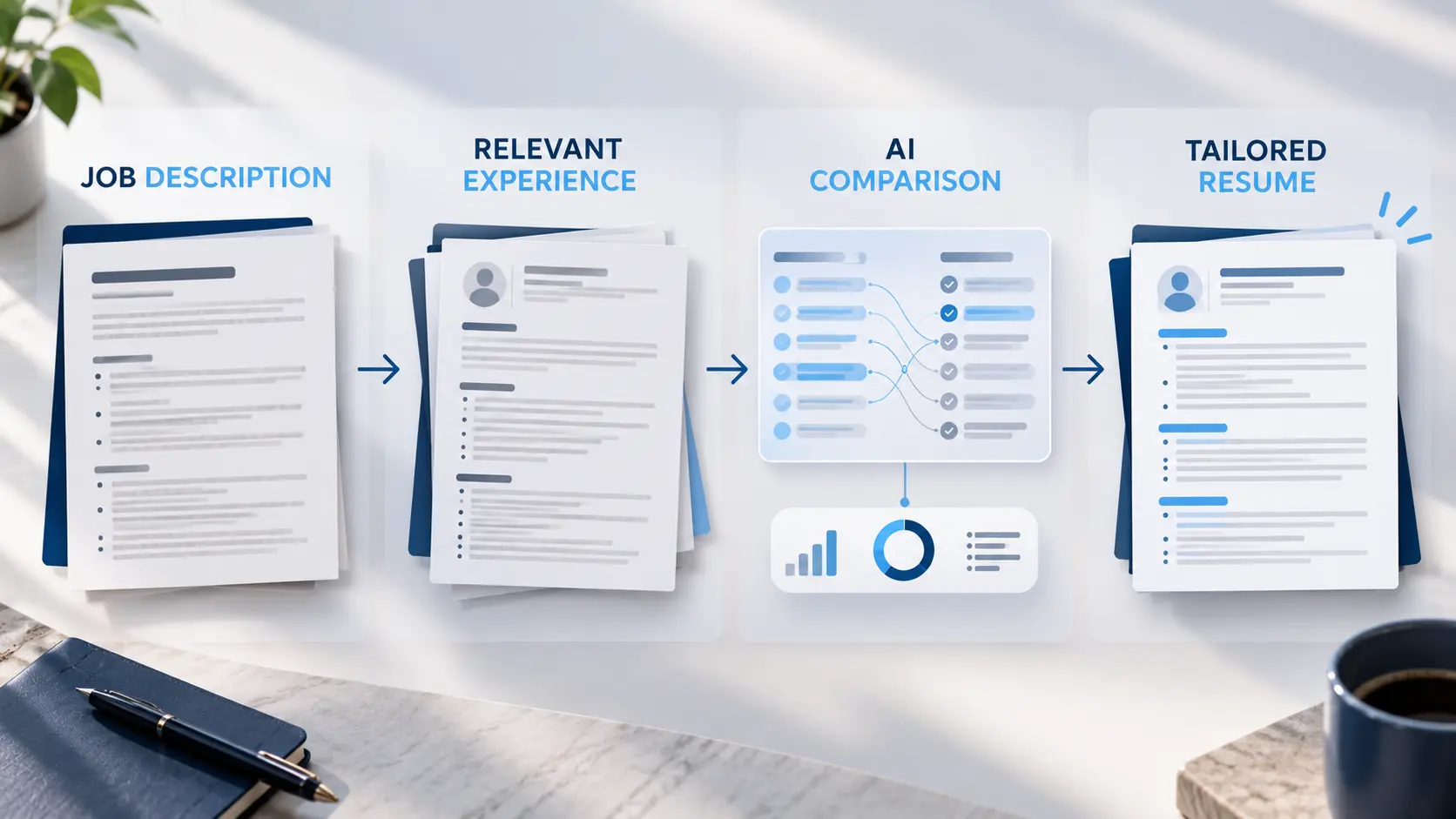
If there's one place an AI resume tool earns its keep, it's comparison rather than generation. Writing from scratch is where AI tends to drift toward generic phrasing. Comparing two existing documents — your resume and a job posting — is a task it handles well, because it's pattern-matching, not inventing.
Compare Your Resume With the Job Description
Paste in the job description alongside your resume and ask AI to identify the required qualifications, recurring skills, industry-specific terminology, core responsibilities, and any desirable-but-not-required qualifications. Also ask it to flag areas that seem underdeveloped on your resume relative to what the posting is asking for. This is a fast way to see where your document already lines up and where it's leaving something implied instead of stated.
Prioritize Relevant Experience
Tailoring doesn't mean copying the job posting's language wholesale — that's how resumes end up sounding like they were written by the job ad itself. It means surfacing the experience you already have that's genuinely relevant.
For example, a job description might say: “Experience managing cross-functional projects and coordinating stakeholders.”
Your genuine experience could be anything like: "Coordinated product launches with marketing, sales, engineering and customer support."
AI can help you recognize that your launch coordination work is a strong match for that requirement — it just needs to be phrased so a recruiter sees the connection immediately. What it should never do is let you claim "cross-functional project management" experience you don't actually have, just because the phrase matches the posting.
Improve Your Resume Summary With AI
The summary at the top of a resume is often where genericness goes to multiply. A few phrases show up so often they've essentially stopped meaning anything: results-driven professional, highly motivated, dynamic leader, proven track record, team player, passionate professional. If your summary could be pasted onto 500 different LinkedIn profiles without anyone noticing, it probably needs another pass.
Here's the difference specificity makes:
Generic: "Results-oriented marketing expert with a demonstrated track record of delivering new solutions."
Specific: "B2B marketing manager with 9 years of experience designing demand-generation programs for SaaS companies, including campaigns that contributed to six-figure pipeline growth."
The second version tells a hiring manager your role, your industry, your tenure, and a concrete outcome — all in one sentence. AI is genuinely good at helping you sharpen vague summary language into something this precise. But only you know which claims you can actually defend, so treat every AI suggestion here as a draft to verify, not a finished product to paste in.
Use AI to Find Missing Keywords
Many mid-size and large employers use applicant tracking systems to help manage and screen applications before recruiters review them, which is why resume keywords matter. But this section isn't meant to turn into an ATS horror story — the reality is more mundane and more manageable than the internet often makes it sound.
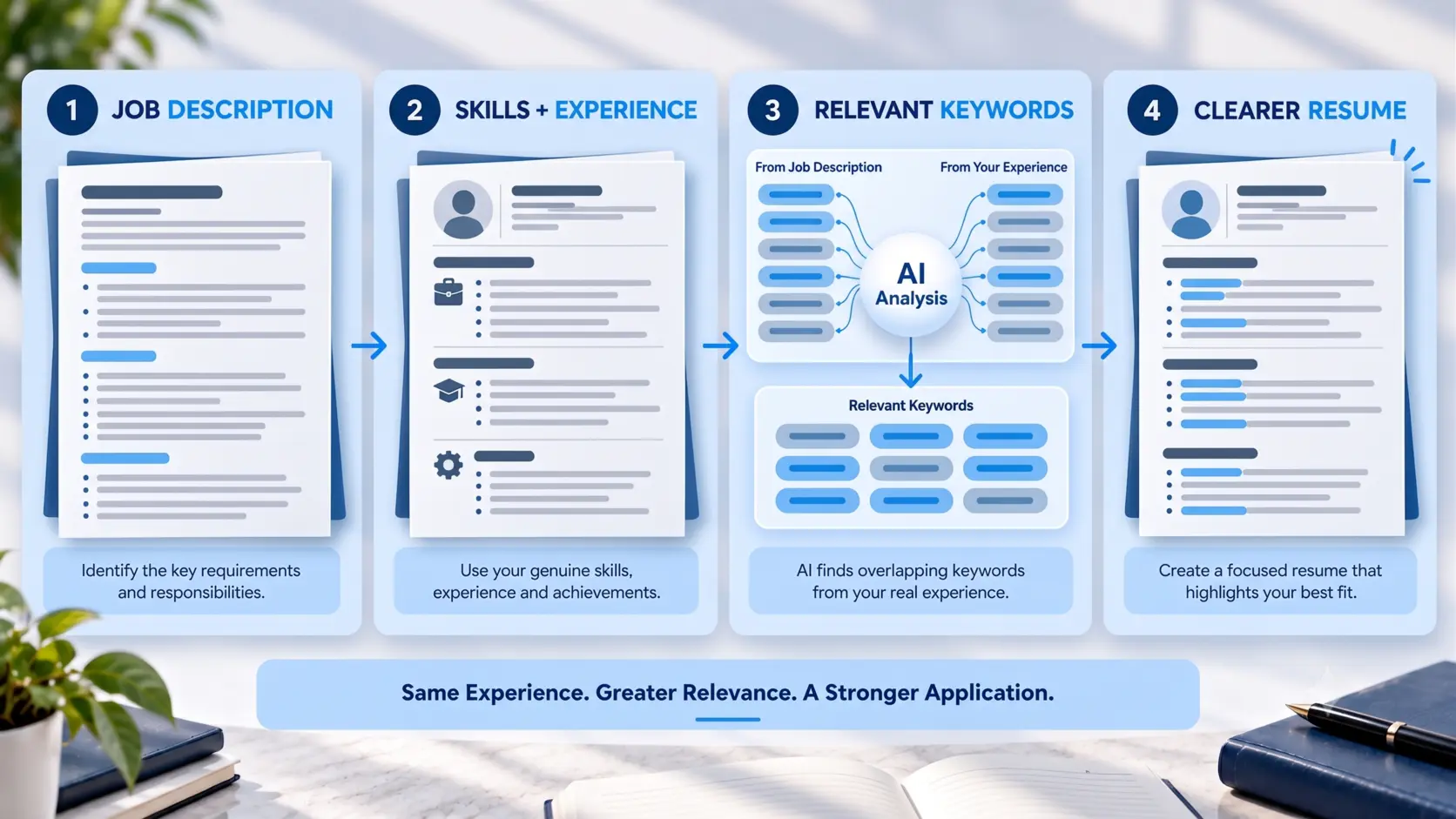
AI can help by matching legitimate skills you already have against the language a job posting uses, identifying terminology differences (you call it "customer success," they call it "client retention"), checking whether relevant experience is buried in a paragraph instead of stated plainly, surfacing missing technical terms, and reviewing your skills section for gaps.
The objective isn't to make your resume contain every phrase in the job description — that's keyword stuffing, and both ATS software and human reviewers are increasingly good at spotting it. The real objective is to make legitimate qualifications easier to recognize, for a machine and for a person. Adding a skill you don't have because it appeared in a job posting doesn't get you further in the process; it just gets you an uncomfortable interview question.
Keep Your AI Resume From Sounding Generic
There's a particular flavor of resume that AI tends to produce when it's given too much freedom: heavy on corporate language, light on anything you could point to and say "that's mine." The tells are pretty consistent once you know to look for them — excessive formality, vague achievements, sentences that all follow the same rhythm, an overload of adjectives, claims with nothing behind them, and buzzwords stacked on buzzwords until the meaning evaporates.
Replace Claims With Evidence
Compare a claim to the evidence behind it:
Claim: "Excellent communicator who consistently delivers results."
Evidence: "Presented quarterly performance findings to executive leadership and translated customer data into three process changes adopted by the support team."
The second version doesn't tell the reader you're a good communicator — it shows them, and it lets them draw the conclusion themselves. That's a small shift with a large payoff.
Keep Some Human Texture
Professional doesn't have to mean robotic. A resume can still carry specific details, clear preferences, meaningful context, and the kind of distinctive expertise that only comes from actually having done the work. If every sentence on your resume could belong to any candidate in your field, something's been smoothed away that shouldn't have been.
What Not to Let AI Invent
This section matters more than almost anything else in this guide, because it's where an AI resume tool can quietly do real damage to your job search. Language models are built to produce plausible-sounding text, and "plausible-sounding" and "true" are not the same thing. Left unchecked, AI can generate fake metrics, nonexistent certifications, invented software experience, fabricated leadership responsibilities, fictional achievements, exaggerated job titles, incorrect dates, and claims that simply aren't supported by anything you've actually done.
A useful rule to apply to every single line: if you can't defend the statement in an interview, it doesn't belong on your resume. That standard alone will catch most of the fabrication risk before it ever reaches a hiring manager's desk.
It's also worth understanding that AI doesn't "lie" in the way a person does — it generates statements that fit a pattern, and sometimes that pattern produces something confidently wrong. If you want to understand this tendency in more depth, it's worth reading about AI hallucinations, which covers how AI systems generate plausible-sounding information that isn't true and how to catch it before it causes a problem.
A Practical AI Resume Workflow
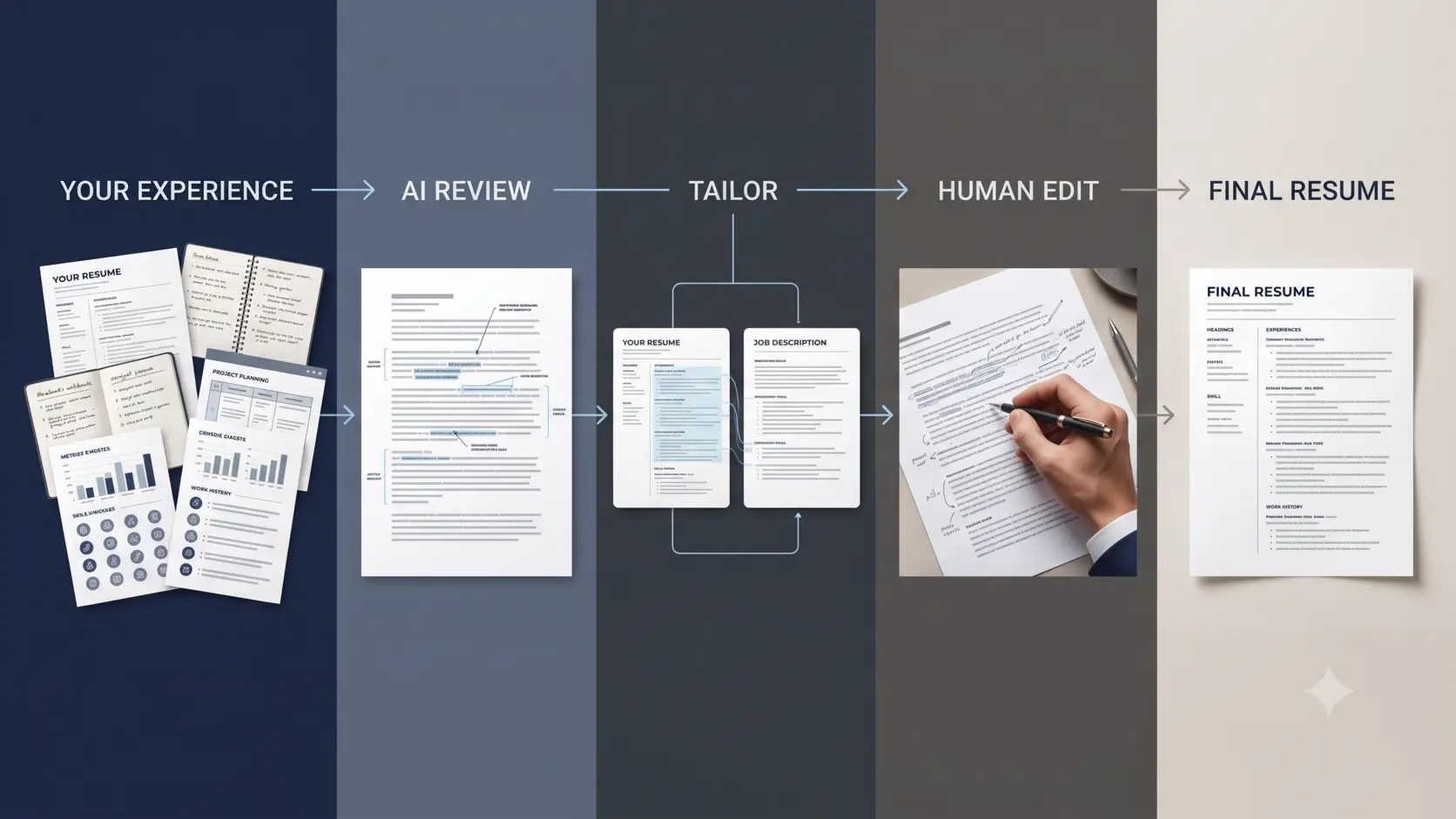
Here's how all of the above fits together into one repeatable process — a workflow you can actually reuse every time you apply to something new.
Step 1 — Gather Your Evidence
Collect accomplishments, metrics, projects, responsibilities, skills, and work history in one place before you write anything.
Step 2 — Create Your Master Resume
Build the complete, factual, un-tailored version first. This becomes your source document for every future application.
Step 3 — Ask AI to Identify Weak Spots
Have it identify confusing bullets, redundancy, unsupported statements, weak verbs, missing results, and imprecise terminology — don't rewrite everything; simply point out the problems.
Step 4 — Tailor to the Job
Compare your master resume against the specific job description you're applying to.
Step 5 — Rewrite Selectively
Accept the suggestions that genuinely improve clarity or impact. Ignore the ones that don't sound like you, even if they sound "professional."
Step 6 — Restore Your Voice
Read the whole thing out loud. If a sentence sounds like something you would never actually say, rewrite it in your own words.
Step 7 — Verify Every Claim
Double-check every number, date, title, skill, certification, employer, technology, and accomplishment before you submit anything.
Step 8 — Final Human Review
AI gets the second-to-last word. You get the last word.
Final AI Resume Quality Check
Before you hit submit, run through this checklist one more time.
- Accuracy: Is every claim true? Can you defend every number? Are the dates correct?
- Relevance: Does the resume address this particular job? Are your most relevant qualifications easy to find at a glance?
- Specificity: Does the resume show what you actually did? Is every accomplishment backed by evidence rather than adjectives?
- Voice: Does it sound like you? Have the generic AI phrases been removed?
- Readability: Could a recruiter understand your experience quickly? Are the bullets concise? Is the document easy to scan?
- AI quality: Did AI genuinely improve the resume — or did it just make the same content sound more polished without making it more true or more specific? That last question is the one most people skip, and it's usually the most revealing.
Frequently Asked Questions About AI Resumes
Can I Use AI to Write My Resume?
You can, but it's rarely the strongest approach. Handing AI a blank page and accepting the first draft tends to produce something generic, because the model has no access to your actual experience. Using AI as an editor and strategist — feeding it your real accomplishments and asking it to sharpen the language — almost always produces a stronger, more accurate result.
Is It Okay to Use an AI Resume Builder?
Yes, with some caution. AI resume builders can be genuinely helpful for formatting, structure, and getting past a blank-page problem quickly. The limitation is that most builders still rely on you to supply the substance — the metrics, the specific projects, the real outcomes. Treat the builder as scaffolding, not a finished product.
How Do I Make an AI-Generated Resume Sound Less Generic?
Lean on personal evidence instead of adjectives. Replace vague claims with specific accomplishments and real metrics, use the industry terminology you'd actually use in conversation, and edit out any phrase that could apply to literally anyone in your field.
Can AI Help Tailor My Resume to a Job Description?
Yes — this is one of the strongest uses of AI in the resume process. It's particularly good at identifying which of your existing skills and experience are most relevant to a specific posting, so you can bring them forward instead of burying them.
Can AI Add Keywords for an ATS?
It can identify relevant terminology from a job posting, but keywords should only make it onto your resume if they accurately represent experience you actually have. Adding a keyword you can't back up in an interview creates more risk than it solves.
Should I Tell Employers That I Used AI on My Resume?
There's no universal rule here — it depends on how you used it and what your target employer's policies say. Using AI as an editing tool, the way you'd use a thesaurus or a proofreader, is different from having it generate your entire professional narrative. What matters most in every case is accuracy and authenticity: whatever ends up on the page has to be true and defensible, regardless of what tool helped you phrase it.
Conclusion
The best AI resume isn't the one that sounds the most polished. It's the one that makes your real experience easier to understand. Polish is easy to manufacture and easy for an experienced recruiter to see through; specificity is harder to fake, which is exactly why it works.
Used well, AI should help you clarify your story — not replace it. That means leaning on it for the parts it's genuinely good at, and staying firmly in charge of the parts that only you can supply.
Use AI to: clarify, tailor, compare, edit, identify gaps.
Don't use AI to: invent, exaggerate, fabricate, impersonate, or replace your own judgment.
If you're revisiting your resume as part of a bigger move — a new industry, a step up, or just a long-overdue update — it's worth pairing this process with a broader look at your job search strategy or thinking through what a career change actually requires before you start sending anything out.
Ready to Improve Your Resume With AI?
If your resume needs work, you don't need to hand the whole thing over to AI. Start with one section — a few weak bullets, your summary, or a resume tailored to a specific job — and use AI to find clarity you can verify. Then make the final decisions yourself. If you're actively applying, pair this process with a stronger job search strategy so your resume and outreach work together. If you're considering a larger career move, take the time to understand the skills, evidence, and positioning you'll need before you make the jump.
The goal is simple: let AI make your resume clearer, while making sure the experience behind every line is genuinely yours.
Explore Job Search Strategy