Career Progression Plan: How to Map Your Next Professional Steps
A practical roadmap for connecting your current position, target direction, skills, experience, and next steps into a workable career progression plan.
Read Guide
Career development is more manageable when you have a defined objective and a practical way to monitor progress. This section brings together straightforward guides and useful frameworks to help you make better decisions, strengthen valuable skills, and take the next step with more confidence.

Start with the part of your career development that deserves your attention right now.
Use straightforward structures to clarify where you want to go, set realistic goals, identify your strengths and determine what you should do next.
ExplorePractical ideas on how to choose the correct opportunities and adapt your applications, prepare for interviews and follow up without losing momentum.
ExploreHow to get your work noticed, show measurable value, build credibility, and set yourself up for the next role in your organization.
ExploreBuild the skills, knowledge, experience, and professional habits that help you perform better now and prepare for the opportunities you want next.
ExploreUse market data, plan for performance assessments and request remuneration with proof not conjecture.
ExploreIdentify your transferable skills, fill your critical skill gaps and select a move that works for you. Head into another field.
ExploreThese practical starting points break down larger professional goals into manageable decisions, actions, and mileposts.
Discover valuable growth opportunities, simplify the recognition of your contributions, and strengthen your case for your next promotion or expanded role.
Explore BlueprintA focused process for identifying good openings, customizing applications to the job and preparing for interviews with a clear story to tell.
Explore BlueprintPrepare for compensation conversations by combining market research, evidence of your contribution, and a calm plan for discussing what comes next.
Explore BlueprintAssess a possible career change, identify the skills you can carry with you, close the most important gaps, and make the move without discarding the experience you already have.
Explore BlueprintCareer development rarely comes from one dramatic decision. More often, it grows through a series of sensible choices: understanding where you are, deciding where you want to go, building the right capabilities, and reviewing what is working.
The goal is not to follow a rigid formula. Use the steps below as a practical guide, then adapt them to your experience, industry, and priorities.
Good career decisions usually become clearer when you compare what you want with what the market rewards. Look at the work you enjoy, the results you can demonstrate, the skills employers are asking for, and the opportunities available to you. That gives you something more useful than a generic five-year plan: a direction you can test and adjust.
Take stock of your current strengths, experience, interests, results, and the skills that may be holding you back.
Select a realistic path and decide which roles/projects/opportunities deserve your effort next.
Acquire the skills, knowledge, and professional relationships that will make your chosen direction more achievable.
Make your value more visible with better work, a sharp resume or portfolio, and more articulate professional conversations.
Translate that progress into action by asking for a raise, a promotion, a broader role or a well-planned move elsewhere.
Career development is not only about getting a new title. The skills you use every day influence how well you solve problems, communicate decisions, work with others, and take on greater responsibility.
You do not have to wait for an annual review to think about your career. Treat your progress as something you can manage throughout the year: choose a direction, identify the capabilities it requires, look for useful opportunities, and check your progress regularly.
Explore Professional Development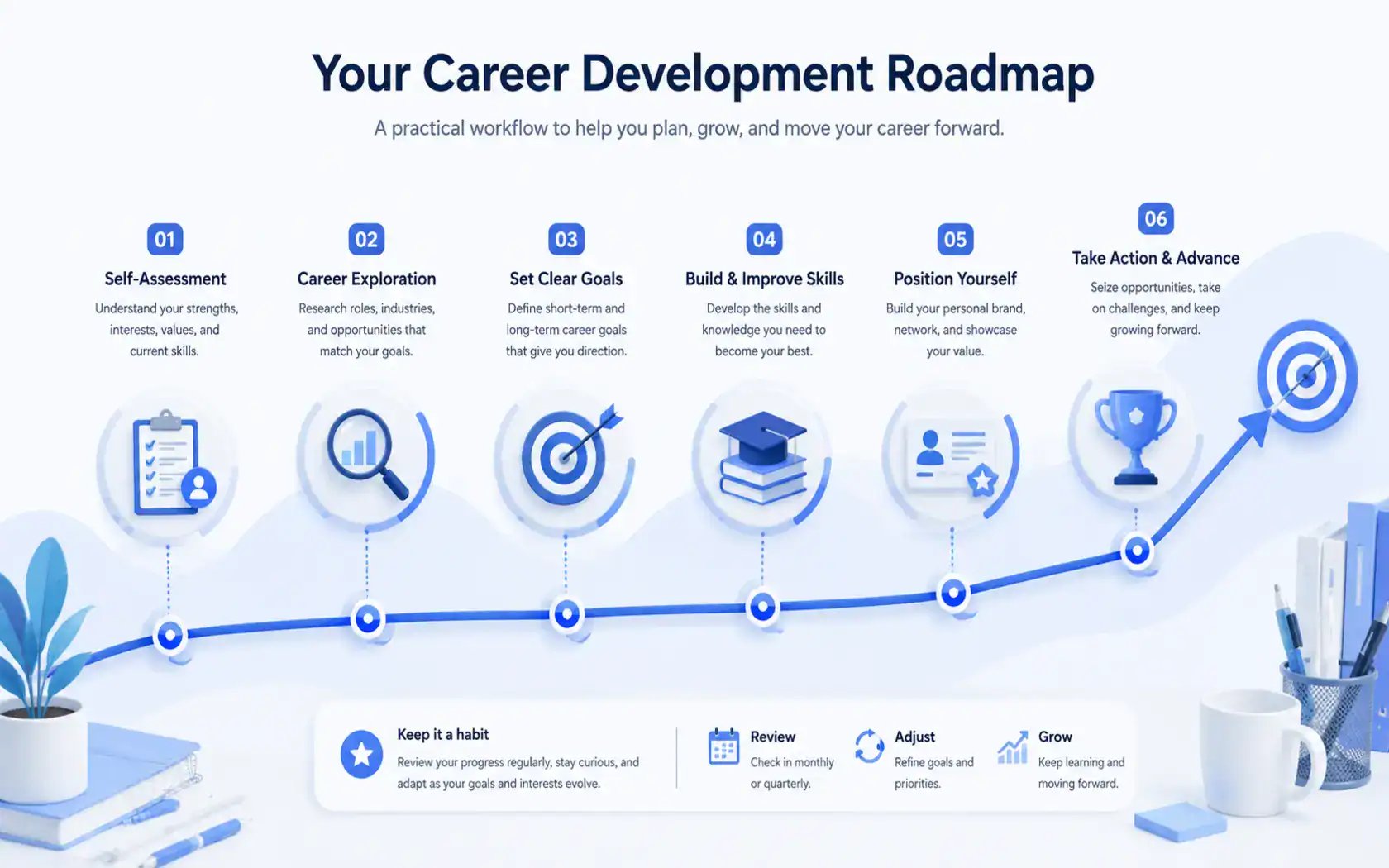
Practical ideas and frameworks for making thoughtful career decisions in a changing workplace.
A practical roadmap for connecting your current position, target direction, skills, experience, and next steps into a workable career progression plan.
Read GuideHow to collect useful compensation benchmarks, document the value you have delivered, and approach a salary conversation with preparation instead of pressure.
Read GuideA practical guide to building skills, knowledge, experience, and professional habits that support your current role and prepare you for what comes next.
Read GuideTemplates, worksheets, and checklists that turn career development ideas into actions you can actually work through.
Useful worksheets for planning your next move, organizing resume content, preparing cover letters, and getting ready for performance reviews.
Explore TemplatesPractical checklists for interview preparation, compensation discussions, and the key steps involved in a career transition.
Explore ChecklistsPreparation tools for structuring behavioral interview answers, choosing useful examples, and asking questions that reveal whether a role is right for you.
Explore MaterialsSimple tools and decision frameworks for comparing offers, thinking through trade-offs, and making career choices with a little more clarity. For broader occupational research, you can also consult the U.S. Bureau of Labor Statistics Occupational Outlook Handbook.
Explore Tools
Find practical guides, useful frameworks, and resources that can help you turn a career goal into a realistic next step.