What Is a Value Proposition?
A value proposition is the short, specific answer to a question every visitor asks silently: "What's in it for me, and why here?" It isn't a poem about your company. It's a working sentence (sometimes two) that points a particular customer toward a particular benefit.
A Simple Definition
In plain terms, a value proposition explains four things:
- Who your business serves
- What problem, frustration, or goal that person has
- What benefit your product or service delivers
- Why they should pick you over the other options on the table
The U.S. Small Business Administration includes value proposition among the key elements of a lean startup business plan and describes it as a clear and compelling statement about the unique value a company brings to the market. You can see that framing in the SBA's business planning guidance. Notice the word "clear." A statement that needs a decoder ring has already failed.
What a Value Proposition Is Not
People mix this up with several neighboring ideas, so let's sort the drawer:
- A slogan is a catchy line built to be remembered, not to explain everything your offer does.
- A tagline is a brand signature, usually short enough to fit on a coffee mug.
- A mission statement describes why your company exists, mostly from your side of the table.
- A product description tells people what the thing is.
- A feature list tells them what the thing has.
None of these are bad. They just do different jobs. Here's the difference in action:
Weak: "We provide innovative marketing solutions."
Stronger: "We help local service businesses turn more website visitors into booked appointments with simple, conversion-focused marketing."
The second version names a customer, a problem, and an outcome. The first could describe roughly forty thousand agencies, and probably does.

Why a Strong Value Proposition Matters
Marketing is mostly a series of small decisions made by strangers who are busy and slightly distracted. A strong value proposition makes those decisions easier.
It Gives Customers a Reason to Pay Attention
Attention is cheap to lose. When someone opens your homepage, sees your ad, or gets a cold email from you, they're running a quick, mostly unconscious test: does this seem relevant to me? If the answer takes more than a few seconds to find, many people simply leave. A sharp value proposition answers that question before they've had time to ask it.
It Connects Marketing to Customer Needs
Once you've settled the core promise, it starts showing up everywhere it should:
- Website headlines and landing pages
- Paid ads and social posts
- Sales conversations and pitch decks
- Product descriptions
- Email campaigns
Without it, each channel tells a slightly different story, and customers notice the mismatch even if they can't say why. With it, your marketing plan has a spine.
It Helps Clarify Differentiation
"Better" is a conclusion, not an explanation. Better in what way? For whom? Why should they care? A good value proposition answers those follow-ups up front. The SBA's guidance on business planning similarly connects a value proposition with the specific value a company brings to its market, while its business-planning guidance emphasizes understanding customer needs and competitive advantages.
Quick word on scope: if you’re looking at this topic from the business-model side, our approach to building a business value proposition discusses how it fits into the entire organization. This article stays closer to the customer's side of the counter: messaging, benefits, and testing.
The Core Elements of a Strong Value Proposition
Every effective statement I've seen, whether from a corner bakery or a software startup, is built from the same five parts. Miss one and the whole thing wobbles like a table with a short leg.
1. Target Customer
Who, specifically, is this for? "Small businesses" is a category. "Independent dental practices with two to five dentists" is a person you could actually find.
2. Customer Problem
What frustration, need, or goal brings them to you? The best problems are ones customers would describe in their own words, not yours.
3. Solution
What do you actually provide? Keep this plain. A service, a product, a process, a promise.
4. Customer Benefit
What changes for the customer once they've used it? Less time wasted, fewer headaches, more revenue, more confidence. Benefits live in the customer's life, not in your product specs.
5. Differentiation
Why you and not the other option, including doing nothing? This is the part most drafts skip, and it's usually the part that makes people stop scrolling.

How to Develop a Strong Value Proposition
Here's the working process. Grab a notebook and, ideally, a few real customer conversations. Guessing from your desk is the marketing version of assembling furniture without the instructions.
Step 1: Define Your Target Customer
"Everyone" is a lovely audience and a terrible target. Compare these:
Too broad: "We help businesses grow."
Focused: "We help independent fitness studios attract more local members."
The second one lets a studio owner in Tucson nod along. If you haven't pinned down who you're serving yet, start with our guide to identifying your target market, then come back. Narrowing your audience doesn't shrink your business. It just makes your message land.
Step 2: Identify the Problem You Actually Solve
Products describe themselves. Customers describe problems. Try answering these questions using what customers have actually told you:
- What frustrates them most about the current situation?
- What eats too much of their time?
- What costs them more than it should?
- What outcome are they really after?
- Which alternatives have already let them down?
A landscaper doesn't sell mowing. The homeowner's real problem is "I don't want to spend Saturday behind a mower, and I don't want to think about it." Different problem, different message.
Step 3: Identify the Most Important Customer Benefit
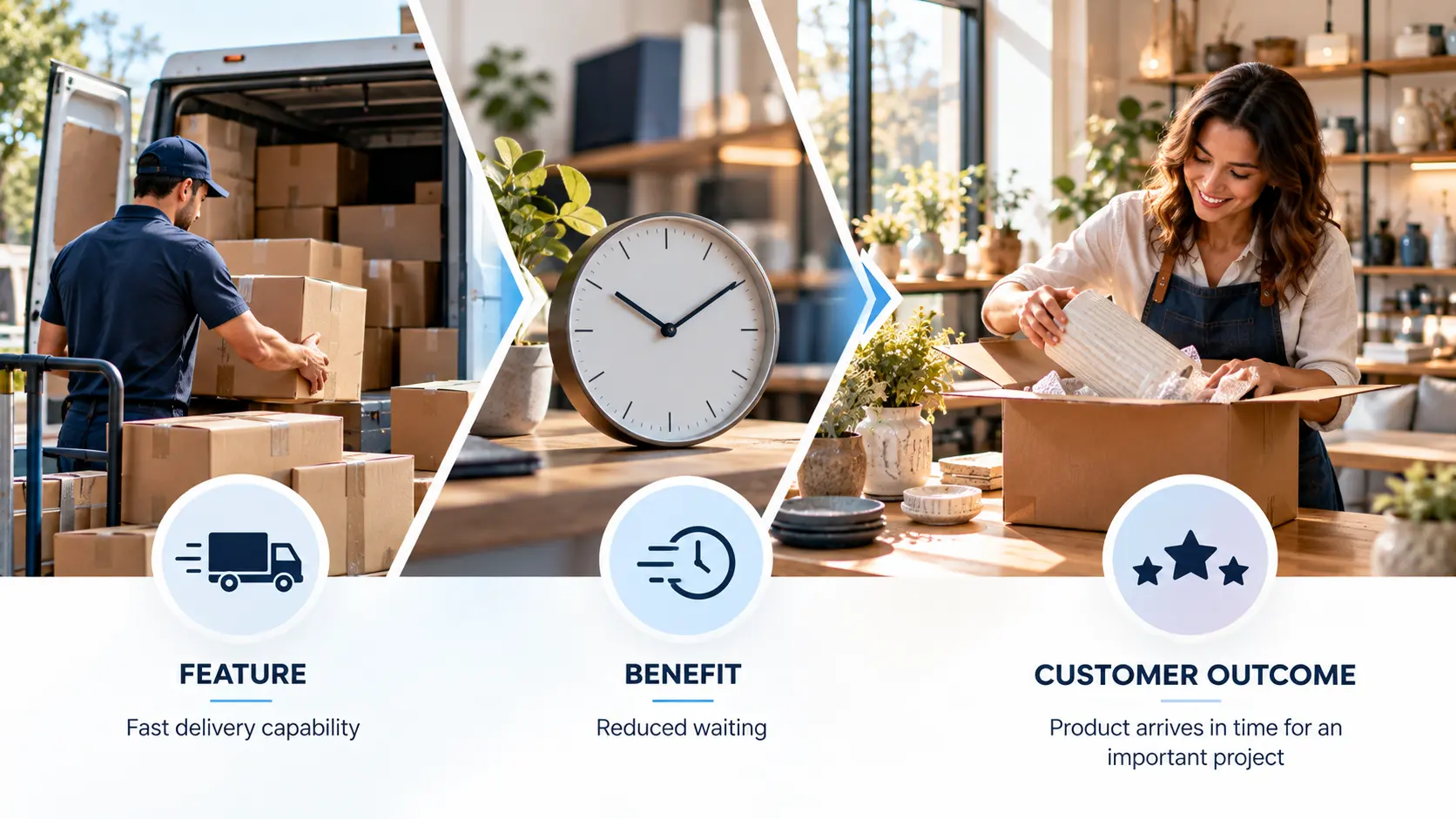
You probably have five benefits. Pick the one customers value most. First, separate features from benefits:
Feature: Same-day delivery.
Benefit: Customers don't have to wait several days for what they ordered.
Outcome: The renovation project stays on schedule.
Go one level deeper than feels natural. The outcome is what people remember and pay for.
Step 4: Figure Out What Actually Sets You Apart
This is where all that competitor homework starts paying off. Haven't done it yet? A proper competitive analysis will save you a lot of guesswork here. Ask:
- What are competitors leaning on in their own messaging?
- What do customers keep complaining about in reviews?
- Where are the alternatives inconvenient, slow, or confusing?
- What do you do differently?
- What can you deliver consistently, not just on your best day?
That last question matters. A difference you can't sustain is a future refund request.

Step 5: Write the First Draft in One Sentence
Now put the pieces together with a simple template:
"For [target customer] who [problem or need], [business or product] provides [solution and benefit] by [differentiating factor]."
For example: "For independent dental practices that lose patients to missed calls, our answering service books appointments around the clock by handling calls with trained, local-sounding staff."
Treat this as scaffolding. You're not obliged to publish it word for word, and you probably shouldn't. Its job is to force your thinking into a shape. Later, you can loosen the phrasing into something that sounds like a human being said it.
Step 6: Remove the Marketing Fluff
Read your draft aloud and cross out anything vague. Words like "world-class," "innovative," "cutting-edge," "best-in-class," "revolutionary," and "customer-centric" usually add volume without adding information. Keep them only if you can back them up with something specific.
Here's a fast test: if a competitor could copy your sentence by swapping in their company name, the statement isn't doing enough work.
How to Turn Features Into Customer Benefits
Features are what your offer has. Benefits are what your customer gets. The trick is going one step further, to the outcome, because that's what people are actually buying. Here's how the progression looks:
| Feature | Immediate Benefit | Customer Outcome |
|---|---|---|
| Same-day shipping | Faster delivery | Customer gets the product when needed |
| Automated reporting | Less manual work | More time for higher-value tasks |
| Flexible appointments | Easier scheduling | Less disruption to the customer's day |
| Transparent pricing | Easier comparison | Greater confidence before buying |
The pattern is Feature → Benefit → Outcome. When you're stuck, ask "so what?" after every feature. "We use a 24-hour scheduling system." So what? "You can book at midnight." So what? "You don't have to interrupt your workday to call us." Now that's something a customer would repeat to a friend.
One caution: don't cram every benefit into the statement. Pick the one or two that matter most to your chosen customer and let the rest live on your product pages.
How to Differentiate Your Business
Differentiation gets a bad reputation because people treat it as a hunt for something dramatic. Usually it's more mundane, and more useful.
Look Beyond Product Features
Your edge doesn't have to be a gadget. Businesses stand apart through:
- Convenience and speed
- Specialization or deep expertise
- Service quality and reliability
- Simplicity (fewer steps, fewer decisions)
- A different pricing model
- Accessibility
- The overall customer experience
A neighborhood hardware store can't outprice a national chain. It can, however, promise that a staff member who has actually fixed a leaky faucet will walk you through the repair. That's differentiation, and it fits into a sentence.
Make the Difference Relevant
A difference is only valuable if customers care about it. If you use a proprietary sourcing method that shoppers never think about, it doesn't belong at the center of your message, however proud you are of it. Lead with what your customer already wants, then mention the clever stuff as proof. For the wider picture of how this connects to positioning, see our overview of business strategy.

Value Proposition Examples
The following examples are fictional but realistic, written to show the shift from generic to specific. They aren't real company statements.
Local Cleaning Business
Weak: "Professional cleaning services for homes and businesses."
Stronger: "Reliable recurring home cleaning for busy families who want a consistently clean house without giving up their weekends."
Why it works: it names the customer (busy families), the problem (no time), and the benefit (weekends back). "Reliable" and "recurring" also hint at how the service differs from one-off cleaners.
B2B Software
Weak: "Powerful business management software."
Stronger: "Simple scheduling and client management for independent service businesses that want fewer admin tasks and more booked appointments."
Why it works: "Powerful" tells nobody anything. "Fewer admin tasks and more booked appointments" is a result a plumber or salon owner can picture.
Local Fitness Studio
Weak: "Premium fitness for everyone."
Stronger: "Small-group strength training for adults who want structured coaching without the intimidation of a big gym."
Why it works: "everyone" turns into an actual person, and it names a feeling — intimidation — that competitors tend to skip right over.
E-commerce Business
Picture an online shop selling loose-leaf tea. A generic line would be "Quality teas delivered to your door." A sharper version: "Small-batch teas from single farms, with brewing notes on every bag, for people who are tired of guessing what to buy." The value here comes from selection, specialization, and a better buying experience. Another store could build its promise around convenience, say, a monthly subscription that arrives before you run out. Same category, different customer, different message.
How to Test and Improve Your Value Proposition
Your first version is a hypothesis. Nice hypothesis, but still a hypothesis.
Test It With Real Customers
Show the statement to a handful of people in your target audience, without explaining it, and ask:
- What do you think this business offers?
- Who do you think it's for?
- What benefit would you expect to get?
- What makes it different?
- What part is unclear?
The SBA’s market research guidance suggests direct customer research approaches such as surveys, questionnaires, focus groups and in-depth interviews when you want to know how your specific target will react. SBA market research and competitive analysis guidance. If three people out of five describe your business incorrectly, the problem is worth investigating before you blame the audience.
Watch Customer Behavior
Words in a survey are useful, but behavior is louder. Track things like:
- Landing-page engagement
- Inquiries and calls
- Conversion rate
- Objections raised in sales conversations
- Patterns in customer feedback
Be careful about promises here. A stronger message can help, but it won't guarantee more conversions, because pricing, timing, and trust all play a part. Use the numbers as clues, not as judgments. When it’s time to fold your message into a broader campaign, your marketing plan is where you can schedule and organize those tests.
Refine Based on Evidence
Change one thing at a time so you can see what worked. Swap the headline, adjust the target customer, or lead with a different benefit, then compare. Over a few rounds, the statement gets sharper, and it usually gets shorter too.
Common Value Proposition Mistakes
Most weak statements fail in the same handful of ways. Check your draft against this list:
- Trying to Appeal to Everyone. A message meant for all customers usually resonates with none. Choose a primary audience.
- Listing Features Instead of Benefits. Nobody wakes up wanting "a 12-point inspection checklist." They want a car that won't die on the highway.
- Using Generic Marketing Language. If it sounds like a brochure from 2009, rewrite it in the words a customer would use.
- Making Unsupported Superiority Claims. "The best" needs evidence. Reviews, results, certifications, or specifics all help.
- Making the Statement Too Complicated. If you can't say it comfortably in one breath, trim it.
- Focusing on the Company Instead of the Customer. "We are a leading provider of..." is a sentence about you. Flip it so the customer is the subject.
- Writing It Once and Never Revisiting It. Customers' opinions change, businesses evolve, and markets keep shifting. Don't treat your message as permanent copy; instead, review it periodically.
Frequently Asked Questions About Value Propositions
What is a value proposition?
A value proposition is a clear statement explaining who your business serves, what problem it solves, what benefit customers receive, and why they should choose you over the alternatives. It acts as the central promise behind your marketing.
What makes a strong value proposition?
Mostly specificity. A good one identifies a specific customer, tackles an actual problem, articulates a meaningful result, and explains a benefit customers can recognize. It is also short enough to be understood at a glance.
What is the difference between a value proposition and a tagline?
A tagline is a memorable phrase that supports your brand identity. A value proposition explains the value you deliver and to whom. Your tagline may be inspired by it, but the two aren't interchangeable.
How long should a value proposition be?
Aim for one or two sentences for the core statement. You can then expand it into a headline, a supporting subheading, and a few benefit points on your website, but the core should be easy to say aloud without running out of breath.
Can a small business have more than one value proposition?
Yes, if you serve distinct customer groups or offer very different products. A wedding photographer and a corporate headshot studio, for instance, probably shouldn't use the same message. Just keep each statement focused on one audience.
How do you test a value proposition?
Show it to people in your target market and ask what they think you offer, who it's for, and why it's different. Then watch behavior: clicks, inquiries, sales conversations, and objections. Adjust one element at a time and compare.
Resources
Use these resources as you continue refining your value proposition and the marketing decisions that support it:
- U.S. Small Business Administration — Plan Your Business — Useful guidance on market research, competitive analysis, business planning, and customer research.
- U.S. Small Business Administration — Write Your Business Plan — Explains how value proposition fits within the lean startup business-plan format.
- Blueprint To Progress — Marketing Strategy — Continue from the value proposition into the wider strategic role of marketing.
- Blueprint To Progress — Target Market — Useful when you need to sharpen the audience your value proposition is intended to serve.
- Blueprint To Progress — Competitive Analysis — Useful when you need stronger evidence for the differentiation part of your message.
External links to the SBA should be implemented as standard DoFollow links in the production HTML unless a site-wide SEO policy changes that behavior. Do not add rel="nofollow" to these editorial references.
Final Takeaway
A strong message follows a sequence: Customer → Problem → Solution → Benefit → Difference → Evidence. Skip a step and the whole thing gets fuzzy; hit all six and people tend to understand you quickly.
Here's a practical way to finish. Take your current homepage headline, or whatever message you lead with, and ask five questions:
- Who is this for?
- What problem does it address?
- What benefit does the customer receive?
- Why is this offer different?
- Would a real customer describe the value this way?
If you can't answer any of those in a few seconds, you've found your next edit. Fix that one, test it, and repeat. Your value proposition doesn't need to be perfect on the first try. It needs to be clear enough for a stranger to repeat back to you, and a bit better each time you look at it.
Put Your Value Proposition to Work
You don't need another week of staring at the sentence. Take the value proposition you have today and put it somewhere customers can react to it.
Start with your homepage headline, landing page, product description, sales script, or ad copy. Put the message in front of real people, listen to what they understand, and note where they hesitate. Then make one focused improvement.
A clear value proposition is useful only when it changes how customers understand your offer. Turn the draft into a real marketing message, test it, and let customer response show you what needs to become clearer.
Your Next Step
Ready to sharpen your marketing message? Use the Marketing Strategy guide on Blueprint To Progress to connect your value proposition with your target market, positioning, channels, and broader marketing decisions.
Start With Marketing Strategy