
How to Create a Marketing Plan
You can have a solid product, a little money set aside, and a notebook full of promising ideas, and still watch your marketing go nowhere. The problem usually isn't effort. It's that the newsletter, the Instagram posts, the ad experiment, and the flyer at the local gym are all pulling in different directions. A marketing plan is what makes them pull together. It's the practical layer that sits underneath your broader marketing strategy, and done well, it's shorter and more useful than most people expect: a working document that ties your goals to your audience, your budget, and your calendar. This guide walks through ten steps to build one, shows a complete example, and flags the mistakes that quietly wreck otherwise decent plans.

What Is a Marketing Plan?
A marketing plan is a written roadmap that spells out what you'll do to reach customers, in what order, with how much money, and how you'll know whether it worked. Think of it as the working schedule for your marketing rather than the mission statement.
The difference between a plan and a marketing strategy trips a lot of people up, so it's worth pinning down. Strategy is direction and choices: who you're going after, what you want to be known for, where you intend to compete. The plan is organized execution: the specific campaigns, channels, dates, budgets, and numbers that carry the strategy out.
Take a plumbing company in Columbus, Ohio. Its strategy might be, "We want to be the first call homeowners in our service area think of." That's a direction, not a to-do list. The plan turns it into something you can act on by Tuesday: a defined group of target homeowners, a Google Business Profile that collects fresh reviews every week, a referral offer for past customers, a follow-up email after each job, a monthly spending limit, and a lead target somebody can actually count.
Notice what's missing: fifty pages of market theory. A useful marketing plan for many small businesses can fit on one to three pages. Length isn't the point; clarity is. If you couldn't explain the whole thing to a new hire in ten minutes, it's too complicated.
Why Your Business Needs a Marketing Plan
Without a plan, marketing quietly becomes a pile of "we should probably try that" decisions. Someone's cousin swears by podcast ads. A competitor launches a TikTok account, so you do too. A radio rep calls at exactly the wrong moment and exactly the right price. None of these ideas is silly on its own. Together, with no filter, they drain your budget and leave you unable to say what worked.
A plan is that filter. Here's what it actually buys you:
- Prioritization. You know what to do first and what to politely decline.
- Consistency. Slow months, busy months, your message and schedule stay the same.
- Budget control. Money gets assigned to specific activities instead of drifting.
- Better channel choices. You show up where your customers are, on purpose.
- Accountability. Every task has an owner and a date.
- Measurement. You define success before a campaign starts, which keeps you honest afterward.
- Faster course correction. When something flops, you notice in weeks instead of quarters.
None of this requires a bound, formal document. A one-page marketing plan taped above your desk beats a forty-slide deck nobody reopens. The U.S. Small Business Administration also has free planning resources worth a look — a handy second opinion while you're putting your own plan together.
The 10 Steps to Create a Marketing Plan
The next 10 steps follow a logical sequence: first goals, then audience and message, then channels, tactics, budget, timeline, and measurement. Work through them in order the first time. Once you've built a marketing plan, you can revisit individual steps without redoing the whole thing. Set aside a couple of hours, a notebook, and ideally one person who will challenge your assumptions.
Step 1: Start With Your Business Goals
Marketing exists to serve something bigger than itself. Before you draft a single tactic, write down what the business needs over the next six to twelve months. Maybe it's more revenue, a new product launch, a second location, more repeat purchases, or a calendar full of better-fit clients. Pick one or two. Three starts to look like a wish list.
The trick is specificity. "We need more social media followers" feels like a goal, but followers don't cover payroll. Compare it with, "We want 100 qualified leads a month from our target market by the end of the second quarter." Now you have a number, a deadline, and a definition of quality. Every later step in your plan should be able to trace a line back to that sentence, and any tactic that can't is a strong candidate for the chopping block.
Step 2: Define Your Marketing Goals
Business goals describe where the company is headed. Marketing goals describe what marketing has to deliver to get it there, and they need to be measurable. If the business goal is "grow revenue by 20%," your marketing goals (or marketing objectives, if you prefer that label) might be "generate 150 qualified leads per month," "lift website conversion rate from 2% to 3%," and "get 30% of first-time buyers to purchase again within 60 days."
You've probably run into SMART goals: specific, measurable, achievable, relevant, time-bound. It's a decent checklist, and each goal deserves one pass through it. Just don't let the acronym become the project. If a goal has a number, a deadline, and an owner, you're most of the way there.
Common numbers to anchor on include leads, revenue, conversion rate, website traffic, email subscribers, new customers, and repeat purchases. Choose the two or three that connect directly to your business goal and set the others aside for now.
Step 3: Identify Your Target Audience
Next comes the question that shapes everything else: who are you trying to reach? If you haven't done this work yet, start with our guide on how to identify your target market and ideal customer, then come back.
Good audience definition goes well beyond age and job title. Look at what your customers need, what frustrates them, how they make buying decisions, what finally triggers them to act, and which objections they raise. Geography counts too; a dentist in suburban Phoenix and an online course creator face very different reach problems. Talk to real people. Even five customer conversations will surface language and worries you'd never guess from behind a desk, and that kind of customer research is worth more than any generic persona template.
Consider the coffee shop that says its audience is "everyone who drinks coffee." That statement can't tell you where to advertise, what to say, or what to charge. Now try, "local professionals on hybrid schedules who want great espresso and a comfortable place to work for an hour or two." Suddenly you know to focus on weekday mornings, reliable Wi-Fi, loyalty punches for regulars, and a partnership with the coworking space two blocks over. Specificity is what turns a vague marketing plan into a usable one.

Step 4: Clarify Your Value Proposition
Your audience has options. Your value proposition is a quick and truthful answer to “Why should I pick you?” It includes the problem you are solving, the benefit to the customer, what you do that no one else does, and the proof to back it up. For a deeper walkthrough, see our piece on how to define a business value proposition that customers understand.
Watch out for statements that could belong to any competitor. "We provide high-quality bookkeeping services" is one of them; every bookkeeper on earth says it. Try this instead: "We help small-business owners keep their books accurate and understandable, without spending their evenings inside accounting software." It names the customer, the outcome, and the pain point in a single breath.
Looking at the competition helps here. If three rivals in your area all promise "fast, friendly service," that promise is table stakes, not a differentiator. A basic competitive analysis will show you which claims are crowded and which are wide open. Then choose a message you can prove with reviews, case results, guarantees, or concrete details like response times. Claims without proof read as noise.
Step 5: Choose Your Marketing Channels
Marketing channels are the places where you'll meet your audience: organic search, email, social media, paid search, paid social, content marketing, partnerships, referrals, events, and direct outreach. It looks like a buffet. It isn't one. The most common mistake at this stage is trying to eat everything.
Filter your options with a few honest questions:
- Where does your audience actually spend time and make decisions?
- Does the channel fit your business model? (A B2B software company and a food truck don't need the same mix.)
- Can you afford it, in both money and hours?
- Can you measure the results?
- Can you keep it going consistently for at least three months?
That last filter is the one people skip. For a small team, a few channels done well can be more useful than six handled sporadically. A solo accountant might choose local search, a referral arrangement with a few attorneys, and a monthly email. That's plenty. If organic search lands on your list, Google's own Search Central documentation is a free, first-party reference for how pages get discovered and ranked.
Let your audience drive the choice, not your comfort zone. Disliking video is a fair reason to skip it only if your customers aren't watching it.

Step 6: Decide on Your Marketing Tactics
People often blur channels and tactics, and the blur makes plans vague. A channel is where; a tactic is what you actually do there.
Email is a channel. Its tactics might include a welcome sequence for new subscribers, a monthly educational newsletter, a seasonal promotion, an abandoned-cart reminder, or a win-back message for customers who've gone quiet. Search engine optimization is a channel too, with tactics such as articles built around questions customers ask, improved service pages, internal linking, comparison content, and local landing pages.
For each channel, list two to four tactics, then rank them by expected impact and effort. This is where your marketing plan starts to feel operational, because each tactic can become a task with an owner and a date. A single marketing campaign, such as a spring first-visit offer, will often combine several tactics across channels: a landing page, two emails, a few social posts, and a referral nudge, all carrying the same message and pointing at the same goal.
Resist the urge to launch everything on day one. Sequence your tactics, starting with the ones that are cheapest to run and closest to buying decisions. Save the ambitious ones for when you've got early results to learn from.
Step 7: Set Your Marketing Budget
Mostly because everyone wants a magic number, budgets make people nervous. You'll see rules of thumb floating around, but no single share of revenue fits every business. What you should spend depends on your stage, your profit margins, what a new customer is worth, how much demand already exists, and how fast you want to grow. A brand-new business building awareness from zero has different needs than a fifteen-year-old plumbing company running mostly on referrals.
Start by listing cost categories: paid advertising, content production, design, software and email platforms, freelancers or an agency, events, and a small fund for testing. Then attach amounts to the tactics you chose in Step 6.
Here's an illustration, and only an illustration, for a small service business with $1,000 a month to spend: $500 on paid search, $200 on content and design, $100 on email and software, and $200 held back for testing. Your numbers will differ. The habit worth copying is the testing line. Reserving even a modest amount for experiments lets you try new ideas without raiding the money that's already working.
Step 8: Create a Marketing Timeline
Tactics without dates are wishes. Lay your plan across a calendar so every piece has a slot. A simple first-quarter structure might look like this:
- Week 1: Audience research and offer refinement
- Week 2: Landing page build and tracking setup
- Week 3: Content and campaign preparation
- Week 4: Launch
- Month 2: Review early results
- Month 3: Optimize and expand what's working
Notice the rhythm: planning, launch, measurement, optimization. Many plans stall because they schedule the launch and treat everything afterward as an afterthought. Put the review dates in the calendar now, the same way you'd book a dentist appointment, or they won't happen.
Also note who owns each task. Even in a two-person business, "we'll handle it" tends to mean nobody will. And build in some slack. Launches slip, designers get sick, and printers lose files. A timeline with a little breathing room survives real life better than a perfect one.
Step 9: Define Your Marketing Metrics
Marketing metrics should mirror your goals, not whatever your software happens to display. Match them up like this:
- Generate leads: qualified leads, lead-to-customer conversion rate
- Increase sales: revenue, number of transactions, average order value
- Build awareness: reach, branded search volume, website traffic
- Improve retention: repeat purchase rate, churn
- Grow your email list: new subscribers, signup conversion rate
Google Analytics is a common starting point for tracking website behavior. Set up tracking during Week 2 of your timeline rather than after launch, because data you didn't collect can't be recovered later.
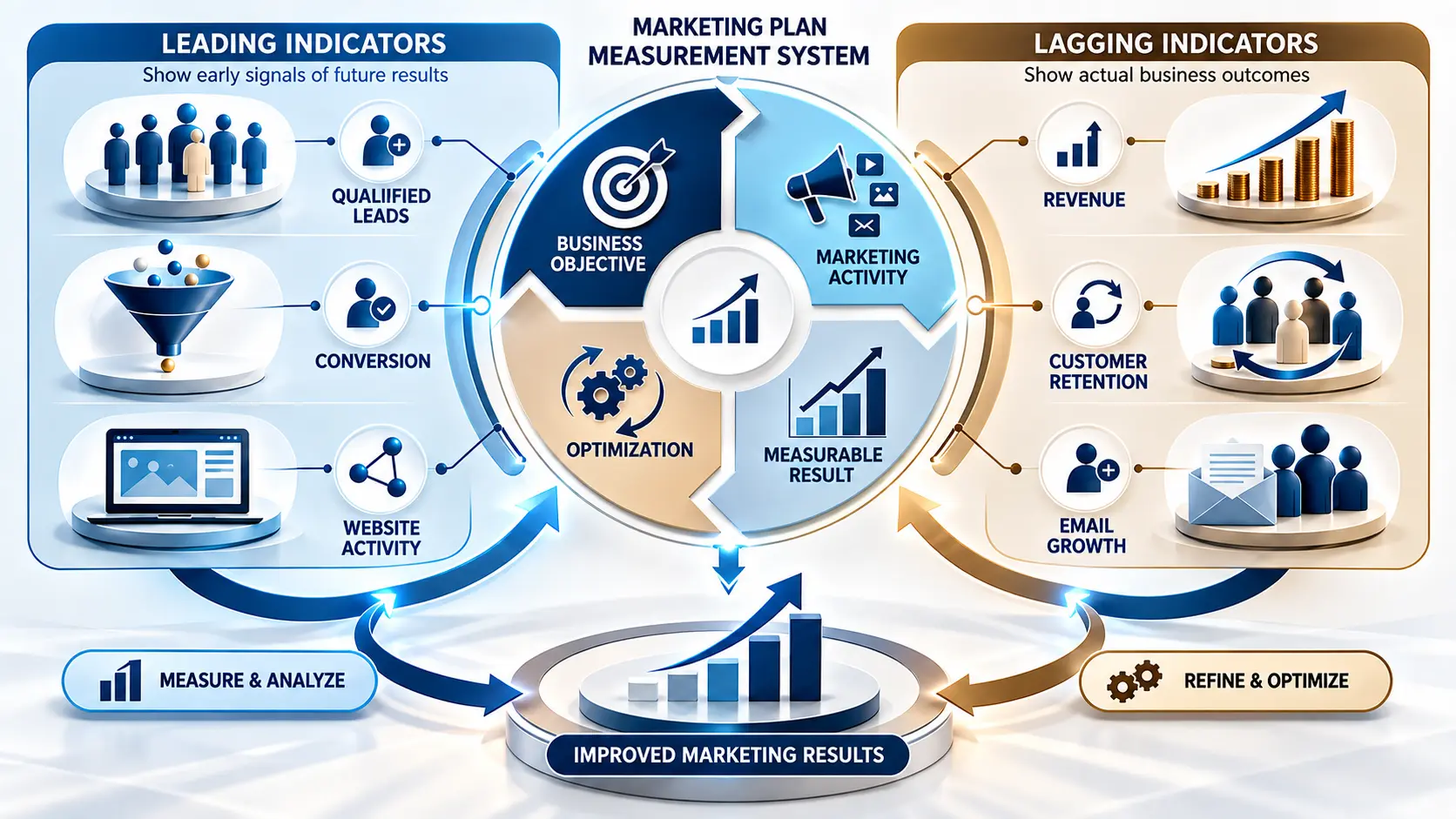
One useful distinction is between leading and lagging indicators. Revenue is a lagging indicator: by the time it moves, the causes are weeks old. Leads, email signups, and inquiry calls are leading indicators, and they tell you sooner whether your marketing performance is heading the right way. Track both, but check the leading ones more often. And keep the dashboard small. Five to seven numbers you actually look at beat thirty you don't.
Step 10: Review and Improve Your Plan
A marketing plan isn't a document you finish; it's a loop. Measure, interpret, adjust, test, and measure again. Put a recurring review on the calendar (monthly works for most small businesses) and ask the same questions each time:
- What worked, and by how much?
- What flopped?
- Which audience segment responded?
- Which channel produced qualified results, not just clicks?
- What consumed time or money without enough return?
- What should change next month?
Be careful with interpretation. One bad week isn't a trend, and one viral post isn't a strategy. Give a tactic enough time and volume to prove itself, usually at least one full cycle of your sales process, before you cut it. When you do make changes, adjust one or two variables at a time so you know what caused the difference.
Then write down what you learned. Over a year, those notes become the most valuable part of your plan, because they're specific to your customers rather than borrowed from somebody else's blog.
Marketing Plan Example
To see how the pieces connect, here's a compact marketing plan for a fictional company: Cedar Table Meals, a chef-run meal-prep service in Raleigh, North Carolina.
- Business goal: Increase monthly recurring customers.
- Marketing goal: Generate 120 qualified local leads each month and convert 35% of first-time purchasers to subscribers in 45 days.
- Target audience: Busy working professionals inside the delivery zone, especially two-income households with no energy left for weeknight cooking.
- Value proposition: Chef-prepared meals for busy professionals who want better weekday dinners without spending hours in the kitchen.
- Channels: Local SEO, email, Instagram, referral marketing, and paid search.
- Tactics: Weekly educational content about meal planning, customer testimonials, a first-order discount, a referral reward, and a three-message email onboarding sequence.
- Budget: $2,400 per month: $900 paid search, $600 local SEO and content, $350 photography and design, $200 referral rewards, $150 email software, and $200 for testing.
- Timeline: Four weeks to build and launch, a results review at the end of month two, and a channel reshuffle at the end of month three.
- Metrics: Qualified leads, first-time sales, converted subscriptions, customer acquisition cost, and rate of repeat purchases.
Here's the connective tissue that makes it a plan rather than a list. Local SEO and paid search catch people who are already typing something like "meal prep delivery Raleigh." The first-order discount gives them a low-risk way to try the service. The onboarding emails nudge that first order toward a subscription, which is the real business goal. Testimonials feed both the website and Instagram, and the referral reward turns happy subscribers into a cheaper acquisition channel.
Every piece also answers to a number. If leads look healthy but subscription conversion is weak, the fix isn't more advertising. It's the onboarding emails. That kind of diagnosis is only possible because the plan connected each activity to a specific goal.

Common Marketing Plan Mistakes
Most plans don't fail because of a single dramatic error. They erode through small, familiar ones. Here are six worth watching for.
Trying to Reach Everyone
Vague audiences produce vague marketing. If your message is written for "anyone who might be interested," it usually lands with no one. Narrow the audience until you can picture where they spend their time and what makes them hesitate. You can widen the net later, once the core group is responding.
Choosing Too Many Channels
Every added channel means more content, more logins, more reporting, and more habits to maintain. A five-person company running seven channels tends to run all seven at half strength. Start with two, prove they work, then add a third.
Confusing Activity With Progress
Posting daily feels productive. So does redesigning a logo or attending a networking mixer. But none of it counts as progress unless it moves a number tied to your goals. For each task, ask what result it's supposed to produce and how you'll know.
Setting Goals Without Metrics
"Build brand awareness" sounds respectable and can never be reviewed, because nobody defined what awareness looks like. Attach a measure and a deadline, such as branded search growth or direct website visits, so you can honestly answer yes or no at review time.
Ignoring the Customer Journey
People rarely jump from first glimpse to purchase. They notice you, compare options, hesitate, buy, and maybe come back. A plan focused only on awareness leaves the middle and end of that journey unattended, which is where a lot of revenue quietly leaks out. Make sure at least one tactic serves each stage.
Never Updating the Plan
Customer behavior shifts, competitors change their pricing, and campaign results pile up. A plan written in January and never revisited becomes a historical document by June. Schedule the reviews and treat the plan as something you edit, not something you frame.
How Often Should You Update a Marketing Plan?
Short answer: review often, rebuild rarely. A tiered rhythm works far better than a monthly rewrite.
- Weekly monitoring (about 15 minutes): Scan your leading indicators. Are leads, signups, and inquiries roughly on pace? This is how you catch a broken form or a stalled campaign early.
- Monthly review (60 to 90 minutes): Evaluate outcomes in light of your objectives and select what to retain, discard, or put to the test.
- Quarterly strategic review: Step back. Is the audience still right? Have competitors done something new? Does your spending still match your results?
- Annual planning: Set next year's business goals and rebuild the plan around them.
You don't need to rewrite the whole document every month. That's the trap: people confuse reviewing a marketing plan with recreating it. Most months, you'll edit a few lines. Shift $300 from one channel to another, swap out a tactic, update a target. Save the full rebuild for real turning points, like a new product line, a move into a new market, a major pricing change, or a sharp shift in customer behavior.
Frequently Asked Questions
What should a marketing plan include?
At minimum: your business and marketing goals, a description of your target audience, your value proposition, the channels and tactics you'll use, a budget, a timeline, and the metrics you'll track. Many plans also add a short competitor snapshot and a note on who owns each task. If a section doesn't help you make a decision or take an action, leave it out.
How long should a marketing plan be?
For most small businesses, one to three pages is usually enough. Startups pitching investors or larger companies coordinating several teams may need more detail, but length shouldn't be the goal. Here's a useful test: could a new employee read your marketing plan in ten minutes and know what to do this week? If so, the length is right.
What is the difference between a marketing strategy and a marketing plan?
A marketing strategy sets the direction: your audience, your positioning, and the competitive ground you want to win. A marketing plan carries that direction out with specific channels, tactics, budgets, dates, and metrics. Strategy answers "where are we going and why?" The plan answers "what are we doing this quarter, who's doing it, and how will we know it worked?" You need both, and the plan is much easier to write once the strategy is clear.
How do I create a marketing plan for a small business?
Follow the ten steps above, but shrink each one. Write one business goal, two or three marketing goals, a one-sentence audience description, and a value proposition. Choose two channels you can sustain, list a few tactics for each, set a modest budget, and schedule a monthly review. A small business can build a workable first version in an afternoon and refine it as real results come in.
How much should a business spend on marketing?
There is no set amount. The right budget depends on your stage of business, profit margins, customer lifetime value, and growth ambitions. Newer companies may spend more of their revenue to create recognition and established companies with constant referrals may spend less. The practical way is to begin by determining what you can afford, measure your cost per new customer and adapt as the data rolls in.
How often should a marketing plan be reviewed?
Monitor critical numbers weekly. Review performance monthly. Revisit strategy quarterly. Plan annually. You only need to recreate the complete document when something substantial happens, like a new product, a new market or a big movement in budget. Usually, a few modest tweaks after each monthly review will keep your marketing plan up to date.

Resources
If you want to go beyond the framework in this article, these resources can help with planning, search visibility, and measurement:
- U.S. Small Business Administration: The SBA provides practical guidance and planning resources for small-business owners. Visit the SBA
- Google Search Central: Google's first-party documentation is useful when organic search is part of your marketing channel mix. Visit Google Search Central
- Google Analytics: Use analytics to understand website behavior and evaluate whether your marketing activities are contributing to your goals. Visit Google Analytics
- Blueprint To Progress — Marketing Strategy: If you need to clarify the strategic direction before building your plan, revisit our guide to marketing strategy.
- Blueprint To Progress — Target Market: If your audience definition is still broad, use our guide to identify your target market and ideal customer.
- Blueprint To Progress — Business Value Proposition: If your positioning needs work, see how to define a business value proposition that customers understand.
Use these resources as supporting references, not as substitutes for the decisions in your own marketing plan. The useful part is connecting the information back to your customers, goals, budget, and actual results.
Final Takeaway
Every good marketing plan follows the same chain of logic. A business goal leads to a marketing goal, which shapes who you target, what you promise, where you show up, what you do there, how much you spend, when things happen, and what you measure. Then the last link feeds back into the first, as results teach you what to change.
You don't need a template with forty tabs to do any of this. Start with one page. Write down your goal, your audience, two channels, a budget, and a review date. Run it for a month and see what the numbers say. And if you'd like to strengthen the front end of the plan first, revisit your marketing strategy, your target market, and your business value proposition. Those three pieces make everything downstream easier.
The goal isn't to create a marketing plan that looks impressive in a document. It's to create one that helps you decide what to do next, and gives you a way to tell whether it worked.
Your Next Step
A useful marketing plan starts with one clear business goal, a defined audience, realistic channels, and measurable results.
Start with the Marketing Strategy guide, then use the steps in this article to turn that direction into a practical working plan.
Start here: Write down your primary business goal, your target audience, your two most realistic marketing channels, and the metric you will review first.