

What Is a Target Market?
A target market is the specific group of people or organizations a business builds its products, prices, and messages around. It sits between two extremes: the general public, which is too large to serve well, and a single buyer, which is too small to sustain a company. Somewhere in between is a group whose problems you understand and whose budgets match what you charge.
That's different from a general audience. An audience is anyone who happens to see your post or walk past your storefront. A target market is the subset you'd deliberately go looking for. "Everyone" fails as a definition because it settles nothing. Which ad platform? What tone? What price? If the answer is "whatever suits everyone," you end up with messaging that suits nobody in particular.
Typical Ways of Defining a Target Market
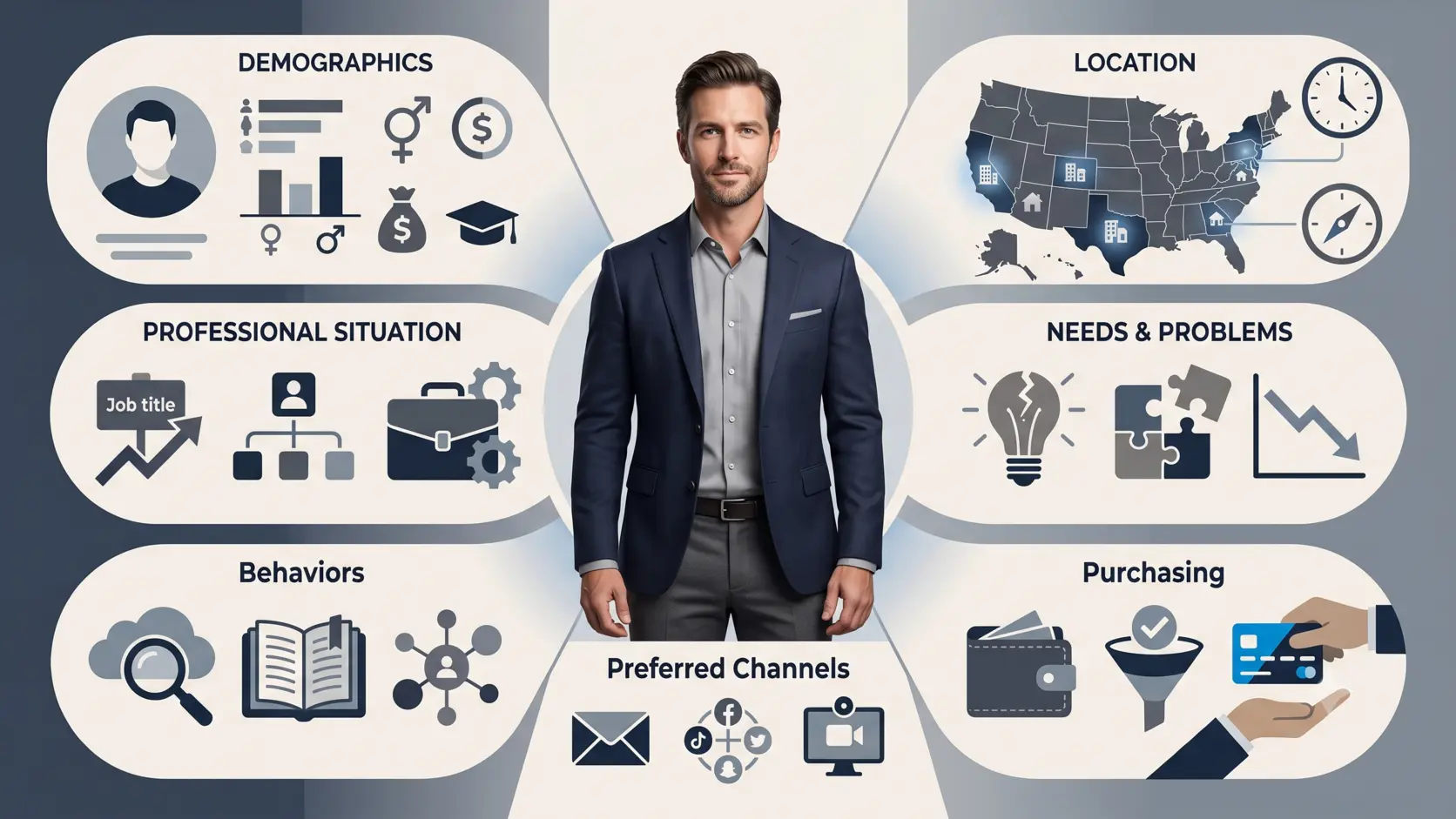
Most definitions are some combination of these six lenses:
- Demographics: age, income, occupation, education, household composition
- Geography: state, metro area, ZIP code, or service radius
- Psychographics: values, priorities, attitudes, lifestyle
- Behaviors: where, what, and how often consumers buy
- Needs and problems: what they’re trying to fix or achieve
- Purchasing conditions: the trigger, timing, and budget of a purchase
Think of a meal-prep firm. A weak definition: "People who want to eat healthier." A more useful one: "Busy professionals in their 30s and 40s who want convenient, high-protein weekday meals." The second version tells you where to advertise, what to put on the menu, and roughly when to send the emails.
Target Market vs. Ideal Customer
The two terms get swapped constantly, and in casual conversation that's harmless. When you're making decisions, they do different jobs.
Your target market is the broader group you serve. Your ideal customer is a specific profile inside it: the buyer who gets the most value from your offer and returns the most value through repeat business, referrals, and healthy margins. Think of it as zooming in, from the overall market to your target market, then to a customer segment, then to the ideal customer.
Take a bookkeeping firm. Its target market is small-business owners who need help with their books. Its ideal customer is a US-based service-business owner with five to 15 employees who spends several hours a month wrestling with spreadsheets and would happily pay for predictable monthly support.
The first description tells you who might buy. The second tells you who should. You need both: the wide view guides strategy, and the narrow one settles smaller questions, like which lead gets a callback first on a busy Friday.

Why Identifying Your Target Market Matters
The payoff shows up in places you might not expect. Messaging gets clearer because you're addressing one kind of person's problem instead of hedging for five. Product decisions get easier, since a new feature can be weighed against what your customers actually need. Ad budgets stretch further when you stop paying to reach people who were never going to buy. Sales calls improve too: you spot a good-fit prospect quickly, and you notice a poor-fit one before burning three meetings on them.
There's a resource argument as well. Small teams have limited time, money, and attention, and a defined target market helps you decide what to skip, whether that's a channel, a feature, or an entire category of customer. It also shapes your broader business strategy, because pricing, hiring, and partnerships all depend on knowing who you serve.
One caution. This isn't about shrinking your audience for its own sake. A tiny group that can't sustain the business is just a different mistake. The aim is relevance: being the obvious choice for the people you're trying to reach.
Start With the Problem You Solve
Ask most founders who their customer is and they'll start with who can afford the product. A better first question is who has the problem the product exists to fix. Budget matters, but the problem is what creates the motivation.
A few prompts help:
- What problem does the business solve?
- Who runs into it, and how often?
- How costly or frustrating is it when it happens?
- What do people do about it today?
- Why might they switch?
Payroll is a good illustration. Product-centered thinking says, "We provide payroll processing." Customer-centered thinking says, "We help small employers cut the administrative hassle and anxiety of running payroll." Same service, very different starting point. The second version points straight at owners who dread payday, who've been burned by a filing error, or who just hired their first employee and discovered that withholding is a whole subject.
Pay attention to the current alternative, too. Sometimes it's a competitor. More often it's a spreadsheet, a cousin who's "good with computers," or doing nothing at all. That's your real rival, and your value proposition has to beat it.
Identify the People Who Need Your Solution
Once the problem is clear, look for the people who have it. Five dimensions keep the search organized, and the last one tends to matter most.
Demographics
Age, income, occupation, education, and household characteristics. These help most with consumer products, but they describe who someone is, not why they buy. Treat them as a starting filter rather than a verdict.
Geography
State, metro area, ZIP code, urban versus suburban versus rural, or the distance you can realistically serve. A mobile dog groomer cares far more about drive time than about national averages.
Psychographics
Priorities, attitudes, values, motivations, and lifestyle. Two homeowners with the same income can want opposite things: one hunts for the cheapest option that works, the other wants the best tool and will pay for it.
Behavior
Purchasing habits, preferred channels, how they use similar products, how readily they switch brands, and how often they buy. What people do is usually more reliable than what they say they'll do.
Need and Situation
The circumstances that make your solution relevant right now: a new baby, a first hire, an expiring lease, a failed inspection. Situation often predicts a purchase better than demographics do. Anyone who just launched a business needs bookkeeping, regardless of age or ZIP code, and your marketing should be built to recognize that moment.
Research Your Target Market
A first guess is fine as a draft and risky as a final answer. Four sources will give you real evidence.
Start With Existing Customer Data
If you already have customers, they're the cheapest research you'll ever get. Look at order history, repeat purchases, average order value, service usage, reviews, support requests, and cancellations. Patterns surface quickly: one group may purchase twice as often as another, while a different group accounts for most of your refund requests.
Talk to Customers
Ten short interviews can beat a hundred assumptions. Ask what problem they were trying to solve, what alternatives they considered, what made them choose you, what nearly stopped them from buying, and what would make the product more useful. Then stop talking. The answers you didn't expect are usually the valuable ones.
Study Competitors
Notice who your competitors appear to serve, how they position themselves, what they charge, and what their reviews complain about. Recurring complaints point to gaps, and gaps are where a smaller business can win. The U.S. Small Business Administration's guide to market research and competitive analysis is a solid walkthrough.
Use Reliable Market Data
For U.S. firms, the Census Bureau’s Census Business Builder is a good place to start—and it’s free. It gathers demographic, economic, and consumer-spending data down to the county, city, and ZIP code level, so you can see who lives where and how many other similar firms are already there. The Census Bureau’s Powerful Data for Your Small Business page explains how to apply it to researching customers, competitors, and locations.

Build Your Ideal Customer Profile
Now pull the research together into an ideal customer profile, often shortened to ICP. Think of it as a one-page summary of the pattern you keep seeing. A B2B version might look like this:
| Attribute | Example |
|---|---|
| Customer type | Small-business owner |
| Industry | Professional services |
| Company size | 5-20 employees |
| Location | US metropolitan areas |
| Main problem | Manual administrative work |
| Goal | Save time and reduce errors |
| Buying trigger | Business growth |
| Objection | Cost and switching effort |
| Decision factor | Reliability and ease of setup |
Swipe horizontally to view the full table.
For a consumer business, swap company size for household details and keep the same logic.
One editorial note. A profile should describe a pattern found in evidence, not an invented character created because a template insisted every customer needs a name, a stock photo, and a favorite coffee order. "Marketing Mary, 34, loves oat lattes" has never helped anyone choose an ad channel. "Service-business owners with five to 20 employees who still track books in spreadsheets" actually does. If a detail didn't come from your data, your interviews, or your sales conversations, leave it out, and keep the whole thing to a single page you could scan in half a minute.
Segment and Prioritize Your Audience
Research often turns up more than one promising group. That's good news, as long as you resist chasing all of them at once. Segmenting means dividing a broad market into groups that share needs or behaviors. Prioritizing means deciding where to start.
Score each segment against a handful of criteria: how severe the problem is, how well your offer fits, willingness to pay, how easily you can reach them, how crowded the competition is, the value a customer is likely to bring over time, and how well the segment matches what your business can actually deliver.
A simple two-by-two keeps the conversation honest, with customer fit on one axis and business opportunity on the other:
| Higher opportunity | Lower opportunity | |
|---|---|---|
| Higher fit | Start here | Keep warm |
| Lower fit | Tempting; test carefully | Set aside |
Swipe horizontally to view the full table.
The lower-fit, higher-opportunity box deserves extra suspicion. Stretching toward a big segment feels ambitious, and the stretch usually costs more than it looks. Whichever segment you choose will shape your marketing strategy, from channels to tone, so make the call deliberately rather than on gut feel during a slow Tuesday.
Test Your Target Market Assumptions
A customer profile is a hypothesis until real behavior backs it up. Plenty of businesses do the research, write a tidy profile, and then treat it like scripture. Don't.
Testing doesn't require a research department. Select a few of these:
- Landing pages: A/B test two different messages for two distinct audiences.
- Small ad experiments: Run small budgets across different segments.
- Email responses: Send the same offer to two segments and compare their reactions.
- Sales conversations: Identify who closes and who stalls.
- Interviews and surveys: Ask the segment itself.
- Product trials: See who actually uses the product.
- Website analytics: See who stays, clicks, and converts.
Decide what counts as success before the results arrive. If you're comparing freelance designers with agency owners, define "better" first, whether that means reply rate, trial signups, or revenue. Otherwise every outcome will look like a win.
Refine Your Target Market Over Time
Markets move. Customer needs shift, competitors appear, prices change, products expand, and technology alters how people buy. Your target market should be reviewed when evidence like that shows up, not on a schedule chosen because it makes a tidy calendar reminder.
The opposite mistake is just as common: redefining your audience every time a campaign underperforms. One flat month is often a messaging problem, not a market problem. The steadier approach is a loop of research, hypothesis, test, learn, and refine, then around again. It's the same discipline behind good strategy execution, where plans get adjusted by results rather than by mood.
Small adjustments are usually enough. Maybe your ideal customer turns out to be firms with 10 to 25 employees instead of five to 15. Maybe a region you ignored keeps sending orders. Follow the evidence, change one thing at a time, and write down what you learned.

Target Market Examples
Abstract advice only goes so far, so here are three cases showing how a broad definition becomes a useful one.
Local fitness business. Broad: people who want to get fit. More specific: working adults within a defined service area who want structured strength training but have limited weekday availability. This suggests early-morning and lunch-hour sessions, short programs, and marketing aimed at nearby offices rather than the whole metro area.
B2B accounting service. Broad: businesses that need accounting. More specific: US-based professional-service firms that have outgrown basic bookkeeping but aren't ready for a full internal accounting department. That suggests a fractional-controller offering and messaging built around the awkward middle stage between a part-time bookkeeper and a full finance team.
Online career education. Broad: people who want career help. More specific: working professionals considering a career change who need practical guidance on exploring roles, improving their positioning, and planning their next move. Content for this audience looks very different from generic resume advice, and it connects naturally to guidance on career change.
A Practical Target Market Checklist
Use this list as a working session, not a formality. If you can't answer an item, that's your next research task.
- What problem does the business solve?
- Who experiences that problem?
- How significant is it to them?
- What characteristics do these customers share?
- Where can they be reached?
- What alternatives do they use now?
- What motivates them to buy?
- What objections could stop a purchase?
- Which customer segment fits the business best?
- What evidence supports each assumption?
- How will the target market be tested?
- When will the customer profile be reviewed?
Frequently Asked Questions About Target Markets
What is a target market?
A target market is the specific group of people or organizations a business chooses to serve. These customers share similar needs, characteristics, or buying situations. It’s a practical way to focus on the people a business can serve well instead of trying to sell to everyone.
What is the difference between a target market and an ideal customer?
A target market is the broader group; an ideal customer is a specific profile within it. The first guides strategy, and the second guides day-to-day choices about leads, messaging, and offers.
How do I find my target market?
Start with the problem you solve. Study your existing customers, interview a few, review your competitors, and check sources such as Census data. Then build a profile from the patterns you find and test it in the real market.
Can a business have more than one target market?
Yes, but prioritize them. Most small businesses are better served by focusing on one primary target market first and treating other segments as secondary markets. Once the primary segment is working, the business can test additional groups without watering down its message or spreading its resources too thin.
How specific should a target market be?
Specific enough to tell you where to advertise and what to say, yet large enough to sustain the business. If you can't name where these people gather or how you'd reach them affordably, the definition is probably too vague or too narrow to act on.
How often should I review my target market?
Review it when meaningful evidence changes: a product update, new customer patterns, a market shift, or plans to expand. A fixed calendar date matters less than what the data is telling you.
Other Resources
Once you've identified your target market, the next step is to connect that understanding to the rest of your business strategy. These related guides can help:
- Business Strategy — Turn your understanding of customers, markets, and competitive choices into a clearer strategic direction.
- Business Value Proposition — Clarify why your target customer should choose your offer instead of the alternatives.
- Strategy Execution — Translate strategic choices into priorities, initiatives, ownership, metrics, and review.
- Marketing Strategy — Connect your target market to channels, messaging, content, and marketing decisions.
- Career Change — Explore practical guidance for professionals evaluating a career move.
- Business Resources — Browse additional practical guides and resources from Blueprint To Progress.
Turn Customer Research Into a Clearer Business Strategy
Every step here builds on the one before it: problem, customer, evidence, segment, test, refine. Skip the evidence and you're left with a guess in a nice font. Skip the testing and the guess hardens into policy.
The practical next step is small. Start with the customers you already understand, name the problem they were trying to solve, and look for patterns instead of assumptions. Then take those patterns into the real market and see whether they hold. A well-defined target market won't do the selling for you, but it will make nearly every other decision cheaper to get right.
From here, the natural move is turning what you've learned into a clear value proposition and a marketing plan that speaks to the right people. For more guides in this series, browse our business resources.
Take the Next Step
You don't need a perfect customer profile before you start. You need a useful one that is grounded in evidence and specific enough to guide a decision.
Start with one customer segment. Write down the problem they are trying to solve, the evidence you have, where you can reach them, and what might make them choose your offer. Then test those assumptions with real conversations, behavior, and small experiments. Keep what the evidence supports, change what it doesn't, and repeat.
If you're building or refining a business, continue with the Business Strategy and Business Value Proposition guides to turn your target-market research into clearer strategic and marketing decisions.