How to Build a Practical Marketing Strategy
A practical framework for defining your marketing goal, target market, value proposition, channels, messaging, measurement and execution.
Read the Marketing Strategy Guide →
Marketing is often treated as if it begins with an advertisement. In reality, the harder work usually happens much earlier: understanding who you are trying to reach, what they need, why they should care, and how you will know whether your efforts are working.

Marketing is the discipline of connecting the right product, service, idea or message with the right audience at the right time. That can involve strategy, research, content, search, email, social media, advertising, analytics and plenty of decisions that never appear in a campaign dashboard.
A company can have a polished website, an active social media account and a generous advertising budget and still struggle to attract customers. The problem may not be the campaign. It may be that the company is speaking to the wrong audience about the wrong problem.
That is why practical marketing starts with understanding rather than promotion.
At Blueprint To Progress, the goal is to make marketing easier to understand and more useful to apply. You will find practical guidance on Marketing Strategy, Digital Marketing, Content Marketing, SEO and Social Media Marketing , along with frameworks and examples that help connect these disciplines.
You do not need to become a marketing expert overnight. You need to understand the decisions that matter, choose the channels that make sense for your situation, and learn from what happens next.
Marketing has a reputation for being all about advertisements, slogans and social media posts. Those things can certainly be part of it, but they are only pieces of a much larger system.
Good marketing begins with questions.
Who is the customer?
What problem are they trying to solve?
What alternatives are already available to them?
What makes your offer useful or different?
Where do they look for information?
What would make them trust you?
And, perhaps most importantly, what would make them take action?
Those questions sit underneath almost every effective marketing decision.
Consider a small professional services company trying to attract new clients. It could immediately start running advertisements. But before spending money, it may discover that its potential customers are searching for answers to very specific questions. Publishing useful articles could bring those people to the website. An email resource could help build trust. A well-designed service page could then turn some visitors into inquiries.
The advertisement was not necessarily wrong. It just wasn't the first call that needed making.
That's really why marketing works better as a connected system than a grab-bag of tactics you deploy one at a time.
Marketing Strategy helps determine what you are trying to accomplish and where your effort should go. Digital Marketing hands you the channels to actually reach people online. Content Marketing gives them a reason to stick around once you have their attention. And SEO is what gets you found by people who are already looking. Social Media Marketing can create awareness, conversation and community.
The five areas overlap, but they are not interchangeable.
A strong strategy can tell you which channels deserve attention. Good content can give those channels something worthwhile to distribute. SEO can help useful content remain discoverable. Social media can introduce that content to new audiences. Analytics can then show what is actually happening.
That is the bigger picture behind the marketing guides on Blueprint To Progress.
Marketing covers a lot of ground. Rather than treating every tactic as equally important, it helps to divide the subject into a few connected disciplines.
Published articles are shown directly under each topic. Future Marketing guides can be added to the relevant cluster as they go live.
Build a clearer understanding of your audience, positioning, goals, competitive environment and the choices that determine where marketing effort should go.
Explore → 02Understand how websites, email, search, paid campaigns, analytics and other digital channels can work together instead of becoming a collection of disconnected activities.
Explore → 03Write the stuff people are actually searching for. Content that earns attention on its own merits and actually helps someone along at whatever stage of the buying journey they're in.
Explore → 04Improve how your website is discovered through search by creating useful content, building strong site architecture and matching pages to genuine search intent.
Explore → 05Use social platforms deliberately to build awareness, communicate with audiences and create conversations rather than simply filling a posting schedule.
Explore →Go deeper with the published Marketing guides below. Target Market and Business Value Proposition remain in the Business pillar, where they belong in the site architecture.
A practical framework for defining your marketing goal, target market, value proposition, channels, messaging, measurement and execution.
Read the Marketing Strategy Guide →A practical step-by-step framework for turning marketing goals, audience insights, positioning, channels and measurement into an actionable plan.
Read the Marketing Plan Guide →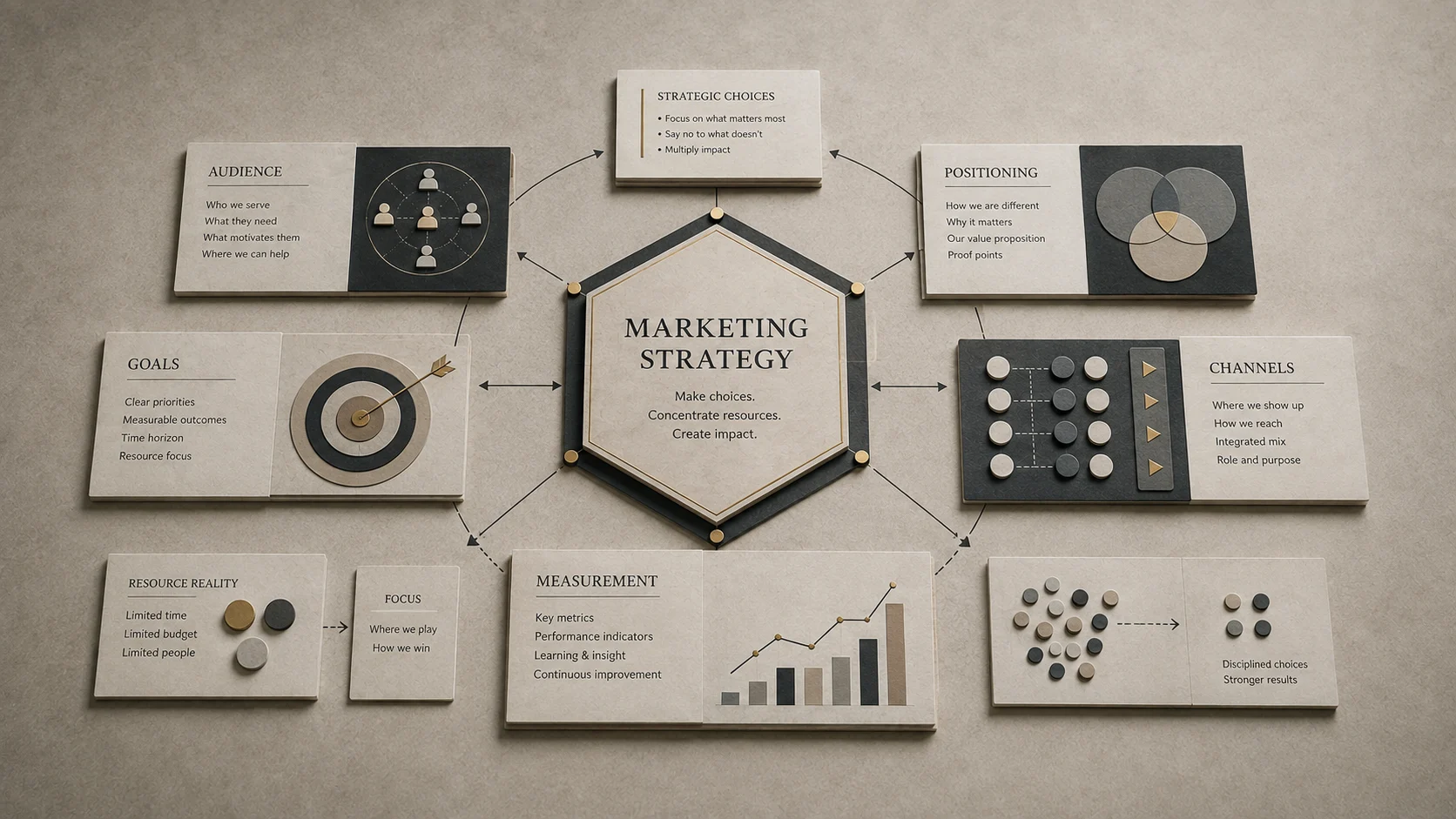
Marketing strategy is where the important choices begin.
A strategy does not have to be a 60-page document full of impressive-looking charts. In many cases, a useful strategy is simply a clear explanation of who you want to reach, what you want to achieve, how you intend to help your audience, and where you will concentrate your resources.
The word concentrate matters.
A business with limited time and budget cannot realistically do everything. Trying to maintain every social platform, publish constantly, run paid advertising, send newsletters, optimize every page and attend every possible industry event can quickly turn marketing into a second full-time job.
A better strategy makes choices.
The first step is understanding the people you want to reach.
That means going beyond basic demographic information. Age and location may be useful, but they rarely explain the whole decision.
You also want to understand:
For example, a company selling accounting software to small businesses is not simply selling "software."
Its customers may be trying to reduce manual work, understand cash flow more clearly, avoid mistakes or spend less time preparing reports.
Those problems should influence the company's messaging and content.
The product remains the same. The way its value is communicated becomes much more useful.
Once you understand the audience, you need to determine why your offer deserves their attention.
This is where positioning becomes important.
A strong position does not necessarily mean claiming that you are the best at everything. That usually sounds suspicious anyway.
Instead, identify what you can credibly be known for.
Perhaps you serve a particular type of customer. Perhaps your service is easier to implement. Perhaps your product solves a specific problem especially well. Perhaps your expertise is unusually deep in one area.
Good positioning gives your marketing something solid to communicate.
Without it, businesses often fall back on vague phrases such as "high quality," "customer focused" and "innovative." Those words are not necessarily false. They are simply difficult for customers to distinguish from everyone else's claims.
Not every audience behaves the same way.
A specialist B2B consultancy may gain more from search, referrals, LinkedIn and detailed educational content than from trying to create daily entertainment videos.
A consumer brand aimed at younger audiences may find visual social platforms much more important.
A local service business might benefit from local search visibility, reviews, a useful website and community relationships.
The objective is not to collect marketing channels.
It is to identify where your audience is most likely to notice, evaluate and act on your message.
Marketing needs measurement, but measurement should answer useful questions.
Depending on the business, relevant indicators might include:
A large number can be impressive without being particularly useful.
Ten thousand website visitors who have no interest in what you offer may be less valuable than 500 visitors who genuinely need your service.
The best marketing measurement connects activity with outcomes.
Standalone Digital Marketing articles will appear here as they are published. This keeps the hub accurate rather than filling it with placeholder or duplicate guides.
The hub is structured and ready. New published articles can be added here without changing the page architecture.
Browse All Guides →Digital marketing has become so common that the term can sometimes mean almost anything conducted online.
A more useful definition is simpler: Digital Marketing is the coordinated use of digital channels to attract, inform, convert and retain customers.
Those channels might include a website, search engines, email, paid advertising, social media and other digital touchpoints.
The important word is coordinated .
A collection of unrelated activities is not automatically a strategy.
For many organizations, the website is still the place where interest turns into deeper consideration.
A visitor may arrive from Google, a social post, an email or a paid advertisement. Once there, the website needs to answer basic questions quickly.
What does this organization do?
Who is it for?
Why should I trust it?
What problem does it solve?
What should I do next?
A beautiful website that leaves those questions unanswered is still a difficult website to use.
The same principle applies to landing pages. A person who clicks an advertisement promising a specific solution should not arrive on a generic homepage and be left to figure everything out.
Good digital marketing respects the customer's context.
Different digital channels perform different jobs.
Search can help people discover you when they are already looking for information or solutions.
Email lets you talk directly to people who've already raised their hand and said they want to hear from you.
Paid advertising can get you in front of the exact audience you're after, fast — just keep a close eye on what it's costing you versus what it's actually returning.
Social media can help create awareness, relationships and ongoing interaction.
None of these channels is automatically superior.
Which combination actually makes sense for you comes down to your audience, your business model, what resources you've got, and what you're actually trying to achieve.
A useful way to think about digital marketing is as a journey:
Discovery → Consideration → Conversion → Retention
Someone may first encounter your company through a search result.
They might then read an article.
Later, they could download a useful resource or subscribe to an email list.
Several weeks later, they may become a customer.
That means the first interaction and the eventual purchase may be separated by considerable time.
Good digital marketing accounts for that reality instead of expecting every interaction to produce an immediate sale.

Standalone Content Marketing articles will appear here as they are published. The pillar overview remains useful as the introduction to this future cluster.
The hub is structured and ready. New published articles can be added here without changing the page architecture.
Browse All Guides →
Content marketing is sometimes reduced to "writing blog posts."
That is a little like describing cooking as "putting things in a pan."
The format matters, but the thinking behind it matters much more.
Content Marketing , at its core, is about putting useful information out into the world — the kind that pulls people in, earns their trust, and quietly supports whatever you're actually trying to achieve as a business.
The content might be an article, guide, video, research report, email, case study, podcast or another useful format.
The key question is not:
"What can we publish this week?"
A better question is:
"What does our audience need to understand?"
The strongest content ideas often come from questions customers are already asking.
For example:
These questions provide much stronger foundations than producing generic content simply because a calendar says Tuesday is "blog day."
Useful content reduces uncertainty.
It can explain a complicated subject, compare alternatives, demonstrate expertise or help someone make a better decision.
A practical content process might look like this:
Research → Create → Publish → Distribute → Measure → Improve
Research identifies genuine questions and opportunities.
Creation turns those ideas into useful material.
Publishing makes the material available.
Distribution helps the intended audience discover it.
Measurement shows what happened.
Improvement makes the next version better.
That final step is often forgotten.
A piece of content does not become valuable simply because it has been published. Sometimes the best move is to update it, expand it, improve its examples or make its answer clearer.
There is a persistent temptation to believe that publishing more automatically produces better results.
It does not.
Publishing three mediocre articles every week does not magically become a strategy because there are three of them.
A smaller library of genuinely useful resources can be more valuable than a large collection of thin pages.
Think about your own behavior.
When you search for an answer to a difficult question, you probably do not think, "I hope I find 37 articles."
You want one good answer.
That is the standard content marketing should aim for.
Standalone SEO articles will appear here as they are published. The SEO section below continues to provide the foundational overview.
The hub is structured and ready. New published articles can be added here without changing the page architecture.
Browse All Guides →Search engine optimization, usually called SEO , sits at an interesting intersection between technical work, content and marketing strategy.
At its best, SEO is not about tricking a search engine.
It is about making useful information easier for both people and search engines to understand and discover.
A keyword is not the same thing as an intention.
Someone typing "what is SEO" just wants an explanation, plain and simple.
Someone typing "best SEO agency" is out there comparing providers.
And someone typing "SEO audit service" is basically ready to buy — they're not browsing anymore.
These represent different stages of intent.
Common categories include:
Understanding the reason behind a search helps determine what type of page should be created.
If someone wants to learn, give them a useful explanation.
If they are comparing options, help them compare.
If they are ready to act, make the next step straightforward.
Modern SEO should not be reduced to repeating one phrase a certain number of times.
A useful page naturally contains related concepts.
A page about marketing strategy, for example, might reasonably discuss:
These concepts help search engines understand the subject, but more importantly, they help readers understand it too.
That is the better reason to include them.
A well-structured page should give clear signals about its subject.
Important elements include:
Internal linking earns its keep especially as a site grows — it helps readers stumble onto related information, and it quietly tells search engines how your pages relate to each other.
For example, a marketing article about SEO could naturally lead to a more detailed guide about content marketing.
The link should exist because it helps the reader—not because someone decided that every paragraph needs a link.
Content alone is not the whole story.
Technical SEO includes areas such as:
None of this is stuff a regular visitor would ever notice — but it can make a real difference in how easily a website gets crawled, understood, and shown in search results.
For authoritative guidance, Google's SEO Starter Guide is a useful reference.

The five areas covered here become much more useful when viewed as one connected system.
Marketing Strategy determines where you want to go.
Digital Marketing provides channels through which you can reach and engage people.
Content Marketing gives your audience useful information.
SEO helps people discover relevant content when they search.
Social Media Marketing can distribute ideas, create conversations and build relationships.
Then measurement brings the information back into the strategy.
A simplified system looks like this:
Audience → Positioning → Message → Channels → Content & Campaigns → Measurement → Learning
And then the cycle starts again.
Imagine a specialist consulting firm that wants to attract more business.
Its strategy identifies operations leaders at mid-sized companies as an important audience.
Its positioning focuses on helping those leaders solve a particular operational problem.
The company creates detailed educational content explaining the problem and potential approaches.
SEO helps those resources appear when relevant questions are searched.
LinkedIn gives you another outlet for that content, plus a way to actually take part in the conversations happening in your industry.
The website gives interested visitors a clear path to learn more.
Email allows the company to continue communicating with people who are not ready to buy immediately.
Analytics then show which topics attract the right visitors and which activities generate meaningful inquiries.
No single tactic is responsible for the entire result.
The system works because the parts reinforce one another.
That is the central idea behind practical marketing.
You do not need to rebuild your entire marketing operation on Monday morning.
Start smaller.
Write down who you want to reach.
Don't settle for "everyone."
A solid audience definition goes deeper than demographics. It should tell you what the individual needs and how they make decisions.
What's your audience genuinely trying to solve?
The answer should be more specific than, "They want a better product."
Look for the actual problem, frustration, risk they're weighing, and outcome they're really after.
Explain why your product, service, or expertise actually matters here.
Keep the language understandable.
If your audience needs a dictionary to decode the message, the message probably needs another edit.
Start where your audience is most likely to pay attention.
A focused combination of search, useful content and email may outperform a scattered presence across seven platforms.
Decide what success means before you begin.
Then look at what actually happened.
Keep what works.
Improve what is promising.
Stop what clearly is not earning its place.
Marketing becomes much less mysterious when it is treated as a process of making decisions, observing results and learning.
Google’s SEO Starter Guide is a useful starting point for understanding search-friendly content and search engine optimization.
Visit resource →Google Analytics Help provides guidance for using Analytics and understanding website and campaign measurement.
Visit resource →The SBA Business Guide includes practical information for planning, operating and growing a small business, including marketing and sales.
Visit resource →The FTC provides guidance on advertising and marketing, including truth-in-advertising, endorsements and online marketing.
Visit resource →HubSpot Academy offers free online marketing education, including digital marketing, content and social media courses.
Visit resource →These are the Marketing articles currently published under the Marketing pillar. Business-cluster guides such as Target Market and Business Value Proposition are intentionally kept in the Business pillar.
A practical framework for defining goals, target market, value proposition, channels, messaging, measurement and execution.
Read Guide →A practical step-by-step framework for turning marketing goals, audience insights, positioning, channels and measurement into an actionable plan.
Read Guide →Looking for every published guide across Career, AI, Business, Marketing and Money?
Browse All Guides →Marketing is the process of understanding an audience, communicating the value of a product, service or idea, and helping people move from awareness to consideration and action. Everything from planning and research to writing and publishing to search and advertising to email and social media and analytics can be a part of it. Promoting a product is just one part of effective marketing. It’s about connecting what an organization has to give with what an audience needs.
A marketing strategy is a structured approach to deciding who an organization wants to reach, what it wants to achieve, how it will position its offering, which channels it will use and how it will measure progress. A useful strategy involves choices. It helps an organization decide what deserves attention and, just as importantly, what does not.
At its simplest, it's marketing run through digital channels — websites, search engines, email, paid ads, social media, and the analytics tracking all of it. But those channels don't do much in isolation. They earn their keep when they're all working toward the same goal, rather than existing as separate, disconnected activities.
Content marketing means putting together and sharing genuinely useful information for a specific audience — to answer their questions, earn some trust, show you actually know what you're talking about, pull in search traffic, or just keep the relationship warm. It can show up as articles, guides, videos, emails, case studies, whatever format actually fits.
SEO is what gets your pages discovered by people already searching for them. It connects useful information with people actively looking for answers, products, or services — and it's part content, part technical groundwork: search intent, how a page is structured, internal linking, whether it can even be crawled and indexed properly, and how fast the site actually loads.
It’s about leveraging social platforms intentionally to build awareness, get information in front of people, build meaningful relationships and sometimes drive leads or purchases. Posting alone is generally not the strategy. It only works if you really know your audience, the platform, the format and what you are attempting to achieve.
Start with the audience and the problem, not the channel. Figure out who you're trying to reach, understand what they actually need, get your message straight, and pick a handful of channels that genuinely make sense for that audience. Create something useful, make yourself easy to find, track what actually matters, and keep adjusting. A focused marketing system is usually easier to manage than trying to be everywhere at once.
Good marketing rarely comes from doing everything at once. Start with a clear audience, a useful message and a sensible set of choices. From there, content, search, digital channels and social media can reinforce one another.
You do not need every platform. You do not need to publish every day. You need to understand your audience, make thoughtful choices and pay attention to what happens next.
Social Media Marketing: Build Relationships, Not Just Reach
Social Media Marketing Guides
Standalone Social Media Marketing articles will appear here as they are published. The pillar remains ready to expand without inventing unpublished content.
Standalone guides will appear here
The hub is structured and ready. New published articles can be added here without changing the page architecture.
Browse All Guides →Social media makes marketing unusually visible.
You can see follower counts, views, likes, comments and shares almost immediately.
That visibility can be useful.
It can also create some very strange priorities.
A post receiving thousands of likes may produce little business value. Another post with modest reach may attract a highly relevant customer.
Social Media Marketing works best when the platform, content and measurement are connected to a genuine objective.
Choose Platforms for a Reason
There is no prize for maintaining the largest number of social media accounts.
Instead, ask where your audience actually spends time and what they expect to find there.
A professional audience may respond well to industry insights and practical advice.
A consumer audience might respond more strongly to demonstrations, visual storytelling or community content.
A local organization might benefit from conversations about events and community activity.
Platform selection should follow audience behavior rather than fashion.
Give People a Reason to Follow
People do not usually follow a company because they are desperate for another advertisement in their day.
They follow because the account gives them something.
That might be:
The best social content often feels like communication first and promotion second.
That does not mean a company should never sell.
It means the audience should receive value between the sales messages.
Create a Sustainable Publishing Rhythm
Consistency matters, but consistency should be sustainable.
If a company promises itself that it will publish five times every day and gives up after three weeks, the impressive calendar was not particularly useful.
A smaller publishing schedule that can be maintained for a year is usually more valuable.
Create repeatable formats.
For example:
The exact schedule is less important than having a system that people can realistically maintain.
Measure More Than Likes
Social media metrics should connect to the objective.
Depending on the campaign, useful measurements could include:
A vanity metric is not automatically useless.
It simply should not be mistaken for the final business outcome.