How to Use AI for Job Search and Career Research
An AI job search isn't just typing "find me a job" into a chatbot and hoping something useful comes back. Used well, AI becomes a research assistant that reads job postings faster than you can, a sounding board for career decisions, an editor for your resume, and a sparring partner before interviews. What it shouldn't become is a shortcut around your own judgment. AI can speed up the research and preparation — it can't invent your qualifications, decide your career for you, or hit "submit" on your behalf without a final human check.

In This Guide
What Can AI Job Search Actually Help You Do?
Let's clear up a misconception first: AI is not a job board with better manners. It won't magically surface openings that don't exist, and it can't guarantee an interview. What it's genuinely good at is compressing hours of scattered research into a focused conversation you can act on.
Across a job hunt, AI can realistically help with:
- Exploring career directions and adjacent roles
- Identifying titles and industries worth targeting
- Breaking down job descriptions line by line
- Comparing requirements across similar postings
- Spotting gaps between your experience and a role's expectations
- Tailoring a resume to a specific opening
- Drafting a cover letter you'll still need to edit
- Researching companies before an interview
- Prepping talking points for networking conversations
- Practicing interview answers, including the awkward follow-ups
- Keeping track of where you've applied and when to follow up
A simple framework holds the whole process together: RESEARCH → MATCH → TAILOR → APPLY → PREPARE → REVIEW. Keep that loop in mind as you read the rest of this guide — nearly everything below fits into one of those six stages.
Here's where it gets practical. Say you're searching for "marketing manager" roles. On paper, that title looks consistent. In practice, one posting wants someone fluent in lifecycle email and retention metrics, another is really a paid-acquisition role wearing a generalist title, and a third is closer to product marketing with a dash of brand strategy bolted on. AI can pull those distinctions out of a stack of postings in minutes — work that would otherwise mean reading twenty job descriptions with a highlighter and a headache.
Start With Career Research Before Searching for Jobs
Most job-search advice starts in the wrong place. It tells you to open LinkedIn, punch in a title, and start applying. That's backwards. Before you touch a job board, it's worth spending an afternoon figuring out what you're actually aiming for — otherwise you're applying to everything and optimizing for nothing.
Define the role you want
AI is useful here because it's not limited by your own vocabulary. Describe your background and ask it to generate a list of job titles that fit, along with adjacent roles you might not have considered, industry-specific terms recruiters use for similar work, and skills from your history that transfer even when the job title changes completely. Someone who's spent five years doing operations work at a nonprofit, for example, might not think to search for "program manager" at a tech company — but the underlying skill set often overlaps more than the titles suggest.
Compare similar career paths
Job titles blur together more than employers like to admit. Marketing Manager, Product Marketing Manager, and Growth Marketing Manager can describe three genuinely different jobs, or three names for the same one, depending on the company. Ask AI to lay out the differences in responsibilities, common tools, typical KPIs, and seniority expectations for each path. Treat the output as a starting map, not gospel — verify anything that resembles a hard labor-market fact (salary ranges, hiring demand, growth projections) against a source built for that purpose.
Identify your skill gaps
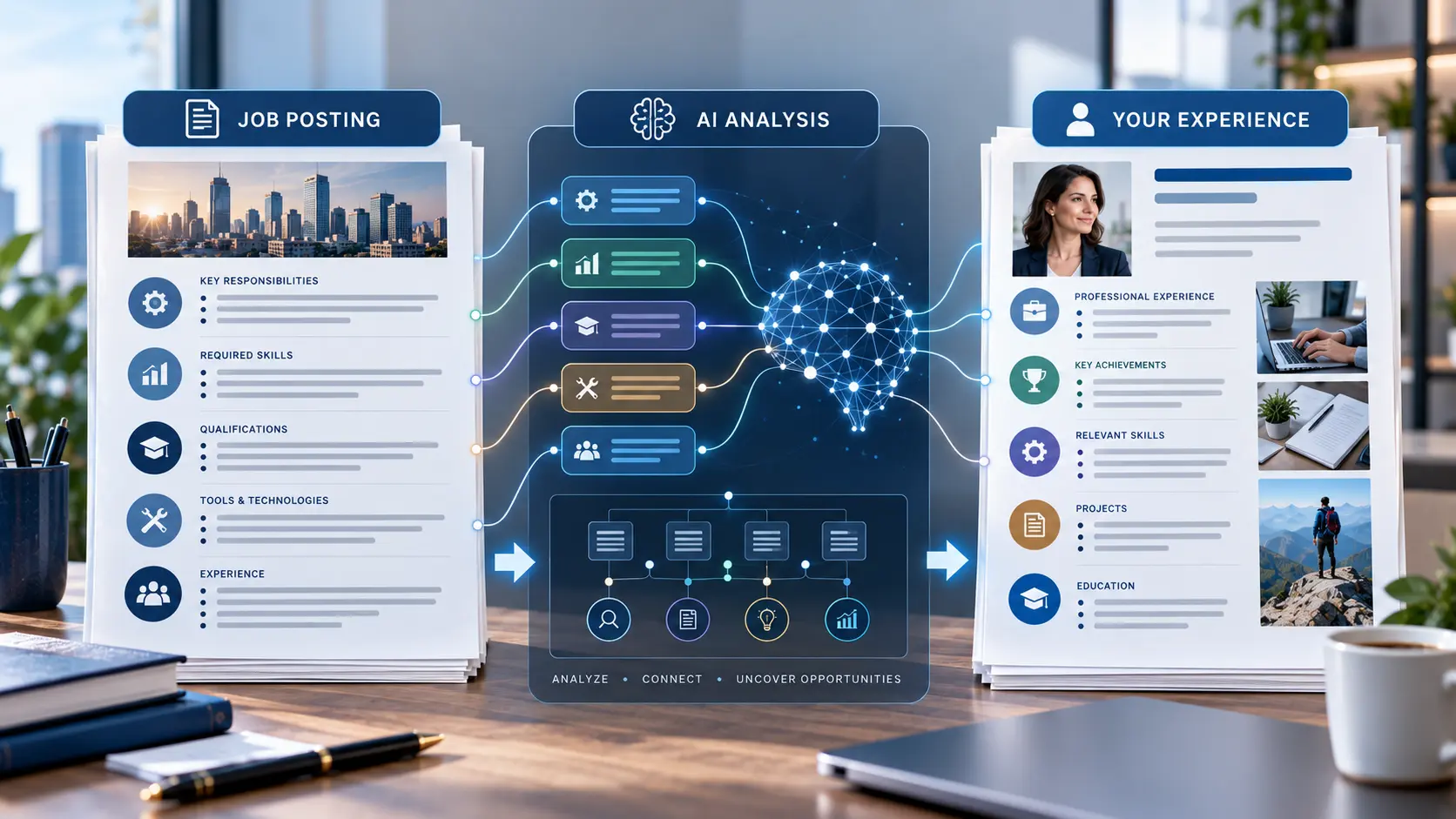
This is where an AI-assisted job search starts to feel genuinely useful rather than gimmicky. Paste in your current skills and experience, then paste in the requirements for a role you're targeting, and ask for an honest comparison. The output should read like a research checklist — areas to strengthen, certifications worth considering, language to develop — not a verdict on whether you're "qualified." That judgment call is still yours.
Turn Your Experience Into an AI-Assisted Job Search Strategy
Once you have a direction, the next step is turning your actual background into something you can search and apply with. This is where a lot of AI job search advice gets vague, so let's get specific.
Give AI your real experience
Feed it what you actually have, your résumé, job history, talents, successes, side projects, certifications, industries you’ve worked in, ideal locations, goal salary range and what you want out of the next move. The more specific and honest the input, the more useful the output. There's one rule that matters more than any other in this whole process: never ask AI to invent experience you don't have. Everything that follows in this guide assumes you're working from what's real.
Create a target-role profile
Ask AI to organize your information into something like this:
| Area | Example |
|---|---|
| Target roles | Marketing Manager, Growth Marketing Manager |
| Core skills | SEO, analytics, content strategy |
| Transferable skills | Project management, stakeholder communication |
| Gaps | Paid media, lifecycle marketing |
| Evidence | Campaign results, traffic growth, conversion improvements |
Having this laid out in one place makes every later step — searching, tailoring, interviewing — faster, because you're not reconstructing your own story from scratch every time.
Build a search vocabulary
Employers rarely use the same words for the same job. "Marketing analytics" at one company is "marketing performance" at another, "campaign analytics" somewhere else, or "growth analytics" if the team leans data-heavy. AI can generate this list of synonyms and near-matches faster than you'd find them by trial and error on a job board's search bar, and using a wider set of search terms is one of the more underrated AI job search tools available to you — it simply means you see more of the postings that actually fit.
Use AI to Find and Evaluate Job Opportunities
Don't stop at "find me some jobs." That's the least interesting thing AI can do here. The more valuable use is evaluation — figuring out which of the dozens of postings you find are actually worth your time.
Search using multiple job titles
One target role rarely equals one useful search phrase. Combine role, seniority, industry, location, remote or hybrid preference, and any specialized skill you bring. "Senior growth marketer, remote, B2B SaaS" will surface a different — and usually better — set of results than "marketing manager" on its own.
Analyze job descriptions
This is one of the more satisfying uses of AI for job search research. Paste in a posting and ask it to pull out the required skills, the preferred (but not required) skills, recurring responsibilities, tools mentioned, qualifications, and any signals about what the team actually prioritizes day to day. A posting that mentions "cross-functional alignment" three times may be signaling something about how the team works, even if it never says so directly.
Separate requirements from preferences
This distinction trips up a lot of qualified candidates. A posting might list "5+ years of experience" as required and "experience with Salesforce" as preferred. Those are not the same tier of expectation, and treating every bullet point as a hard requirement is one of the fastest ways to talk yourself out of applying to jobs you're genuinely competitive for. Ask AI to flag which line items are truly non-negotiable versus which are closer to a wish list.
Create a job-fit checklist
A simple qualitative framework works better than a fake numerical score: ROLE FIT → EXPERIENCE FIT → SKILL FIT → LOCATION → COMPENSATION → GROWTH → INTEREST. Walk through each one honestly. Resist the temptation to ask AI to spit out a "match percentage" — it sounds precise, but it's manufacturing false confidence out of a judgment call that deserves more nuance than a single number can carry.
Use AI to Tailor Your Resume and Application Materials
This is usually where people start an AI-assisted job search, and it's genuinely one of the highest-leverage steps — but only when it's done as tailoring, not as fabrication.
Tailor instead of rewriting everything
A generic resume tries to say everything about you at once, which usually means it says nothing memorably. A role-specific resume leads with the two or three accomplishments most relevant to that particular posting. AI is well-suited to this because it can hold the job description and your full work history side by side and flag which existing bullet points deserve to move to the top.
Translate experience into employer language
Sometimes the gap isn't in your experience — it's in how you're describing it. "Worked with different departments" is technically accurate and completely forgettable. AI can help you recognize that the underlying work might really be cross-functional collaboration, stakeholder communication, or project coordination, depending on what actually happened. The important caveat: only use language that accurately reflects what you did. If the new phrasing describes something you didn't actually do, it's not tailoring — it's fiction.
Preserve authenticity
This is worth repeating as its own principle, because it's the line where an AI job search tool becomes genuinely useful versus genuinely risky: AI can improve how your experience is presented. It should never manufacture evidence that isn't there.
Check the final resume manually
Before anything goes out, run through this list yourself:
- Is every claim true?
- Are the metrics accurate, not rounded up for effect?
- Does the wording still sound like you, not like a template?
- Did AI quietly introduce a skill you don't actually have?
- Are the job titles exactly right?
- Did tailoring strip out context a reader actually needed?
If you want a deeper walkthrough of this specific step, see our guide on using AI to improve your resume, which goes further into formatting, keyword balance, and ATS considerations than we have room for here.
Research Employers Before You Apply
This is one of the more underused parts of an AI job search, and it's a good way to walk into an interview knowing more than most other candidates in the room.
Research the company
Have AI help you organize research on the business model, products or services, customer base, recent news, leadership, competitors, and any culture signals you can find — then have it flag what seems specific to this particular role's priorities versus generic company boilerplate.
Analyze the company's language
Compare the wording across the company's career page, the specific job description, and its product or marketing content. When a company's careers page keeps saying "customer obsession" and the product marketing repeats the phrase almost verbatim, that's not filler — it's a hint about what they'll actually ask you about in an interview.
Verify AI-generated claims
Here's the honest caveat: AI can summarize a company in ten seconds. That speed doesn't guarantee accuracy. Company details, leadership names, and recent news change constantly, and AI models can confidently state something that used to be true or was never true at all — a pattern worth understanding if you want to avoid AI hallucinations tripping you up during employer research. Cross-check anything you plan to mention in an interview against the company's own site or recent reporting.
External Research Resources
For occupational data — median pay, job outlook, required education, typical duties — go straight to the source. The U.S. Bureau of Labor Statistics' Occupational Outlook Handbook is a primary government resource for this kind of occupational information, making it a stronger starting point than relying on a chatbot alone.
For a deeper look at specific skills, tools, and tasks tied to an occupation, O*NET OnLine is the companion resource worth bookmarking — it's built specifically for exploring what a role actually involves before you commit time to pursuing it.
Prepare for Interviews With AI
Once you've landed an interview, AI shifts from research tool to practice partner.
Generate role-specific interview questions
Feed the actual job description in and ask for likely questions based on it, rather than practicing with a generic list you found online. A posting that emphasizes "ambiguity" and "fast-changing priorities" may give you a useful clue about the kinds of behavioral questions you could encounter.
Practice behavioral questions
Classics still show up in nearly every interview loop: Tell me about a time you solved a difficult problem. Tell me about a conflict with a stakeholder. Describe a project that didn't go as planned. Practicing these out loud, even alone, makes a noticeable difference over rehearsing them silently in your head.
Improve answers without making them robotic
The SITUATION → ACTION → RESULT → LESSON framework keeps answers structured without making them sound memorized. Ask AI to react to your draft answer and point out where it's vague, where it rambles, or where the "result" part is missing entirely — that's usually the piece people skip under pressure.
Practice follow-up questions
This is arguably the most useful interview-prep trick available right now. Instead of polishing one perfect answer, ask AI: "What would the interviewer probably ask next?" Real interviews rarely end after your first answer — they dig. Practicing the follow-up is what actually builds confidence, because it's the follow-up that catches most people off guard.

Avoid These Common AI Job Search Mistakes
A few habits show up again and again, and they're worth naming plainly.
Applying everywhere with AI-generated materials
Sending fifty near-identical applications a week feels productive. It usually isn't. More applications don't automatically mean better odds — they often mean diluted effort spread across roles you're not genuinely a strong fit for.
Letting AI invent qualifications
This one is non-negotiable: no invented achievements, no fabricated metrics, no certifications you don't hold, no exaggerated responsibilities, no imaginary employers or projects. Beyond the ethical problem, it tends to fall apart under a follow-up question you can't answer honestly.
Trusting outdated information
AI models can be confidently wrong about salary ranges, company details, current job availability, and role requirements — all things that shift constantly. Treat anything time-sensitive as a starting point to verify, not a finished fact.
Making every application sound identical
Left unchecked, AI tends to produce polished but interchangeable language. If three of your cover letters could be swapped between companies without anyone noticing, that's a sign the tailoring step got skipped.
Uploading sensitive information carelessly
This deserves a level-headed note, not a scare tactic: be aware of what you're pasting into a third-party AI tool. Full addresses, government ID numbers, and confidential details from a current employer generally don't need to be part of the conversation. Share what's necessary for the task and leave the rest out.
Build a Repeatable AI Job Search Workflow
Pulling everything above into one system makes it repeatable instead of overwhelming. Call it the eight-step AI job search workflow:
- Define: Identify target roles and career direction.
- Research: Investigate occupations, industries, and employers.
- Discover: Search multiple role titles and opportunity sources.
- Analyze: Break down job descriptions.
- Tailor: Adapt the resume and application using only truthful experience.
- Apply: Submit the application yourself and verify everything.
- Prepare: Practice interviews and research the employer.
- Review: Track results and refine the strategy.

A Practical Weekly AI Job Search Routine
Turning the eight steps into a weekly rhythm keeps momentum without burning you out:
- Monday — Research: Review target roles and labor-market information.
- Tuesday — Discover: Find and shortlist relevant openings.
- Wednesday — Analyze: Study job descriptions and assess fit.
- Thursday — Tailor: Prepare role-specific application materials.
- Friday — Prepare: Practice interviews and send any pending follow-ups.
It's a system, not a checklist of one-off prompts — and systems are what actually get people through a job search without losing steam by week three.
Frequently Asked Questions About AI Job Search
Can AI actually help with a job search?
Yes, when used for research, analysis, and preparation rather than decision-making. AI can speed up a lot of the grind — sifting job descriptions, tailoring a resume, running through interview prep. But it works best as a tool that backs up your own judgment, not one that replaces it.
What can AI do for job searching?
AI is genuinely useful for narrowing down target roles, weighing career paths against each other, picking apart job postings, tailoring a resume or cover letter, digging into a potential employer, and putting together practice interview questions. Where it earns its keep is the research and prep work — actually hitting submit on applications is still something you're better off doing yourself.
Can AI tailor my resume to a job description?
Yes. AI may also compare your experience to a given posting and tell you what accomplishments to highlight. But you should also validate each claim, statistic and job title for accuracy before you submit anything.
Should I use AI to write my cover letter?
AI can hand you a decent first draft, but it needs your voice and your actual details to feel like it came from a real person. Go back through it and make it sound like how you'd genuinely describe your own experience — not the smoothed-over, generic version AI tends to default to.
Can AI help me choose a career?
AI can organize information about roles, skills, and industries to support your decision, but the choice itself should stay yours. Let it help you compare options and surface what you need to know; don't let it make the call for you.
How do I know if AI-generated career information is accurate?
Anything specific — salary figures, company facts, job-outlook numbers — is worth double-checking against a real source, like the Bureau of Labor Statistics or the company's own site. Treat what AI gives you as a starting point, not a finished answer, and verify before you actually rely on it.
Can employers tell if I used AI in my job application?
Detection practices vary by employer and tool, and there's no reliable universal answer. What matters more is that your submitted materials accurately represent your actual qualifications and experience, regardless of what tools helped you draft them.
Conclusion
None of this is about outsourcing the decision to a chatbot. Used well, AI job search tools let you research faster, understand roles more clearly, tailor applications with intention instead of guesswork, prepare for interviews more deliberately, and verify the details that actually matter before you act on them — all while keeping what you submit honest and unmistakably yours.
The most useful AI job search isn't the one that produces the most applications. It's the one that helps you understand the market, recognize where your real experience fits, and make sharper decisions about where to spend your effort.
Ready to Make Your Job Search More Strategic?
Your next job search does not need more random applications. It needs a clearer process. Use AI to research roles, understand opportunities, tailor your materials, and prepare with purpose — while keeping the decisions and the final application in your hands.
If you are building a broader career strategy, explore more practical guidance from Blueprint To Progress.
Explore Career Growth Resources