
How to Build Better Everyday Financial Habits
You get paid, you pay the bills, you buy a couple of things you didn't plan on, you make the minimum payment on the credit card, and whatever's left gets shuffled into savings — or it doesn't. Then the month ends and you're left wondering where it all went. If that sounds familiar, you're not bad with money. You just haven't built the financial habits that make the process easier to see and easier to steer.
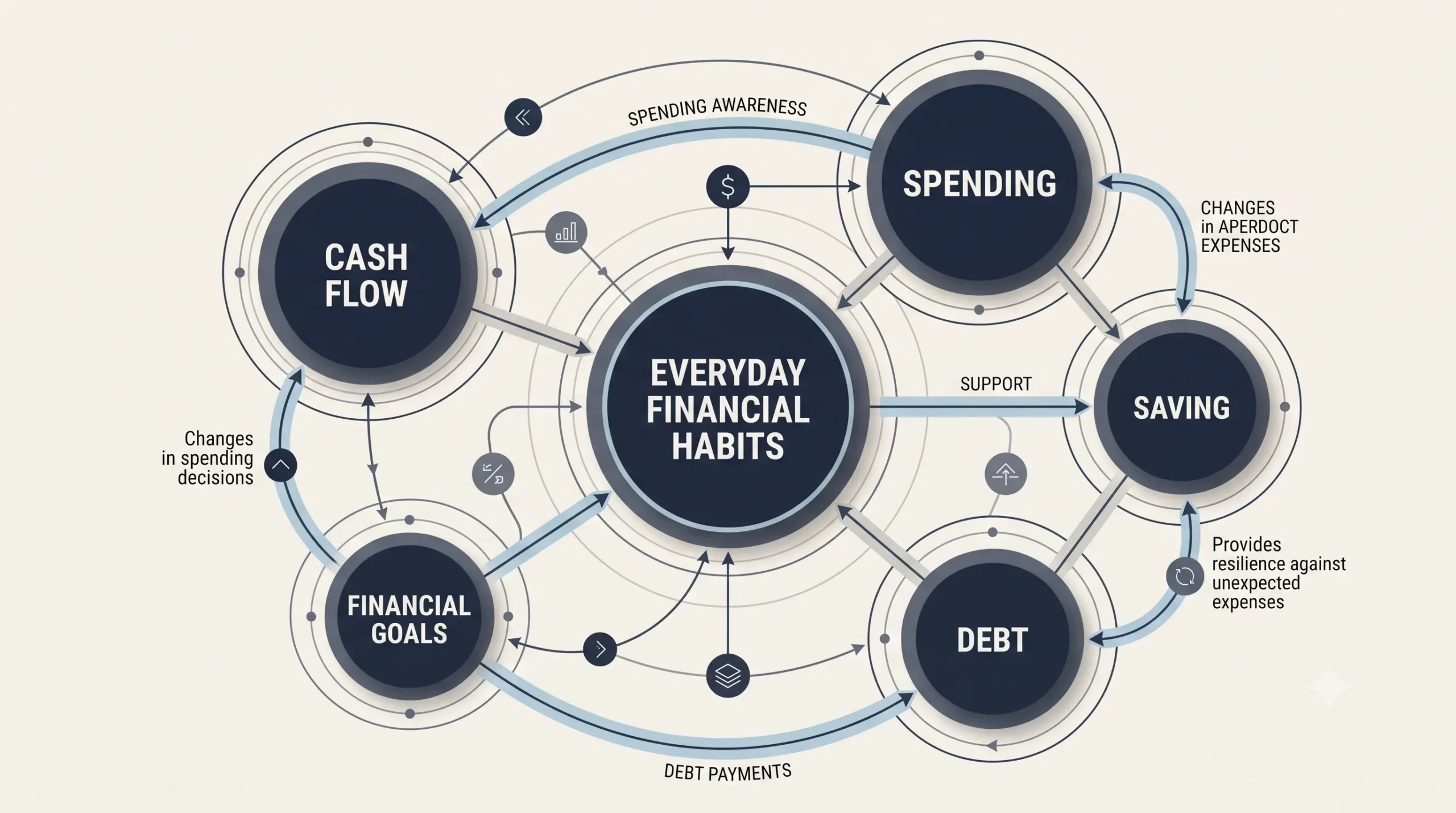
Financial habits are the repeated behaviors — checking an account, moving money into savings, reviewing a bill before it's due — that quietly shape what happens to your money over weeks, months, and years. They're one part of the broader Money system at Blueprint To Progress, where budgeting, cash flow, debt, saving, investing, income, and financial planning work together. This guide walks through what financial habits actually are, why they matter more than any single decision, and how to build a set of them that fits real life instead of a spreadsheet fantasy.
In This Guide
- What Are Financial Habits?
- Why Everyday Money Habits Matter
- How to Build Better Financial Habits
- Build a Simple Spending Awareness Habit
- Create a Weekly Money Check-In
- Make Saving Automatic
- Strengthen Your Debt-Payment Habits
- Connect Daily Habits to Financial Goals
- How to Make Financial Habits Stick
- Common Financial Habit Mistakes to Avoid
- A Simple 30-Day Financial Habits Plan
- Frequently Asked Questions
- Final Takeaway
What Are Financial Habits?
A financial habit is any money behavior you repeat often enough that it stops requiring active thought. That covers a lot of ground: how you spend, how you save, when you pay bills, whether you look at your debt, and how often you check in on your accounts. Some financial habits are automatic, like a scheduled transfer. Others are semi-conscious, like glancing at your balance before agreeing to happy hour.
It helps to separate good financial habits from big financial strategies, because people often confuse the two. A financial habit doesn't have to be a five-year investment plan or a dramatic overhaul of your entire budget. It can be something this small:
- Checking your account before a large purchase
- Moving $50 into savings every payday
- Reviewing subscriptions once a month
- Paying a credit-card balance on schedule
- Glancing at your cash flow before the weekend starts
None of those actions look impressive on their own. But small, repeated actions are exactly what steer larger financial outcomes over time — the same way one grocery trip doesn't define your diet, but a year of grocery trips does.
Financial Habits Are About Systems, Not Perfection
Here’s why most money advice is wrong: If you forget to move the money into savings once, or blow too much on a whim one weekend, it doesn’t indicate your system is a failure. It means you're human. The goal of building healthy financial habits isn't flawless execution — it's a system resilient enough to absorb the occasional slip and keep running anyway. A habit you can recover from beats a "perfect plan" you abandon after the first mistake.
Why Everyday Money Habits Matter
Individually, small money decisions feel insignificant. Collectively, they determine almost everything about your financial life — how much friction you feel, how early you spot problems, and how well your spending lines up with what you actually care about.
Consistent money management habits tend to produce a few concrete effects:
- Less financial friction, because decisions get made ahead of time instead of in a panic
- Better awareness of where money is actually going, not where you assume it's going
- More predictable cash flow from week to week
- Fewer surprises that derail an otherwise reasonable month
- Spending that better reflects your actual priorities
Picture two households. Household A checks its finances only when something goes wrong — a declined card, an overdraft notice, a "why is this bill so high" moment. Household B spends 10 to 15 minutes a week looking at upcoming bills, account balances, recent spending, and savings progress. Household B isn't guaranteed to end up wealthier; life throws curveballs at everyone. But that household sees problems while they're still small and has more chances to adjust course before a minor issue turns into a major one. That visibility is the real payoff of building consistent financial routines.
How to Build Better Financial Habits
Rather than handing you another 30-tip listicle, it helps to have one simple framework you can apply to any part of your financial life. Here it is:
Notice → Decide → Automate → Review → Adjust
- Notice what's actually happening with your money, not what you assume is happening.
- Decide which specific behavior you want to change.
- Automate whatever piece of it can run without your daily involvement.
- Review the result on a regular schedule, not randomly.
- Adjust when your income, expenses, or goals shift.
That five-step loop is the backbone of everything else in this guide. Every section below is really just this cycle applied to a different corner of your finances — spending, saving, debt, and goals.

Build a Simple Spending Awareness Habit
Spending awareness gets a bad reputation because people assume it means logging every cup of coffee for the rest of their lives. It doesn't. It means understanding, in broad strokes, where your money routinely goes so you can make decisions with your eyes open instead of closed.
Know Where Your Money Is Going
Start by separating spending into a few buckets:
- Fixed expenses — rent or mortgage, insurance, loan payments
- Variable expenses — groceries, utilities, gas
- Discretionary spending — dining out, entertainment, impulse buys
- Recurring subscriptions — streaming services, apps, memberships
- Irregular expenses — car repairs, annual fees, holiday spending
Most people can list their fixed expenses without much thought. It’s the monthly subscriptions and the sporadic expenses that do the most silent damage because they’re so easy to forget in between charges.
Use Your Budget as a Decision Tool
A personal budget is far more useful when you treat it as something you check before you spend, not just something you build once and file away. If you already have a sense of your household cash flow, spending awareness becomes almost automatic — you're just glancing at a number you already understand, rather than reconstructing your entire financial picture every time you want to buy something.

Create a Weekly Money Check-In
If you build only one habit from this guide, make it this one. A weekly money check-in takes 10 to 15 minutes and does more for your financial awareness than almost any app or spreadsheet.
A simple weekly checklist looks like this:
- Check your checking-account balance
- Review recent transactions for anything unexpected
- Look at upcoming bills for the next seven days
- Check credit-card balances
- Glance at savings progress
- Note any upcoming irregular expenses
- Decide whether spending needs to be adjusted this week
The important nuance here: this is a routine, not surveillance. A weekly check-in is enough for the vast majority of everyday financial decisions. You don't need to refresh your banking app five times a day — that tends to create anxiety without adding useful information. Pick one day, pick one time, and treat it like a standing appointment with your own finances.
Make Saving Automatic
Of all the saving habits you can build, automation does the most work with the least willpower. If a transfer happens before you ever see the money, you never have to talk yourself into saving it.
A few common approaches:
- Automatic transfers set up for the day after payday
- A separate account dedicated to emergency savings
- Goal-based savings accounts kept apart from everyday spending money
Give Every Savings Transfer a Job
Saving works better when it isn't abstract. Instead of one vague pool labeled "savings," give each transfer a purpose:
- Emergency fund
- Annual insurance premium
- Vacation
- Home repairs
- Future education costs
- A major purchase you're planning for
There is less likelihood of you dipping into it for something unrelated when money has a job. It stops feeling like discretionary cash sitting around and starts feeling like it's already spoken for.

Strengthen Your Debt-Payment Habits
You don't need a full debt-payoff strategy to build better debt habits — you just need a handful of consistent behaviors that keep debt visible instead of ignored.
Worth building into your routine:
- Making payments on time, every time
- Knowing your minimum payments without having to look them up
- Avoiding new debt for things that don't need it
- Reviewing what you're actually paying in interest
- Directing any extra money toward debt intentionally, rather than randomly
- Keeping debt payments part of your regular cash-flow picture, not a separate mental category
If you're actively working through a payoff plan, our guide to debt management goes deeper into strategy. Your regular debt and credit-payment habits can also affect your credit score, so keeping those obligations visible is useful beyond the monthly budget. Here's a nuance worth sitting with: a solid emergency fund can reduce the odds that a surprise expense — a car repair, a medical bill — turns directly into new debt. Debt habits and saving habits aren't separate systems; they lean on each other.
Connect Daily Habits to Financial Goals
A financial goal becomes far more achievable once it has a habit attached to it. "Save more" is a wish. "Transfer $75 every payday" is a habit — and habits are what actually move the needle.
| Goal | Supporting Habit |
|---|---|
| Build emergency savings | Automatic payday transfer |
| Reduce credit-card debt | Weekly balance review + scheduled payment |
| Save for a home | Dedicated monthly transfer |
| Increase retirement savings | Annual review of contribution percentage |
| Reduce unnecessary spending | Weekly spending review |
That’s where your day-to-day habits connect with a wider financial plan. If you haven’t set financial goals already, it’s worth doing before you get into the nitty-gritty of fine-tuning every habit. It’s hard to know which habits to prioritize until you know what you’re truly working for.
How to Make Financial Habits Stick
This is where most financial advice quietly falls apart — not in the planning, but in the follow-through. A few things actually move the needle.
Start Smaller Than You Think
Ambition kills habits faster than laziness does. Instead of:
"I will completely reorganize my finances this weekend."
Try:
"Every Friday, I'll spend 10 minutes reviewing my accounts."
The second version is boring enough to actually survive contact with a busy week.
Attach the Habit to an Existing Routine
New habits stick better when they piggyback on something you already do:
- Payday → savings transfer
- Sunday evening → weekly money check-in
- First weekend of the month → subscription review
- After a bonus lands → allocate it toward a goal
You're not trying to find extra time. You're borrowing a moment you already have.
Reduce Friction
The easier a habit is to do, the more often you'll do it. Automatic transfers, calendar reminders, saved bill-payment dates, and a couple of clearly separated savings accounts all lower the effort required — which is often the only thing standing between a good intention and an actual habit.
Give Yourself a Recovery Rule
This might be the most underrated piece of habit-building advice out there: decide in advance what happens when you slip. Something like:
"If I miss one week, I restart the next week without trying to make up for it all at once."
That single rule keeps a missed week from spiraling into a missed quarter. It's practical, not moralistic — nobody needs another reason to feel guilty about money.

Common Financial Habit Mistakes to Avoid
Trying to Change Everything at Once
A dozen new financial routines launched on the same Monday rarely survive to Friday. Pick one or two habits, let them become automatic, then add more.
Tracking Without Making Decisions
Plenty of people track every purchase in an app and still change nothing about how they spend. Awareness only pays off when it leads somewhere — a decision, an adjustment, a new boundary.
Treating the Budget as a Punishment
A budget isn't a cage. It's a tool for putting money where you actually want it, including the fun stuff. If your budget only ever tells you "no," you'll abandon it — and rightly so.
Ignoring Irregular Expenses
Annual insurance premiums, car repairs, holiday spending, medical bills, and home maintenance have a habit of showing up right when your budget feels under control. Build room for them, even roughly, so they don't feel like ambushes.
Confusing Saving With Investing
Saving and investing solve different problems, and mixing them up can leave your emergency fund exposed to market swings or your long-term growth stuck earning next to nothing. Our guide on saving vs. investing breaks down when each one makes sense.
A Simple 30-Day Financial Habits Plan
You don't need a year-long revamp to feel a change. You can get a good foundation in four weeks.
Week 1 — Observe
- Review recent spending
- Identify recurring bills
- Check current account balances
- Pick one financial behavior worth changing
Week 2 — Automate
- Set up a savings transfer
- Automate the bill payments that make sense to automate
- Create a recurring reminder for your weekly money check-in
Week 3 — Adjust
- Review discretionary spending
- Look closely at debt payments
- Cancel one unnecessary recurring expense
- Redirect that small amount toward a financial priority
Week 4 — Review Ask yourself:
- What became easier?
- What didn't work?
- Which habit actually saved time or money?
- What's worth continuing next month?
The goal isn't to become perfect with money in 30 days. It's to make one or two useful behaviors easier to repeat.

Frequently Asked Questions
What are financial habits? Financial habits are the repeated money behaviors — spending, saving, bill payment, account reviews — that you do often enough that they become routine, as opposed to one-time financial decisions like buying a car or refinancing a loan.
What are some good financial habits to start with? A regular spending review, automatic saving, timely bill payments, basic debt awareness, and a periodic check on your financial goals cover most of the ground worth starting with.
How long does it take to build a financial habit? There's no reliable magic number, and claims like "21 days" oversimplify things. What matters more is consistency, keeping the habit small enough to repeat, and making it fit into your real life, not an idealized picture of it.
What is the most important financial habit? There isn't one universal answer. The most useful starting point depends on your situation — someone carrying high-interest debt benefits most from a different first habit than someone with stable income who's ready to focus on long-term goals.
How can I improve my financial habits if my income is limited? Start with awareness. It doesn’t cost anything. Focus on essential cash flow, cut recurring expenses that no longer justify their cost, and start with even a small, automated savings amount. Consistency matters more than the size of the contribution.
Should I focus on saving, debt, or investing first? This depends on your income, cash reserves, debt costs, employer benefits, and financial goals rather than a fixed order everyone should follow. Begin by determining whether you need an emergency fund, whether high-interest debt management is constraining your cash flow and whether you are currently taking advantage of any workplace retirement benefits. Once those priorities are set, investing for beginners can be factored into the longer-term plan.
Resources
The following resources can help you go deeper into the areas covered in this guide:
- Consumer Financial Protection Bureau — consumer-focused financial education and practical money-management resources
- FDIC financial education resources — information and educational resources related to saving and deposit accounts
- Investor.gov — educational information for understanding investing and the difference between saving and investing
Continue Reading
Final Takeaway
Better financial habits aren't built through one dramatic decision — they're built through small, repeatable actions that make good financial decisions easier to make automatically. Spending awareness tells you what's happening. A weekly review keeps that awareness current. Automatic saving and responsible debt management turn intentions into results. And connecting all of it to your actual financial goals gives the whole system a destination instead of just busywork.
You don't need to fix everything this month. Choose one financial habit that would make your financial life even slightly easier, and make that the habit you practice first.
CTA — Build Your Next Financial Habit
Better financial habits do not require a complete financial makeover. Start with one practical change, make it easy to repeat, and give it enough time to become part of your routine.
Ready to put your money habits into action?
Explore the Money Pillar