How to Manage Debt Without Losing Sight of Your Financial Goals
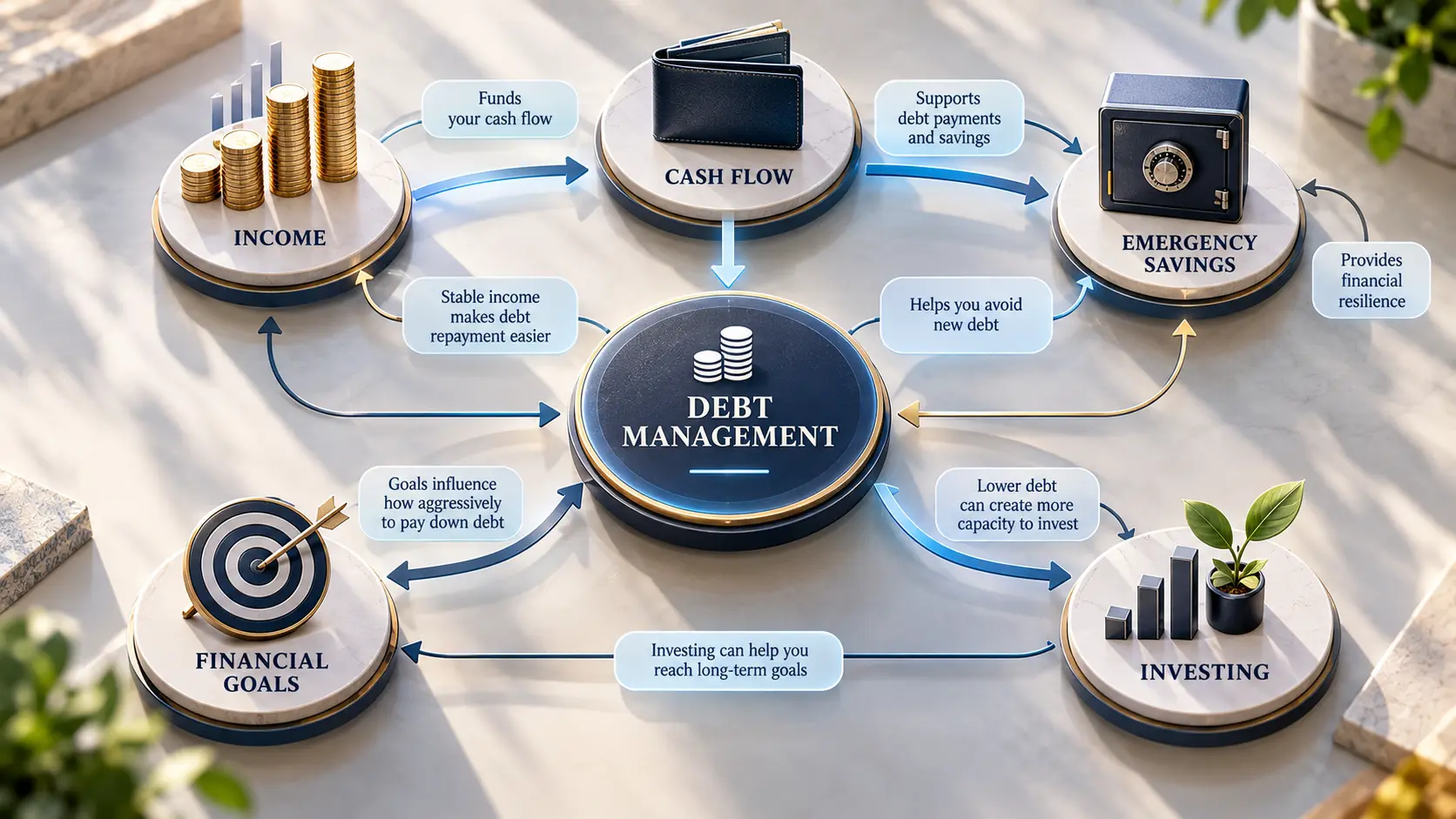
Getting out of debt seems simple enough: throw some more money at the balance, watch it decrease, do that until it’s gone. In practice, it rarely works that cleanly. When every spare dollar gets funneled toward payments, other priorities — an emergency fund, retirement contributions, that down payment you've been chipping away at — can quietly stall. Good debt management isn't about clearing balances as fast as humanly possible. It’s about making debt repayment work with your cash flow, your safety net, and the goals that first got you saving.

Why Debt Management Should Include Your Bigger Financial Picture
Debt rarely shows up alone. Most households are juggling it alongside everything else: a credit card balance here, an auto loan there, maybe student loans in the background, while still trying to keep an emergency fund intact, contribute to retirement, and save toward a home. Treat debt management like its own isolated project, and you can end up "winning" the debt payoff while quietly losing ground everywhere else.
That's why the right question isn't "how fast can I become debt-free?" It's closer to "how do I reduce expensive debt without dismantling the financial system I'm trying to build?" Those two questions can lead to very different plans.
Debt repayment is important, but it is not the only goal
There's an opportunity cost to every dollar. Money that goes toward an extra debt payment is money that isn't going into savings this month, or into a retirement account, or toward a goal you've been working on for years. Sometimes that trade-off is worth it — high-interest debt is expensive, and the math often favors paying it down. But treating debt payoff as the only goal that matters, month after month, tends to leave people financially brittle: technically less indebted, but with no cushion and no momentum toward anything else.
Your financial goals are the reason for paying off debt
Debt management works better when it’s attached to something real. Paying down a credit card frees up monthly cash flow. Reducing interest costs means more of your future income actually belongs to you instead of a lender. That flexibility eventually turns into room for savings and, later, for investing. When debt reduction is tied to a personal budget and a clear read on your cash flow, it stops feeling like punishment and starts feeling like progress with a destination.
Start With a Clear View of Your Debt
You can't manage what you haven't actually looked at. Before choosing a strategy, get every debt in one place — not a rough mental estimate, an actual list.
List Every Balance
For each debt, record:
- Creditor name
- Current balance
- Interest rate (APR)
- Minimum payment
- Payment due date
- Loan type (credit card, auto, student, personal, medical, etc.)
A spreadsheet works fine. So does a notebook. The format matters less than the completeness — half-remembered numbers make for bad decisions later.
Separate High-Cost Debt From Lower-Cost Debt
Interest rate is the number that should drive most of your prioritization. A credit card charging 24% APR is a fundamentally different problem than an auto loan sitting at 6%. The high-cost debt is actively working against you every month it lingers; the lower-cost debt is more of a background obligation. Debt management that treats a $400 credit card balance with the same urgency as a $400 car payment is missing the point.
Calculate What Debt Is Doing to Your Monthly Cash Flow
Add up your required minimum payments and compare that total to your take-home income. This shows you what your actual options are for discretionary spending, saving, or paying off more debt. It’s a natural extension of the cash flow work you may have done on your budget.
Here's a quick illustration. Say a household has a $6,000 credit card balance at 22% interest, a $12,000 auto loan at 5%, and $8,000 sitting in savings. On pure math, the credit card is clearly the more urgent target — it's costing far more per dollar owed. But the full picture also matters: is that $8,000 an adequately sized emergency fund, or is it the only buffer standing between this household and another high-interest balance the next time the car needs a repair? There's no universal answer here. The point is that the complete financial picture, not just the interest rate spreadsheet, should shape the decision.
Decide Which Debt to Tackle First
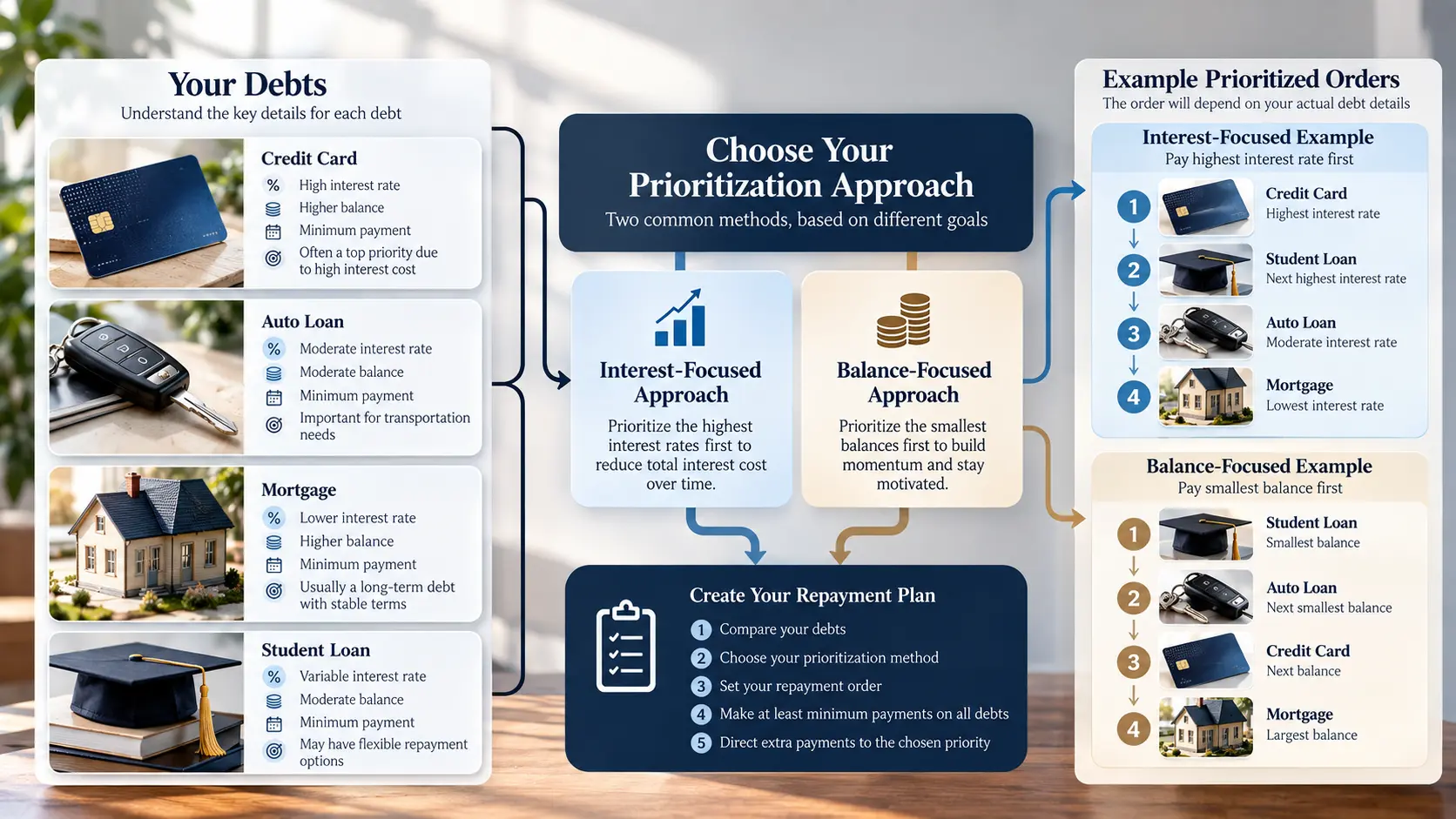
This is where most debt management advice tends to live, and for good reason — the order in which you attack balances has a real effect on both the total interest you pay and whether you stick with the plan.
The Debt Avalanche Approach
Pay the minimum on every debt, then send all extra money toward the balance with the highest interest rate. Once that one's gone, roll the freed-up payment into the next-highest-rate balance, and so on. When other terms are equal, this approach generally minimizes the total interest paid over time.
The Debt Snowball Approach
Same structure, different target: minimums on everything, extra money toward the smallest balance regardless of its interest rate. The appeal isn't math, it's momentum. Clearing a full balance — even a small one — produces a visible win early on, and for a lot of people, that early win is what keeps the plan alive past month two.
| Method | How it works | Main advantage | Main trade-off |
|---|---|---|---|
| Debt avalanche | Direct extra payments to the highest-interest debt first. | When other terms are equal, it generally minimizes total interest over time. | Progress on individual balances may feel slower at first. |
| Debt snowball | Direct extra payments to the smallest balance first. | Early balance wins can create momentum and reinforce the repayment habit. | It can result in more interest paid when higher-rate debts are left longer. |
Choose a Method You Can Actually Maintain
Here's the honest part: the "best" method on paper isn't always the one that gets used. A repayment plan you abandon after ten weeks accomplishes nothing, no matter how elegant the interest-rate math was. If quick wins keep you engaged, the snowball's minor cost in extra interest is often worth it. If you're the type who's motivated by the biggest number moving the fastest, the avalanche will suit you better. Mathematical efficiency and behavioral sustainability aren’t always aligned, and having sustainable financial habits is more critical than winning the argument about which technique is theoretically better.
Build a Debt Repayment Plan That Fits Your Cash Flow
An aggressive repayment plan that collapses the first time your car needs a new alternator isn't actually a good plan — it's just an optimistic one.
Start With Your Monthly Available Cash
Once you know your income, fixed expenses, and minimum debt payments, you can see what's genuinely left over. This is the same exercise behind a solid cash flow review, and it should happen before you commit to any extra-payment number.
Set a Debt Payment That Is Ambitious but Sustainable
There's a temptation to throw every last available dollar at debt. Resist it. A plan with zero breathing room tends to break the moment life throws in a dentist bill or a car repair, and a broken plan often gets replaced with no plan at all. Leave a little slack.
Automate the Minimums and Schedule the Extra Payment
Set up automatic payments for at least the minimums on everything, so a missed due date never becomes an additional problem. Then schedule your extra payment for right after payday, when the money is still there to be assigned intentionally rather than absorbed into everyday spending. Revisit the numbers monthly — income changes, expenses shift, and a plan built once shouldn't be treated as permanent. The method stays aligned when you coordinate it with your personal budget. Your budget feeds your debt plan, and your cash flow feeds your budget.
Protect Your Emergency Savings While Paying Down Debt
This is one of the more counterintuitive parts of debt management, and one of the most important.
Why Paying Every Available Dollar Toward Debt Can Backfire
If you drain your savings to accelerate debt payoff and then a $1,200 repair bill shows up, where does that money come from? Often, right back onto a credit card — undoing progress and adding a fresh balance to the pile. Debt management that ignores this risk can end up creating the very problem it was trying to solve.
Create a Buffer Before Going All-In on Debt Repayment
You don't need a fully loaded emergency fund before making any extra debt payments, but going in with zero cushion is asking for trouble. A modest reserve — enough to absorb a genuine surprise expense — gives your repayment plan somewhere to stand.
Rebuild Savings as Debt Falls
As balances shrink and minimum payments drop off one by one, your monthly cash flow improves. That freed up money doesn’t have to all go back into debt — it can rebuild your emergency fund, providing you a better base to move toward the next priority.

Keep Your Financial Goals in the Plan
Debt payoff shouldn't be treated as the finish line. It's a means to an end, and the end is usually a set of specific goals.
Separate Short-Term and Long-Term Goals
Some goals are close — building an emergency cushion, replacing an aging car. Others sit years out — a home down payment, retirement, financial independence. Naming them explicitly, instead of leaving them as vague someday intentions, makes it much easier to weigh them against a debt payment.
Give Each Goal a Time Horizon
A goal five months away calls for a different approach than one 20 years away — different savings vehicles, different urgency, different tolerance for risk. When you add a rough time frame to each of your financial objectives (https://blueprinttoprogress.com/money/financial-goals/), you convert them into something you can actually plan around, instead of just abstractions.
Track Progress Beyond the Debt Balance
If the debt total is the only number you're watching, you'll miss the bigger story. Also track total interest paid, monthly cash flow freed up as balances clear, emergency savings growth, retirement contributions, and progress toward whatever specific goal matters most to you. A debt balance going down is good news; it's better news alongside a savings account that's finally moving too.
Know When to Prioritize Debt Over Investing
This is where personal finance often gets more nuanced than the "pay off all debt first" or "always invest for the match" camps would suggest.
Consider the Cost of High-Interest Debt
A credit card carrying a very high APR can be an expensive drag on a household's finances. Because investment returns are uncertain and debt interest is a contractual cost, high-interest debt deserves careful attention before assuming that investing more is automatically the better use of every available dollar.
Do Not Automatically Abandon Every Long-Term Contribution
That said, wiping out every retirement contribution to chase debt payoff isn't automatically the right call either — particularly if there's an employer match on the table. Turning down free matching money to pay down a 6% auto loan a little faster is a trade most people would regret later. Consider your time horizon, whether the accounts are tax-advantaged, the actual interest rate on the debt, and your overall cash flow before making blanket decisions.
Think in Terms of Trade-Offs
The underlying question is: what allocation of the capital you have now best serves the financial system you want in five, ten or twenty years? One method could be to target high-interest debt while still making the necessary retirement contributions to get an employer match, then reassess when those costly balances go down. Understanding your comfort with investment risk and the principles of long-term investing can help put a single month’s decision into proper context. If you are new to investing, the Investing for Beginners guide can provide a useful starting point.
Use Extra Income Strategically
Tax refunds, bonuses, freelance checks, and the occasional windfall all raise the same question: debt, savings, or something else?
Rather than a blanket rule that every extra dollar must go to debt, use a simple decision order: shore up an inadequate emergency fund first, then attack high-interest debt, then fund a specific financial goal, then invest. Where the line falls depends on your situation — someone with three months of expenses saved and only $2,000 in credit card debt is in a very different spot than someone with a thin cushion and $15,000 owed at 24%. If your income includes side income, consider dedicating a fixed percentage of it specifically to debt or to saving for financial goals, so the windfall has a job before it has a chance to disappear into everyday spending.
Make Debt Management Easier to Maintain
Strategy is one half of the equation; behavior is the other, and it's the half that actually determines whether the plan survives contact with real life.
Automate What You Can
Automatic minimum payments and a scheduled extra payment remove the plan from your daily willpower budget. The fewer decisions you have to make each month, the fewer chances there are to skip one.
Keep One Monthly Debt Check-In
A single recurring check-in — ten minutes, once a month — is enough to confirm balances, catch a rate change, and adjust the extra payment if income shifted. It doesn't need to be more elaborate than that.
Avoid Adding New Debt While Paying Off Existing Debt
This sounds obvious and still trips up a lot of plans. Paying off a credit card should feel like progress, not like an invitation to celebrate by immediately filling the newly available credit line back up.
Celebrate Milestones Without Creating New Bills
Clearing a balance is worth acknowledging. Just aim for a celebration that doesn't come with its own monthly payment attached.
Evaluate Your Progress and Modify the Plan
Debt management is not something you sit down and write once and file. It's a live strategy that is revised as circumstances change.
Regularly check your balances, interest rates, cash flow, emergency savings and goals, and specifically look at the plan:
- When your income changes
- When a major unplanned expense appears
- When a debt is fully paid off
- When your financial goals change
Each of those moments is a natural opportunity to redirect freed-up cash flow — and a good bridge into a broader financial plan rather than a debt spreadsheet that never talks to the rest of your finances.
Putting the Pieces Together: A Practical Example
Consider a household bringing home $7,000 a month after taxes. Their debts: a $7,500 credit card balance at a high rate, a $14,000 auto loan, and $18,000 in student loans. They have $5,000 in savings and want to maintain their emergency reserve, eliminate the expensive credit card debt, keep contributing to retirement, and eventually save for a home.
Here's a reasonable sequence, rather than a single prescribed answer:
- Protect essential cash reserves — the $5,000 stays largely intact rather than being emptied into debt payoff.
- Cover required minimum payments on the auto loan and student loans, which are relatively low-cost and don't need aggressive extra payments right now.
- Put most of your excess monthly cash toward that credit card, the obvious high-interest outlier.
- Maintain retirement contributions at least up to any employer match, rather than pausing them entirely.
- Once the credit card is cleared, redirect that freed-up payment toward the next goal — building the emergency fund further, then a home down payment.
This isn't the only workable version of this household's plan, but it illustrates the underlying logic: protect the floor, attack the expensive debt, don't abandon long-term contributions, and keep redirecting freed cash as balances clear.
Common Debt Management Questions
Should I pay off debt before building an emergency fund?
Not entirely. Most households benefit from keeping at least a small cash cushion while also making progress on high-interest debt — going to zero savings to accelerate payoff can leave you exposed to the next surprise expense.
Is the debt avalanche or debt snowball method better?
The avalanche saves more in interest over time; the snowball tends to be easier to stick with because of early wins. The better method is whichever one you'll actually follow through on.
Should I invest while paying off debt?
Often yes, at least up to an employer retirement match — turning that down to pay off lower-interest debt slightly faster is rarely worth it. Very high-interest debt is a different story and may deserve priority, particularly when its interest cost is substantial and ongoing.
How much extra should I put toward debt each month?
As much as your cash flow comfortably allows without eliminating your entire buffer. A sustainable amount you'll maintain for a year beats an aggressive amount you abandon after two months.
Should I use extra income to pay down debt?
Extra income — bonuses, refunds, side income — is a good candidate for debt payoff, especially toward high-interest balances, but it's worth checking your emergency fund and near-term goals first.
What should I do after I pay off a debt?
Redirect that payment amount toward the next obligation, your emergency fund, or a financial goal you’ve been waiting to fund instead of letting it silently disappear into everyday spending.
Final Takeaway
Debt management isn't just about making balances disappear. Done well, it helps you understand exactly what you owe, prioritize the debt that's actually expensive, maintain enough financial resilience to handle surprises, protect the goals that matter to you, and make deliberate choices about saving and investing along the way. The real payoff of debt management isn't simply a zero balance — it's having more control over where your future money can go.
Resources
Debt decisions can involve more than a repayment schedule. The following U.S. government resources provide additional information that can help you understand debt, saving, and investing:
- Consumer Financial Protection Bureau (CFPB): Debt collection resources explain how debt collection works and provide information about consumer rights. This is especially useful if a debt has moved into collections.
- Investor.gov: Introduction to Investing explains investing basics, risk, diversification, time horizon, and the relationship between saving and investing.
- Investor.gov: Save and Invest provides a practical roadmap that includes defining goals, paying down high-interest debt, building an emergency fund, and understanding investment risk.
These resources are educational in nature and not a substitute for individual financial, tax or legal advice.
Your Next Step
Debt becomes easier to manage when it is connected to the rest of your financial plan.
Start by putting your balances, interest rates, minimum payments, monthly cash flow, emergency savings, and major financial goals in one place. Then decide which part of the system needs your attention first.
If you are building that system step by step, continue with the Personal Budget and Cash Flow guides, then explore the Emergency Fund and Financial Goals resources.
Start With Your Financial PictureThe objective is not simply to become debt-free. It is to create a financial system that gives your future income more room to work toward the life you actually want.