
How to Create a Personal Budget You Can Actually Live With
A budget that looks perfect on paper can fall apart the first time a car needs a repair, a friend suggests dinner out, or the electric bill decides to become unusually ambitious. If that sounds familiar, you're not bad with money — you probably just built a personal budget that only works in a world where nothing unexpected ever happens.
A good personal budget isn't supposed to predict every dollar perfectly. It should give you a practical framework for deciding where your money goes, while still leaving enough room for the version of life you're actually living. This guide walks through how to build one that survives contact with reality.

What Is a Personal Budget?
At its core, a personal budget is a plan for what happens to your money before it happens. It isn't merely a list of bills you owe — it's a decision-making framework for allocating the income you expect, before that income quietly disappears into two dozen small purchases you don't remember making.
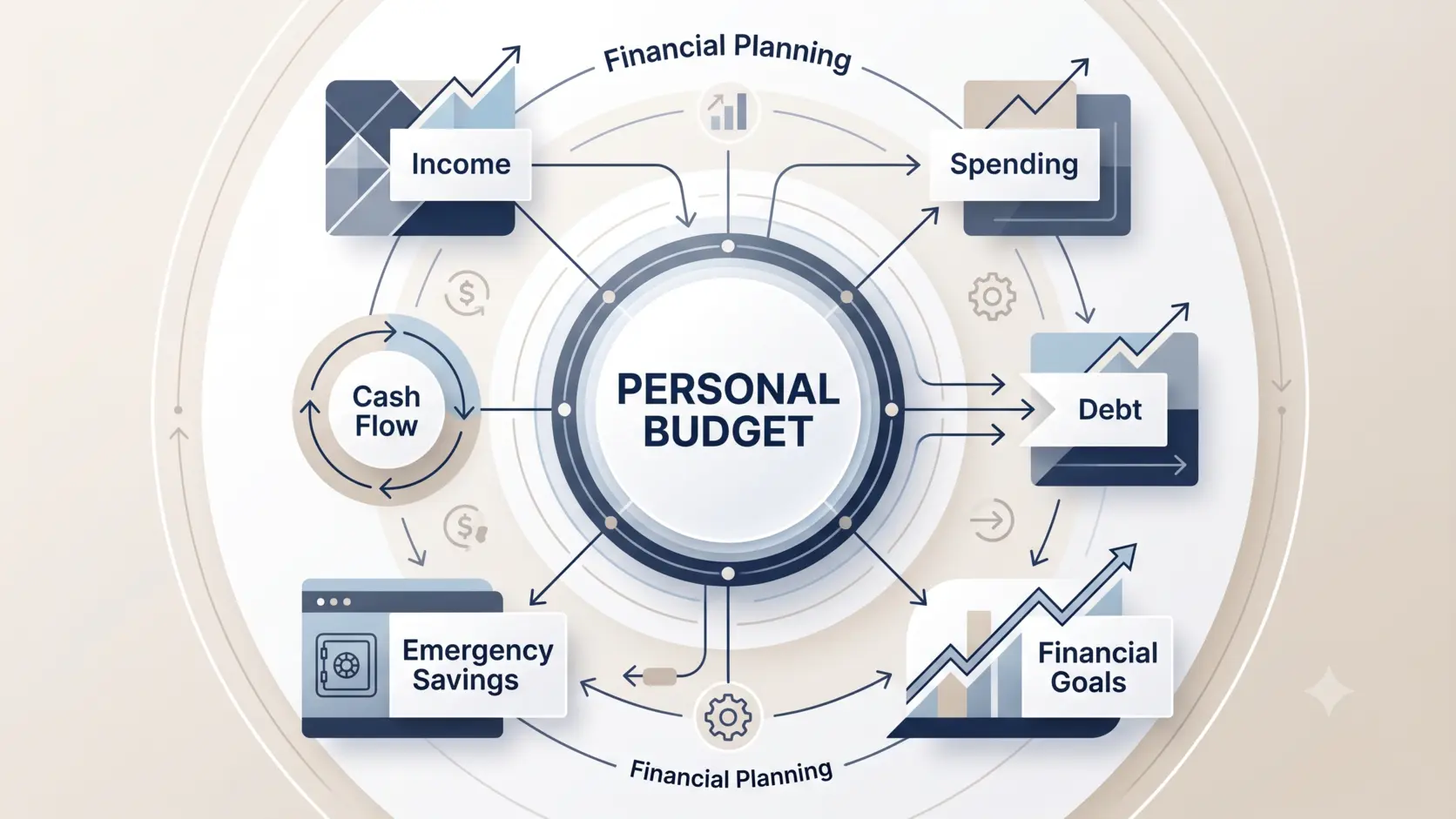
Every personal budget is built from the same basic pieces: income, essential expenses, discretionary spending, debt payments, savings, irregular costs, and whatever cash is left over once everything else has been accounted for. How those pieces get arranged is where budgets start to look different from one household to the next.
Take a fictional example: Maria, a nurse in Ohio, brings home about $5,000 a month after taxes. Her money might get divided something like this — roughly $1,500 toward housing, $400 toward utilities, $500 toward groceries, $350 toward transportation, $200 toward insurance, $300 toward debt payments, $500 into savings, and the remaining amount toward discretionary spending. That breakdown isn't a formula everyone should copy. Someone renting in Austin, someone paying off student loans in Atlanta, or someone supporting three kids in rural Kansas would land on completely different numbers. The categories stay similar. The proportions almost never do.
That's really the point of a personal budget: it's less a universal template and more a mirror held up to your own financial life, with enough structure that the mirror actually tells you something useful.
Why Most Budgets Fail in Real Life
Most people who "fail" at budgeting didn't fail at math. They built a plan for a person who doesn't exist — one who never gets a flat tire, never gets invited to a wedding out of state, and never has a Tuesday bad enough to justify a $14 milkshake. Here's where that usually goes wrong.
The Budget Is Based on Ideal Behavior
Plenty of budgets get built around the best version of a person's habits rather than the honest version. They assume you'll never order takeout, never buy a birthday gift, never replace a pair of worn-out shoes, and never travel. Then the first ordinary month arrives, the plan breaks within two weeks, and the whole system gets abandoned by the fifteenth.
Irregular Expenses Are Treated as Surprises
Car registration, insurance premiums, property-related costs, holiday spending, dental work, home repairs, back-to-school shopping — none of these are actually surprises. They're predictable costs that simply don't show up every single month, so a monthly-only budget tends to miss them entirely until they land like a gut punch in October.
Every Dollar Is Assigned Too Tightly
There's a particular kind of budget that assigns a job to every single dollar, with zero slack anywhere. It feels responsible on a spreadsheet. In practice, it tends to create a cycle: restriction leads to overspending, overspending leads to guilt, guilt leads to frustration, and frustration leads to quietly deleting the budgeting app. A little breathing room isn't a design flaw — it's what keeps the whole system standing.
Start With Your Actual Take-Home Income
Before you assign a single dollar anywhere, you need an honest number to work with — and that number is your take-home pay, not your salary. Gross income is the figure on an offer letter. Take-home income is what actually lands in your checking account after taxes, health insurance, and retirement contributions are already taken out. Budgeting from the gross number is one of the fastest ways to build a plan that's broken from day one.
If you have a single steady paycheck, this step is straightforward: add up what actually deposits each month. It gets more interesting with multiple income sources — a primary job plus freelance work, a side hustle, seasonal bonuses, or irregular client payments. In those cases, list every source separately before combining them, since some will be dependable and others won't be.
What If Your Income Changes From Month to Month?
Variable income throws off a lot of otherwise reasonable budgets. The fix isn't complicated, even if it takes some discipline: build your baseline budget around a conservative, lower-than-average month rather than your best one. If your income comes in higher in a given month, that extra amount becomes a bonus you get to assign — toward savings, debt, or a cash-flow cushion — instead of a number you were quietly counting on just to make rent.
Build Your Core Spending Categories
This is where the abstract idea of a budget turns into an actual plan you can follow. Rather than inventing categories from scratch, most households do well starting with a handful of core buckets and refining from there.
Housing
Rent or mortgage typically anchors this category, along with property-related costs like HOA fees, property taxes if they're not already escrowed, and, depending on how granular you want to get, utilities.
Transportation
Car payments, fuel, routine maintenance, auto insurance, and public transportation costs all belong here. It's worth separating the fixed piece (the loan payment) from the variable piece (gas and repairs), since they behave very differently month to month.
Food
This is one category worth splitting rather than lumping together. Groceries and restaurant spending behave completely differently, and if they're stuffed into one giant "food" bucket, it becomes surprisingly easy to convince yourself that both are equally necessary. Separating groceries, dining out, and delivery or takeout tends to reveal patterns a combined number would hide.
Debt Payments
List every debt with its minimum payment, then decide where extra payments make the most sense. If you're carrying multiple balances — credit cards, a car loan, student loans — a dedicated debt management strategy can help you prioritize which one to attack first without losing track of the rest. Keeping an eye on your credit score can also help you understand how your borrowing decisions may affect your broader financial picture.
Savings and Financial Goals
Savings deserves its own line item, not the leftovers at the end of the month. This generally comes in the form of an emergency fund for the unexpected with a separate line for financial goals — a house down payment, a wedding, a vacation, or whatever you're actually working toward.

Create a Personal Budget That Leaves Room for Real Life
Here's the distinction that matters more than almost anything else in this guide: there's a difference between a mathematically balanced budget and a sustainable one. A mathematically balanced budget adds up perfectly in a spreadsheet. A sustainable personal budget survives an actual month, including the parts that don't go according to plan.
Give Yourself a Realistic Flexible-Spending Category
Entertainment, eating out, hobbies, subscriptions, personal purchases, social plans with friends — discretionary spending isn't automatically irresponsible, and treating it that way is usually what causes a budget to collapse. Give this category an honest number instead of pretending it should be zero.
Budget for Irregular Expenses
This is where sinking funds earn their keep. Say you expect around $1,200 a year in combined car maintenance and registration costs. Instead of treating that bill as an emergency when it arrives, set aside roughly $100 a month ahead of time. By the time the bill shows up, the money is already sitting there waiting for it, and nothing about your cash flow has to scramble to cover it.
Leave a Small Buffer
Not every dollar needs a named job. A modest, unassigned buffer — even $50 or $100 — can absorb the ordinary variation that shows up in any real month, without forcing you to pull from savings or shuffle categories every time something costs a little more than expected.

Turn Your Budget Into a Monthly Spending Plan
A budget is the plan. A spending plan is how you actually run that plan during the thirty-odd days you're living in. The two get confused constantly, but keeping them separate is what turns a budget from a document you made once into a system you actually use.
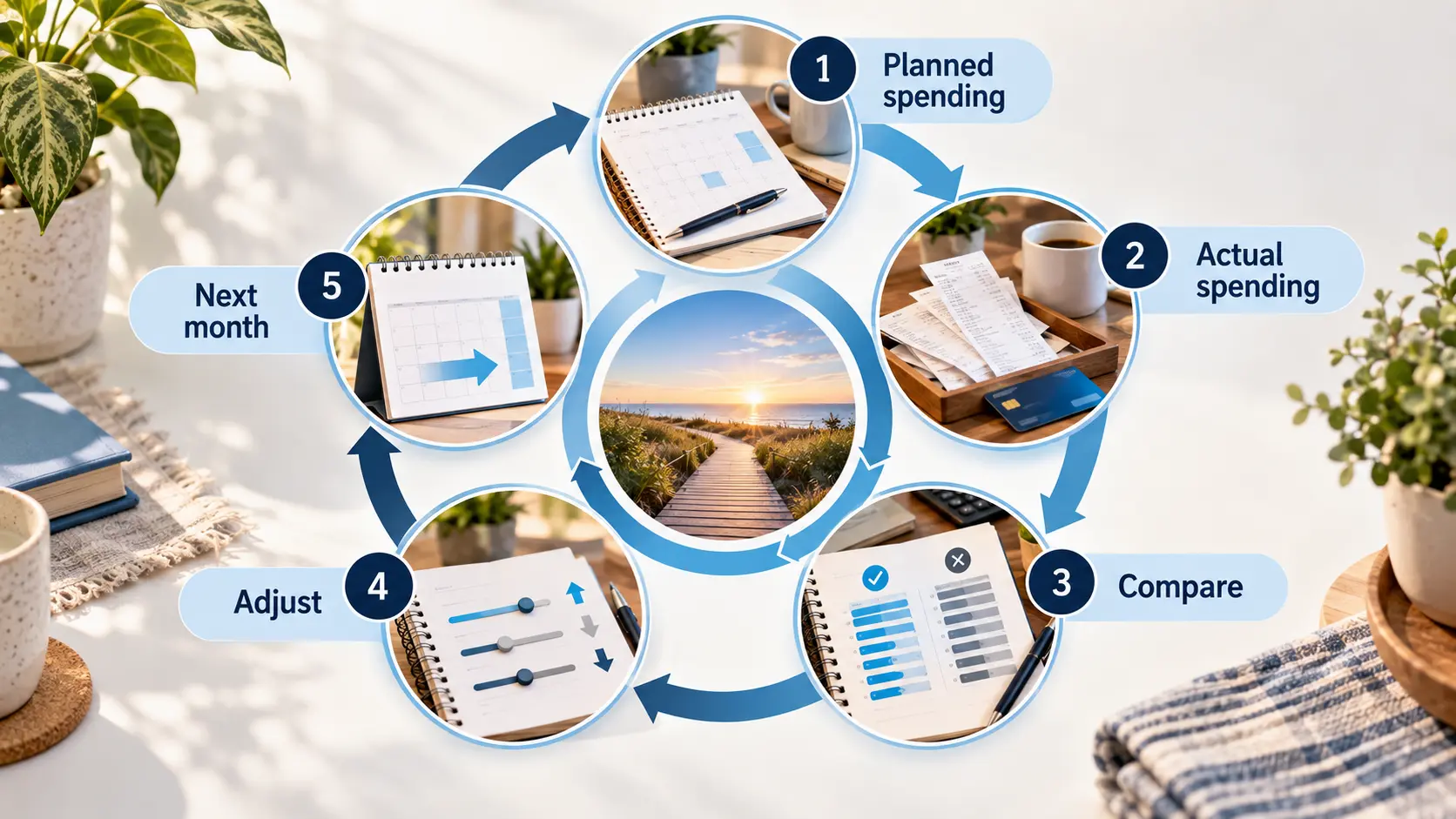
A simple rhythm works well here: Plan → Spend → Check → Adjust.
At the start of the month, map out your paycheck timing against your bills, so you know which checks need to cover which due dates. Automate what you reasonably can — rent, utilities, loan payments, the recurring subscriptions you've decided to keep — so those don't depend on you remembering anything. Stay loosely aware of spending as the weeks go by, rather than avoiding your bank app until the fifteenth. Do a quick mid-month check to catch problems early, move savings transfers on schedule instead of "whenever there's extra," and close the month with a short review before repeating the cycle.
None of this requires a finance degree. It just requires doing the same four steps often enough that they stop feeling like a chore.
Adjust the Budget When the Numbers Don't Work
The first version of a budget is rarely the final version, and that's normal — not a sign you did something wrong. When expenses outpace income, work through the numbers in something close to this order:
- Check for overlooked expenses you forgot to include.
- Separate genuine needs from flexible spending.
- Review subscriptions and recurring charges you may have stopped using.
- Look closely at your debt payments and interest rates.
- Examine larger fixed costs like housing or a car payment.
- Consider whether there are realistic opportunities to raise your income.
- Rework your savings targets if they're currently unrealistic.
- Revisit the whole budget after a month of real data instead of guesses.
That sixth step matters more than most budgeting advice gives it credit for. Cutting expenses has a floor — you can only trim so much before there's nothing left to trim — but growing income doesn't have the same ceiling. If your numbers consistently don't work no matter how much you cut, it may be worth exploring your earning power or preparing for a salary negotiation rather than assuming the only lever available to you is spending less.
Make Your Budget Easier to Maintain
A budget you abandon after six weeks isn't really a budget — it's a spreadsheet you made once. Maintenance is less about sophistication and more about making the system easy enough to keep using.
Automate What You Can
Bills, minimum debt payments, and recurring savings transfers are all strong candidates for automation. If you haven't set up a system to automate savings, that single change tends to do more for consistency than almost any other adjustment on this list.
Use Fewer, Better Categories
There's a temptation to create thirty-seven impossibly specific categories — "coffee," "parking," "streaming," "miscellaneous streaming" — and it almost always backfires. Fewer, broader categories are easier to track honestly and far less likely to get abandoned out of sheer tedium.
Review Spending Regularly
A short weekly check beats an elaborate monthly financial ceremony that you quietly start skipping by the third month. Five minutes on a Sunday tends to outperform a two-hour spreadsheet audit nobody has the energy to repeat.
Keep the System Convenient
The best budgeting system isn't the most detailed one — it's the one you'll actually keep using. A basic app, a simple spreadsheet, or even a notebook all work fine if they fit into how you actually live. Building a good financial system is part of a broader set of financial habits worth developing, and consistency will always beat complexity.
Common Budgeting Mistakes to Avoid
A handful of mistakes show up again and again, across nearly every income level:
- Budgeting from gross income instead of take-home pay
- Forgetting irregular expenses until they arrive as a crisis
- Making the budget unrealistically restrictive from the start
- Ignoring debt payments or treating them as an afterthought
- Treating savings as whatever happens to be left over
- Creating too many overly specific categories
- Assuming every month will look identical to the last one
- Abandoning the entire budget after one difficult month
- Focusing only on cutting expenses and never considering income growth
That last one deserves a second mention. A budget obsessed purely with restriction eventually runs out of things to cut. One that also considers how to grow income tends to hold up far longer — and it's a lot less miserable to live inside.
Final Takeaway
A personal budget should make your money easier to manage — not make everyday life miserable. The process, boiled down, is genuinely simple: know your real income, map your actual expenses, plan ahead for the irregular costs, leave enough room for ordinary life, review what happened, and adjust from there.
None of that requires perfection on the first attempt. It requires a system flexible enough to survive a normal month, including the parts you didn't plan for. From here, the natural next steps involve connecting your budget to the rest of your money management — building an emergency fund, setting clearer financial goals, and eventually shaping a full financial plan around all of it.
Frequently Asked Questions
How much should I budget for discretionary spending?
There's no universal percentage that works for everyone. It really comes down to your income, your fixed expenses, whatever debt you're carrying, your savings goals, and what you personally value. Someone with low fixed costs and no debt hanging over them can reasonably put more toward discretionary spending than someone navigating a tight cash flow situation.
What should I do if my expenses are higher than my income?
Start by identifying the largest adjustable categories rather than trying to cut everything at once. Consider both sides of the equation — realistic spending reductions and potential ways to increase income — rather than assuming spending cuts are the only option available to you.
Should savings be included in a personal budget?
Yes. Savings should be a planned line item, not whatever happens to be left over after everything else is spent. Treating it as an actual category — the same way you'd treat rent or a car payment — is one of the most reliable ways to make sure it actually happens.
How often should I review my budget?
Monthly is a sensible baseline for most people, with brief weekly checks layered on top when useful. The exact frequency matters less than doing it consistently enough to discover issues before they become costly.
Should I use the 50/30/20 budgeting rule?
It's a reasonable starting framework, not a universal rule. Housing expenses, debt burden, income level, geographic location, family structure and financial goals might all make a different allocation more practical. Think of it as a ballpark starting point, not a goal you're falling short of.
What is the difference between a budget and a spending plan?
A budget is the overall allocation — the plan for where your money is supposed to go over the course of a month. A spending plan is how you actually execute that plan day to day, adjusting as paychecks land and expenses come due. One is the map; the other is how you actually drive the route.
Helpful Financial Resources
If you want to go beyond the basics in this guide, these authoritative US government resources provide additional information and tools:
- Consumer Financial Protection Bureau's budgeting resources — practical budgeting guidance and tools for managing everyday finances.
- Federal Trade Commission's guide to dealing with debt — consumer-focused information for understanding and managing debt.
- Investor.gov's introduction to saving and investing — a straightforward introduction to the difference between saving and investing.
These resources are good supplements to the budgeting method outlined in this article, especially when you’re ready to tie your monthly spending decisions to debt management, saving and longer-term financial objectives.
Take the Next Step
A workable personal budget gives you a clearer picture of where your money is going. The next step is to connect that monthly picture to the bigger financial decisions you want to make.
Start with one change this month: build your budget around your actual take-home income, include the expenses you know are coming, and leave yourself enough flexibility to keep using the system next month.