Personal Finance
Understand the financial system you actually live in.
Personal finance covers budgeting, cash flow, debt, credit, spending and everyday financial management.
Explore Personal Finance
FINANCIAL BLUEPRINTS
Money affects almost every major decision we make, yet useful financial guidance is often buried under jargon, unrealistic promises, or advice that assumes everyone's circumstances are the same.
At Blueprint To Progress, we take a more practical approach. Our Money guides are designed to help you understand personal finance, investing, income, saving, and financial planning so you can make clearer decisions about the money you have today and the future you are trying to build.
You do not need to become obsessed with spreadsheets to get better with your finances. In fact, if your financial system requires three color-coded dashboards just to decide whether you can afford dinner, it may be time to simplify it.
The goal is not to make finances complicated. It is to make your financial decisions clearer.

FINANCIAL LIFE IN EVERYDAY LIFE
It is easy to reduce your finances to a number: the balance in your bank account, the amount on your paycheck, the value of an investment portfolio, or the figure you see when you check your savings.
Real financial life is more complicated than that.
Two people can earn the same salary and have completely different financial situations. One might have manageable expenses, a growing emergency fund, little high-interest debt, and a clear plan for long-term investing. The other might earn exactly the same amount but feel permanently behind because every paycheck already has somewhere to go.
That difference is why financial management is not simply about earning more or spending less.
It involves understanding cash flow, financial priorities, saving, investing, debt, risk, income, and future goals — and then deciding how those pieces should work together.
Consider someone who receives a 15% salary increase. On paper, that sounds like a major improvement. But if rent rises, a new car payment appears, subscriptions multiply, and everyday spending gradually expands, the person may end up feeling little more financially secure than before.
More income helps. But what happens to that income matters too.
The same principle applies to investing. A person can own a collection of investments and still have no idea whether those investments match their goals, risk tolerance, or time horizon.
Good financial decisions therefore start with understanding the whole picture.
You do not have to optimize every dollar. You need a financial system that makes sense for your circumstances and is sustainable enough to use in ordinary life.
That is what this section is designed to help you build.
FINANCIAL TOPICS
Your finances become easier to work on when you break them into manageable areas. You do not need to solve everything at once. Start with the part of your financial life that needs the most attention today.
Understand the financial system you actually live in.
Personal finance covers budgeting, cash flow, debt, credit, spending and everyday financial management.
Explore Personal FinanceLearn how investing works before worrying about what to buy.
Investing puts capital to work for longer-term goals while risk, diversification, costs and time horizon shape the approach.
Explore InvestingStrengthen the other side of the financial equation.
Improving earning power through skills, compensation, career development or carefully considered additional income can support long-term progress.
Explore IncomeCreate financial breathing room before chasing bigger goals.
Saving provides accessible funds for emergencies, short-term needs and larger financial goals.
Explore SavingGive your finances a direction.
Financial planning connects today's decisions with retirement, major goals, risk, flexibility and changing circumstances.
Explore Financial PlanningMONEY GUIDES
Use the Money pillar to understand the bigger financial picture, then go deeper with a focused guide. These published guides turn the core Personal Finance topics into practical next steps.
Build a practical personal budget that gives your major expenses a place without making everyday life unnecessarily restrictive.
Read the Personal Budget GuideUnderstand the movement of money into and out of your financial life so you can see where the biggest pressure points actually are.
Read the Cash Flow GuideUnderstand debt as part of the wider financial system and build a repayment approach that still keeps your longer-term goals visible.
Read the Debt Management GuideFocus on repeatable behaviors that make financial progress easier to maintain instead of relying on motivation every month.
Read the Financial Habits GuidePERSONAL FINANCE
Personal finance is the foundation of this pillar because everything else depends on understanding what is happening with your existing finances.
Before worrying about sophisticated investments or complex financial strategies, it helps to answer some fairly ordinary questions.
How much comes in each month?
How much goes out?
Which expenses are fixed?
Which ones vary?
What debt do you have?
How much cash is available for emergencies?
What financial goals matter most right now?
These questions are not glamorous. They are useful.
Cash flow is simply the movement of funds into and out of your financial life.
Income might include salary, freelance work, business income, rental income, or other sources. Expenses can include housing, food, transportation, insurance, debt payments, subscriptions, entertainment, and everything else competing for the same pool of available funds.
A useful first step is to observe the pattern rather than immediately trying to fix it.
If you discover that a significant portion of your income disappears into small recurring expenses, the answer is not necessarily to cancel everything you enjoy.
Perhaps the issue is that your fixed commitments have become too large.
Perhaps irregular expenses are repeatedly catching you off guard.
Perhaps your income needs attention.
Or perhaps your spending is broadly reasonable and the real problem is simply that you have never created a system for directing funds toward your goals.
You cannot improve what you cannot see.
A budget should help you make decisions, not make you miserable.
A useful budget gives every major category a place while leaving enough flexibility for real life.
People sometimes build budgets that look impressive on paper but collapse after two weeks because they assume life will behave perfectly.
It will not.
A car will eventually need something. A family celebration will appear. A meal out will happen. An annual insurance bill, property-tax payment, or other recurring expense will arrive.
A practical budget anticipates some of this.
You can separate expenses into categories such as:
The exact categories are less important than having a system you can maintain.
Debt can be helpful, costly, essential, or risky depending on the situation.
A mortgage is different from high-interest credit card debt. A student loan is different from borrowing for unnecessary consumption. The important questions are the cost, repayment terms, purpose, and effect on your wider financial position.
Instead of treating debt as a personal failure, treat it as a financial variable that needs to be understood.
Look at the interest rate, balance, minimum payment, repayment period, and what the debt prevents you from doing elsewhere.
High-cost debt can make it difficult to build savings or invest because a substantial part of your available cash is already committed.
Good financial habits are often surprisingly boring.
Pay bills on time.
Check the accounts from time to time.
Automate transfers that are important.
Set aside funds for emergencies and keep regular expenses apart.
Learn about major financial decisions before you sign on the dotted line.
Check whether recurring services are still worth paying for.
These habits may not produce an exciting social-media post, but they can create something much more valuable: consistency.
One of the biggest mistakes in personal finance is trying to optimize too early.
Someone might spend hours comparing investment options while having no idea how much they spend each month.
Another person might search for the highest possible savings rate while carrying expensive debt.
Financial improvement usually works better when you start with the basics, identify the biggest sources of friction, and deal with those first.

INVESTING
Investing is one of the most discussed areas of personal finance and one of the easiest to misunderstand.
Markets generate headlines every day. Investments are constantly being compared. New opportunities appear with impressive stories attached to them.
None of that changes the fundamentals.
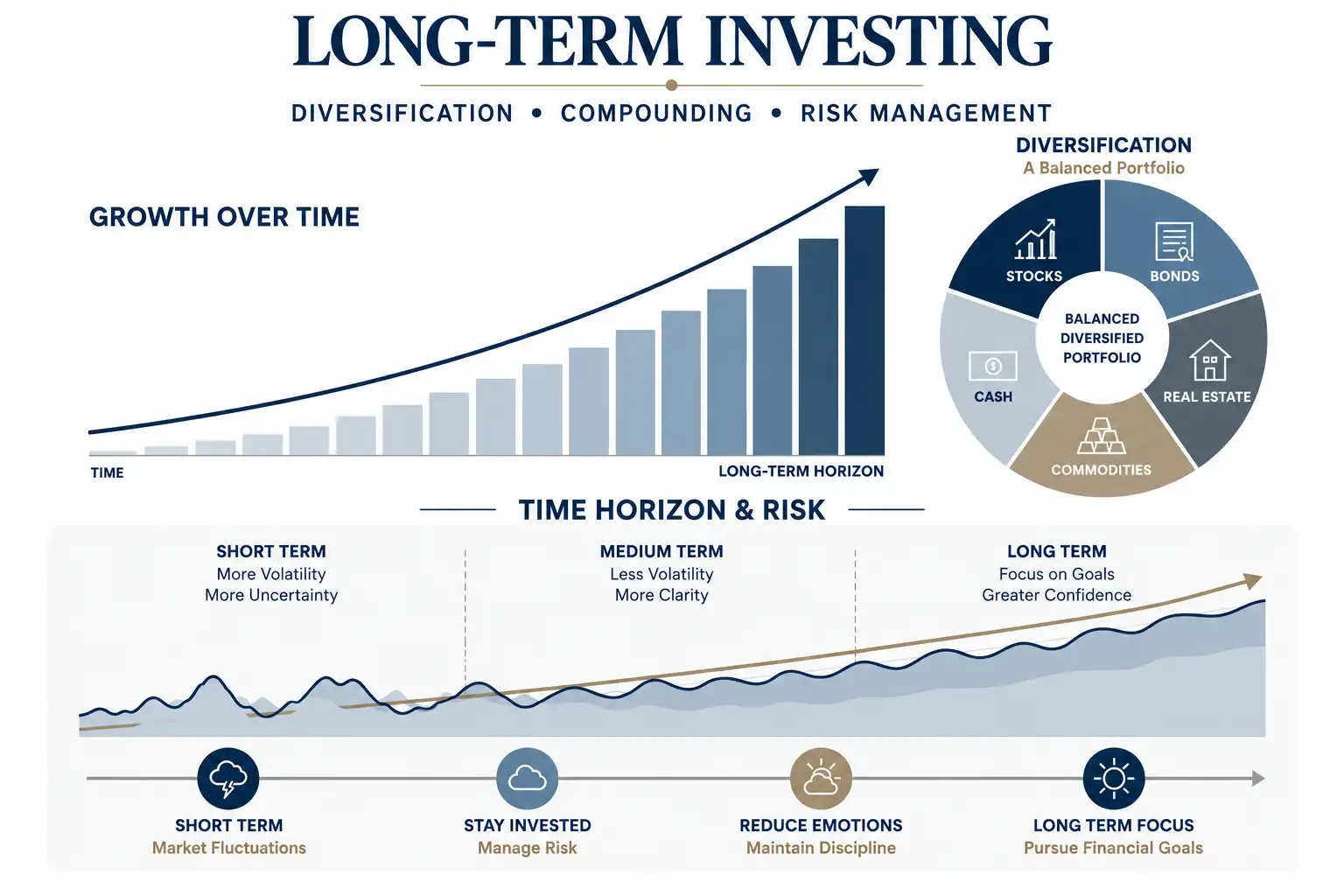
Before deciding where to invest, you need to understand why you are investing, when you will need the funds, how much risk you can tolerate, and what losses you could realistically live with.
Higher potential returns generally come with greater uncertainty.
An investment that can rise dramatically may also fall dramatically. A seemingly stable investment may have different risks that are less obvious.
Risk is therefore not simply the possibility of losing capital.
It can include:
Understanding those risks helps you make more informed decisions.
Concentration risk is when you put all your financial eggs in one basket — be that one company, sector, asset class, or investment idea.
Diversification spreads exposure across different investments so that one disappointing outcome does not necessarily determine your entire financial result.
Diversification does not eliminate risk.
It simply avoids making one particular risk unnecessarily important.
Markets have a peculiar ability to make yesterday's obvious decision look foolish by lunchtime.
Long-term investors therefore need a framework that can survive uncomfortable periods.
If your investment strategy only feels comfortable when markets are rising, it may not be much of a strategy.
A longer time horizon can change how you think about short-term volatility. That does not mean ignoring risk. It means distinguishing between temporary market movement and the reason you invested in the first place.
Usually, when we talk about investing, we mean putting capital into an asset with the hope of making a return over time.
Speculation places greater emphasis on predicting short-term price movements or taking substantial risk in the hope of a particular outcome.
Neither term needs to be used as an insult.
The important thing is knowing which activity you are actually doing.
If you are making a short-term trade, understand that it is different from building a long-term investment portfolio.
A sensible investment approach should consider:
For US investors, this may include understanding the role of accounts such as a 401(k), 403(b), traditional IRA, or Roth IRA when appropriate. These accounts can have different tax rules and eligibility requirements, so the details matter.
The best strategy is not necessarily the most complicated one.
A simple strategy that you understand and can maintain may be more useful than an elaborate approach that causes you to second-guess yourself every few months.
Nobody needs to know what the market will do next Tuesday in order to build a sensible long-term financial plan.
If you find yourself constantly checking market prices, changing investments because of headlines, or chasing whatever has recently performed well, step back.
A financial plan should help you make decisions.
It should not turn every news alert into a crisis.
Financial education, not personalized financial advice: The information in this section is intended for general educational purposes. Investments involve risk, and you should consider your investment objectives, risk tolerance, time horizon, costs, taxes, and other relevant circumstances before making any investment choice.
INCOME
Personal finance discussions often focus heavily on reducing expenses.
There is a good reason for that. Wasteful spending can quietly damage financial progress.
But there is a limit to how far expense reduction can take you.
You can only cut a finite number of expenses. Income, on the other hand, can potentially grow.
That makes earning power an important part of financial planning.
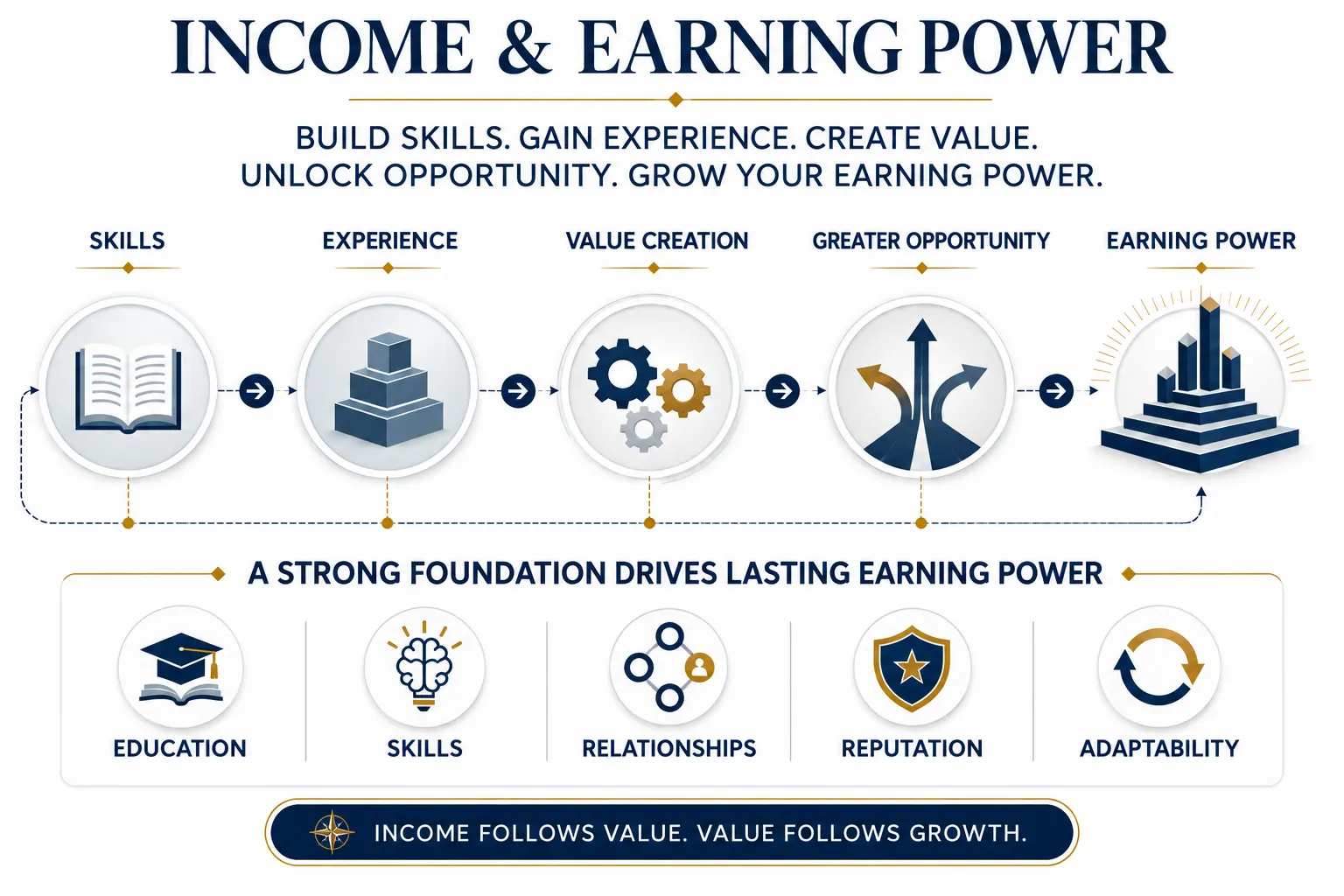
Skills have financial value when they help you solve problems that organizations or customers are willing to pay for.
That might mean building technical skills, getting sharper at communication, learning to actually read data, improving at sales, managing people well, understanding what AI can and can't do, or building specialized knowledge that's specific to your industry.
Not every skill produces an immediate salary increase.
But the right skills can expand the opportunities available to you.
Finances should not be the only reason to choose a career.
It would be a strange way to spend several decades.
Still, income potential is a legitimate part of career planning.
When comparing roles or career paths, consider:
A role that pays slightly more today may not necessarily produce the strongest long-term result.
Similarly, if the change will greatly increase your skills, network, experience, or future prospects, taking a lower income for a while can be a good idea.
For broader career development guidance, explore the Career section of Blueprint To Progress.
Many professionals treat salary negotiation as an uncomfortable conversation they would rather avoid.
It does not have to be aggressive.
Good negotiating begins with an awareness of your worth, the market environment, the duties, and the proof to back up your ask.
The strongest case is usually specific.
Instead of saying, "I work very hard," explain the outcomes you helped create.
Did you increase revenue?
Reduce costs?
Improve a process?
Take responsibility for a larger team?
Deliver an important project?
Build a capability the organization previously lacked?
Those details create a much stronger basis for a compensation conversation.
Additional income can come from freelancing, consulting, education, digital products, small businesses, or other activities.
But "side hustle" should not automatically be treated as a financial solution.
An additional income stream that consumes enormous amounts of time, creates significant risk, or interferes with your primary career may not be worthwhile.
Look at the economics.
How much can realistically be earned?
How much time does it require?
What costs are involved?
What skills does it develop?
Could it become more valuable over time?
A higher income creates opportunity.
It does not automatically create financial security.
If spending rises as quickly as income, the financial position may change surprisingly little.
That is why income works best when connected to the other parts of the system: personal finance, saving, investing, and financial planning.
SAVING
Saving is sometimes treated as the less exciting cousin of investing.
That is a mistake.
Savings perform an important job that long-term investments generally cannot perform as conveniently: they provide accessible funds when you need them.
Unexpected expenses are not really unexpected.
The exact expense is unexpected.
A medical bill, major car repair, home repair, temporary loss of income, urgent travel, or family situation can arrive at inconvenient times.
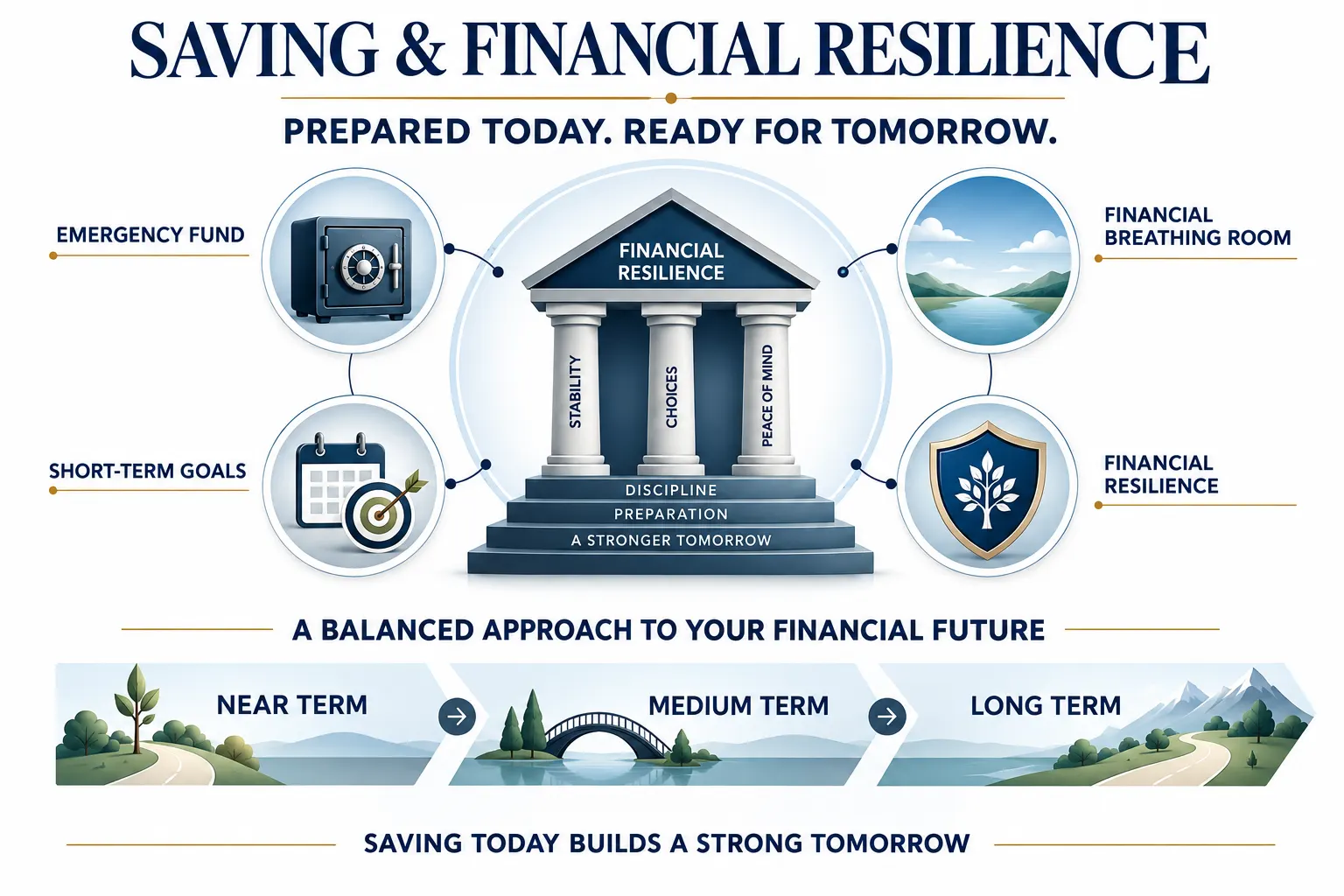
An emergency fund provides a buffer.
Your financial situation, household responsibilities, spending habits, and access to other resources will all influence how much is sufficient for you.
There is no universal number that works perfectly for everyone.
The important principle is having accessible funds set aside for genuine emergencies rather than relying entirely on debt or investments.
A dedicated emergency fund also lines up with what the Consumer Financial Protection Bureau recommends — even a modest amount set aside for the unexpected can give you real financial breathing room.
Funds you need in the near term should generally be treated differently from those intended for a much later goal.
Saving for a vacation next year is different from saving for retirement decades away.
Saving for a home down payment is different from building a long-term investment portfolio.
Separating these goals can make financial decisions clearer.
It also prevents you from investing funds that you may need to access at exactly the wrong time. Investor.gov similarly distinguishes between savings for short-term needs and investing for longer-term goals.
Automation can remove unnecessary decision-making.
If part of your income automatically moves toward savings after you are paid, you do not have to rely on remembering to save whatever happens to be left at the end of the month.
The same principle can apply to regular investing or debt repayment.
Automation is not magic.
It simply makes a good intention easier to turn into a repeated behavior.
Small changes to the environment can matter.
A separate savings account can create psychological distance from everyday spending.
Automatic transfers can reduce temptation.
Setting up specific savings categories can make progress visible.
The aim is not to make spending difficult.
It is to make saving happen without requiring a fresh burst of motivation every month.
Not every financial goal belongs in the market.
If you need the funds soon, market volatility can create a problem.
Imagine saving for a major expense that is six months away and investing the entire amount in an asset whose value can fall significantly. The investment may recover eventually, but that does not help if the funds are needed next month.
Time horizon matters.
Saving and investing are not competing philosophies. They serve different purposes.
FINANCIAL PLANNING
Financial planning connects the pieces.
Instead of asking only, "What should I do with my finances?" you start asking better questions.
What am I trying to achieve?
When will I need the funds?
What could go wrong?
How much flexibility do I have?
What needs to happen first?
That shift can make financial decisions much easier to evaluate.
"Become wealthy" is not a particularly useful financial goal.
A specific goal is easier to work with.
You might want to:
Different goals require different strategies.
A useful financial plan separates goals by time.
Short-term goals can involve funds you may need during the next few years.
Mid-range goals could be larger purchases or life changes.
Some long-term goals may be retirement or financial freedom.
The longer the time horizon, the more opportunities you may have to use investments and compounding.
But a longer horizon does not remove risk.
It simply changes the range of strategies available.
Some expenses are predictable even if the exact amount is not.
You will have some idea of what your annual insurance premiums, vehicle maintenance, education costs, home repairs, vacations, and significant expenditures will be.
Planning for these expenses can prevent them from becoming financial emergencies.
Then there are genuinely unexpected events.
A robust financial plan needs some capacity to absorb uncertainty.
This may involve having an emergency fund, adequate insurance, diversified investments, and enough financial flexibility.
Retirement planning becomes easier when you give long-term saving and investing more time to work.
Starting early does not necessarily mean investing aggressively.
It means giving yourself more time to make regular contributions, adjust your strategy, recover from mistakes, and adapt as circumstances change.
Many US workers have access to employer-sponsored plans such as a 401(k) or 403(b), as well as individual retirement accounts such as a traditional IRA or Roth IRA. The rules and tax treatment are different, so it helps to understand the particular account.
Retirement planning also involves more than investment returns.
Think about:
The earlier you start thinking about these questions, the more options you generally have.
A financial plan is not a contract with your future self.
Your income can change.
Your family circumstances can change.
Your priorities can change.
Markets can change.
You might move, change careers, start a business, have children, receive an inheritance, take on debt, or decide that a goal you once considered important no longer matters.
Reviewing your financial plan periodically allows it to evolve.
A goal without an action is little more than a wish.
If your goal is to build an emergency fund, determine the target and establish a regular contribution.
If your goal is to invest for retirement, decide how contributions will be made and how the strategy will be reviewed.
If your goal is to increase income, identify the skills, career move, negotiation, or business activity that could realistically contribute.
Financial planning becomes useful when it changes behavior.

THE FINANCIAL SYSTEM
The five areas are not separate boxes.
They form a system.
Income determines what enters the system.
Personal finance determines how those funds are managed day to day.
Saving is what gives you resilience — the funds you can actually reach for near-term and medium-term needs.
Investing is about giving long-term capital room to grow, if it's the kind of capital you can afford to leave alone.
Financial planning is the thread that ties both of those back to where you're actually trying to go, and what could realistically get in the way.
Imagine someone receives a salary increase.
The income side has improved.
Instead of immediately increasing lifestyle spending, they might direct part of the increase toward an emergency fund, part toward long-term investing, and part toward something they genuinely value today.
That single decision connects income, personal finance, saving, and investing.
Financial planning provides the reason behind the allocation.
The same system works in reverse.
Suppose someone wants to invest more but has no emergency savings and expensive high-interest debt.
The right answer may not be to search for a better investment.
The more important work may be strengthening the financial foundation first.
This is why financial advice that focuses on one isolated tactic can be misleading.
There is rarely a single financial lever that fixes everything.
The better question is:
Which part of the system is currently limiting your progress?
Sometimes it is spending.
Sometimes it is debt.
Sometimes it is insufficient income.
Sometimes it is a lack of savings.
Sometimes the issue is simply that there is no coherent long-term plan.
Once you identify the constraint, you can focus your effort where it is most likely to matter.

START SMALL
You do not need to rebuild your entire financial life next Monday morning.
Start smaller.
Begin with a basic snapshot.
Understand:
You are not trying to become an accountant.
You are trying to understand the territory before deciding where to go.
Tackle whatever financial problem is causing the most friction right now. That might mean knocking out expensive debt, building up an emergency fund, fixing a cash-flow problem that keeps coming back, or just getting a handle on recurring expenses that have gotten out of control.
Don't try to optimize everything at once — that's a good way to fix nothing at all.
Fix the biggest problem first.
Once the foundation is stronger, start looking at the longer term.
This may include:
The sequence matters.
You are building a system, not collecting financial tricks.
You do not need to solve your entire financial life this weekend. Start with the part causing the most friction.
THE FINANCIAL BLUEPRINT
The Money section of Blueprint To Progress is organized around five connected areas rather than a stream of disconnected financial tips. The pillar explains how the system fits together, while the individual guides take you deeper into specific questions.
Practical guidance for budgeting, cash flow, debt, credit, spending decisions, and everyday financial management.
Clear explanations of investment fundamentals, diversification, risk, long-term investing, portfolio thinking, and common investing mistakes.
Guidance on earning power, career-related income decisions, compensation, negotiation, additional income, and the skills that can improve financial opportunity.
Practical, real-world ways to build up an emergency fund, actually stick to a saving habit, work toward short-term goals, build some financial resilience, and figure out when saving actually makes more sense than investing.
Longer-term guidance on financial objectives, retirement, big life decisions, risk, financial independence, and adjusting your plan as life changes.
Together, these areas create a more complete picture of financial progress. The Money section will continue adding practical guides, while this pillar serves as the central starting point for exploring them.
FINANCIAL RESOURCES
When you want to go deeper, it is worth starting with established sources rather than relying entirely on financial content created for clicks.
Investor.gov provides educational information about investing, investment products, diversification, investment risk, fees, fraud awareness, and investor protection.
Visit U.S. Securities and Exchange CommissionThe CFPB offers consumer information on budgeting, saving, credit, debt, mortgages, and other personal financial issues.
Visit Consumer Financial Protection BureauThe IRS is the authoritative source for federal tax rules and retirement-account information, including 401(k)s and IRAs.
Visit Internal Revenue ServiceFINRA provides investor education and information about investing concepts, financial markets, investment professionals, and common investment risks.
Visit FINRAThe FDIC provides information about deposit insurance and the protection available for qualifying deposits at FDIC-insured banks.
Visit FDICExternal resources should complement your research, not replace personal judgment. Financial products, tax rules, regulations, and individual circumstances can vary considerably.
ACROSS THE BTP SYSTEM
Your finances do not exist separately from the rest of your professional and personal life.
Your career affects your income. Your business decisions can affect your cash flow and financial risk. Your marketing skills can influence earning opportunities. Artificial intelligence may affect the productivity and earning potential of many types of work.
That is why financial progress is often connected to progress in other areas.
FINANCIAL QUESTIONS
There is no single answer for everyone. A useful starting point is understanding your cash flow, controlling expensive debt, maintaining appropriate savings, and knowing what you are trying to achieve financially. Once the framework is in place, it’s easier to tackle investing and longer-term planning.
It really comes down to timing — when you'll actually need the funds, and what they're for. Anything meant for emergencies or near-term goals needs to stay accessible and stable, which generally makes highly volatile investments a poor fit. But if your finances are in decent shape and you're comfortable riding out some risk, that's usually when it makes sense to put capital to work for the long term instead.
Saving and investing are therefore not competing choices. They solve different problems.
There is no universal figure that is right for every household. Think about the stability of your income, regular monthly expenses, dependents, debt, insurance, and other sources of financial support. The aim is to build up some readily available funds that can be used to meet a large financial shock, without having to go into expensive debt or sell long-term investments at an inopportune moment.
Start by figuring out what's actually valuable in your particular market — not in general, in yours. That might mean building a skill that's genuinely in demand, moving into a stronger role, negotiating your pay, shifting career direction entirely, picking up freelance work, starting something of your own, or building another income stream alongside what you're already doing.
The most sustainable approach is usually to build earning power rather than simply chase more ways to work.
Earlier is generally better, but you do not need a perfect financial situation before beginning.
Financial planning can be as simple as identifying your primary goals, recognizing where you are now, building the right savings, and deciding what requires attention first.
A basic plan today can be improved later.
Personal finance is about managing the finances you've got and how they actually get used. Saving is what builds up the accessible reserves you can lean on for emergencies and anything shorter-term. Investing is generally used for capital that can remain invested for longer-term objectives.
Financial planning connects all three to your broader goals.
The important part is not finding a perfect formula.
It is making sure the pieces work together.
BUILD WITH CLARITY
Your financial life does not need to be perfect before you start improving it.
The Money section brings together practical guides covering personal finance, investing, income, saving, and financial planning — with an emphasis on clear explanations, realistic examples, responsible decision-making, and strategies that make sense beyond a spreadsheet. Browse the published guides when you are ready to go deeper.
Less financial noise. More useful guidance. Better financial decisions.