
CAREER PLANNING
How to Set Career Goals: A Practical Step-by-Step Guide
Career goals are useful when they do more than sound impressive on paper. The right goal gives you a direction, helps you decide what to work on, and makes it easier to tell whether you are actually making progress.
The difficult part is usually not coming up with an ambition. Most people can think of something they would like to improve: earn more, move into management, change careers, become better at their work, or find a role that suits them better.
The harder question is what to do next.
This guide shows you how to set career goals that are specific enough to act on without turning your career into a spreadsheet with 47 columns. If you are learning how to set career goals for the first time, the aim is to create enough clarity to act without making your plan unnecessarily complicated. You’ll learn how to choose meaningful goals, make them measurable, break them down into achievable actions, and review them as your situation evolves.

What Are Career Goals?
A career goal is a specific professional outcome you want to work toward. It can relate to your role, skills, responsibilities, income, experience, education, leadership, industry, or the type of work you want to do.
Some career goals are external. You might want to become a manager, move into a particular profession, increase your earning potential, or qualify for a more senior position.
Others are more personal. You may want work that gives you greater flexibility, allows you to use a particular strength, or gives you the opportunity to become highly skilled in one area.
There is no universal definition of a successful career. A goal that looks ambitious to one person may be completely wrong for another. The useful question is not whether your goal sounds impressive. It is whether the goal makes sense for the career you actually want.
Career Goals vs. a Career Development Plan
These two ideas are closely connected, but they are not the same thing.
A career goal describes something you want to achieve. A career development plan explains how you intend to develop the skills, experience, and capabilities needed to move toward that goal.
Think of it this way:
Your career goal is the destination. Your development plan is the route, including the skills to build, experience to gain, actions to take, and milestones to review along the way.
If you want a deeper framework for turning a career ambition into a structured development plan, see our guide on how to create a career development plan.
Why Set Career Goals?
Career goals give your professional decisions a reference point. Without them, it is surprisingly easy to spend months being busy without getting much closer to the kind of career you want.
A useful goal can help you:
- decide which skills are worth developing;
- identify experience you need to gain;
- prioritize professional development opportunities;
- make better decisions about roles and responsibilities;
- measure progress instead of relying on vague feelings;
- have more productive career conversations with your manager; and
- recognize when your current direction no longer makes sense.
Goal setting also gives you something important: a reason to say no. If a new task, course, project, or opportunity does not contribute to anything you currently care about, you can evaluate it more critically instead of automatically adding it to your workload.
How to Set Career Goals: 8 Practical Steps
There is less to effective career goal setting than finding the right formula and more to linking a desired result to realistic actions.
Start With What You Actually Want
Define what success means to you before choosing the goal.
Look at Where You Are Now
Look at where you are now compared to where you want to go.
Choose the Right Type of Goal
Distinguish long-term aspirations from short-term development objectives.
Make the Goal Specific
Replace broad ambitions with something you can actually describe.
Make It Measurable
Decide what evidence will tell you that progress has happened.
Break It Into Actions
Turn the goal into smaller actions you can start taking.
Set a Timeframe
Give the goal a realistic deadline and intermediate milestones.
Define the Evidence
Track results, not merely activities.
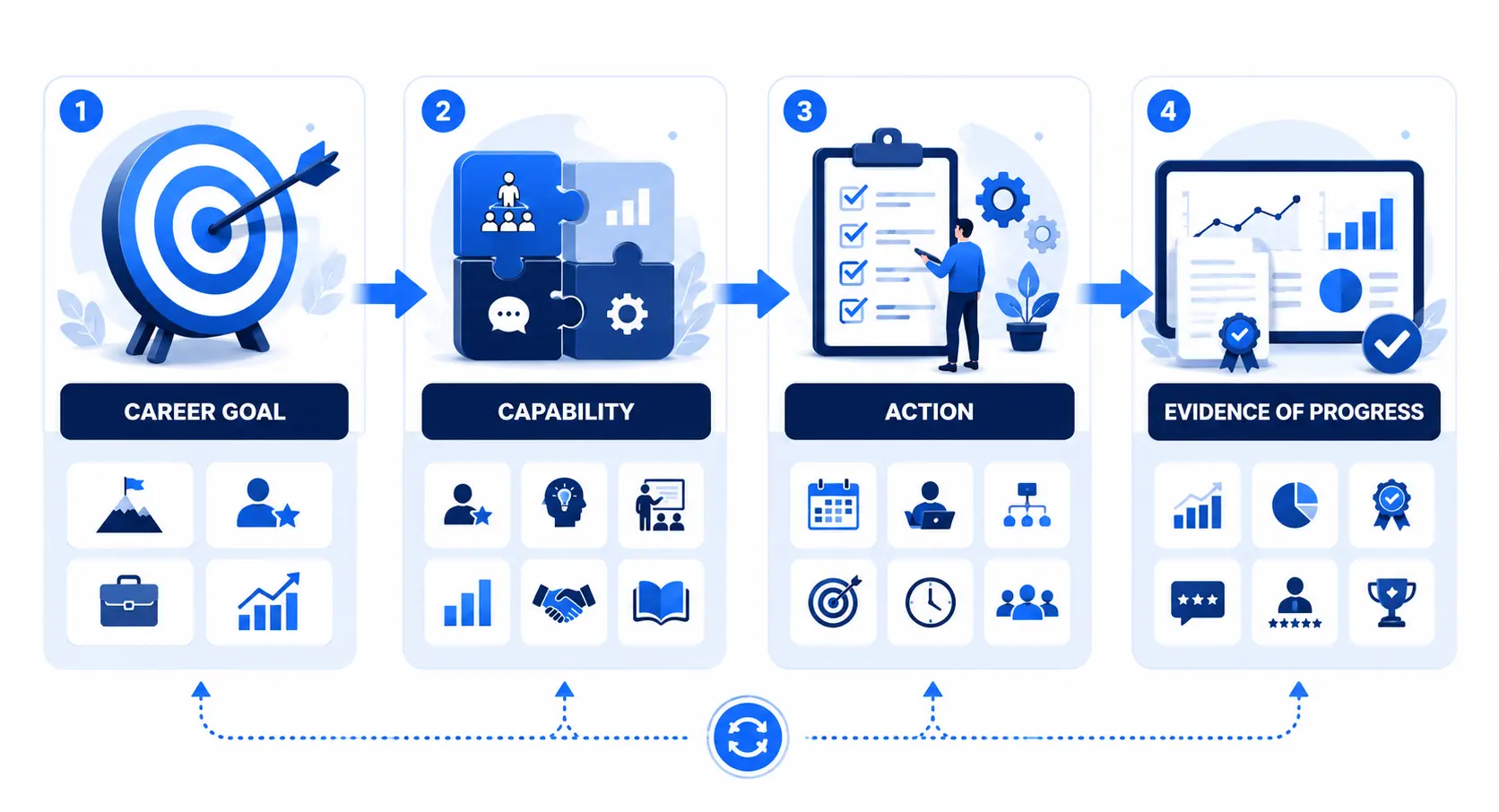
1. Start With What You Actually Want
Before writing a career goal, take a step back. The first part of learning how to set career goals is deciding what you actually want to change, build, or achieve.
It is easy to choose goals because they sound like things successful professionals are supposed to want. A promotion. A management title. A prestigious certification. A bigger salary.
None of those is automatically a bad goal. The problem is choosing one without asking whether it fits your priorities.
Start by asking:
- What kind of work do I want to do more often?
- What responsibilities would I like to have?
- What do I want to become better known for?
- Which parts of my current work give me energy?
- Which parts consistently drain me?
- Do I want more responsibility, more expertise, more flexibility, or a different direction?
- What would make my working life meaningfully better?
Imagine, for example, that you currently work as a marketing coordinator. You could automatically write, "Become a marketing manager."
But perhaps what you actually enjoy is campaign strategy and data analysis, while managing people sounds exhausting. In that case, a senior marketing specialist or marketing analytics role may be a better direction.
A useful test:
If nobody else knew you had achieved the goal, would you still want it? If the answer is no, spend a little more time defining what success means to you.
2. Look at Where You Are Now
A destination is useful only when you know your starting point.
Before committing to a career goal, take an honest inventory of your current position.
Look at:
- your current job or professional situation;
- your strongest skills;
- skills you need to improve;
- experience you already have;
- experience you do not yet have;
- your qualifications and certifications;
- your professional network;
- your current responsibilities; and
- constraints such as time, money, location, or workload.
Suppose your goal is to move into project management. You may already have strong communication and organizational skills, but little formal experience leading projects.
That distinction matters. Your next goal probably should not be "become a project manager." A more useful short-term objective might be to lead a small cross-functional project and document the result.
The gap between where you are and where you want to go is often where the most useful career goals are found.
3. Choose the Right Type of Career Goal
Not every goal needs to operate on the same timeline.
A long-term career goal gives you direction. Shorter-term goals give you something practical to work on now.
| Goal Type | Typical Focus | Example |
|---|---|---|
| Long-term | Career direction | Move into a marketing management role within three years. |
| Medium-term | Capability and experience | Lead two major campaigns within the next 12 months. |
| Short-term | Immediate action | Take ownership of the next campaign planning meeting. |
These goals should support one another. A short-term goal should not feel like a random productivity task; it should contribute to a larger professional direction.
Think in layers: long-term direction → medium-term capability → short-term action.
4. Turn a Broad Ambition Into a Specific Goal
This is where many career goals fall apart.
"Improve my leadership."
"Get better at networking."
"Advance my career."
These statements may describe worthwhile ambitions, but they are too broad to tell you what to do next.
Compare them with:
| Too Broad | More Specific |
|---|---|
| Improve leadership. | Gain experience leading a cross-functional project. |
| Get better at networking. | Build relationships with five professionals in my target field. |
| Advance my career. | Prepare for a move into a senior specialist position. |
| Improve communication. | Deliver four work presentations and request feedback after each. |
Specificity does not mean squeezing every goal into an awkward corporate sentence. It simply means you should be able to explain exactly what you intend to accomplish.
5. Make Your Career Goal Measurable
A measurable goal gives you something to check.
Consider the difference between "become better at presentations" and "deliver four presentations to internal audiences over the next six months and request feedback after each one."
Improve my communication skills.
Deliver at least four presentations to internal audiences over the next six months and request feedback after each one.
The second version gives you an action, a timeframe, and evidence you can review.
Measurement does not always have to mean a number. Depending on the goal, evidence could include:
- a completed project;
- feedback from a manager or client;
- a new responsibility;
- a portfolio of completed work;
- a certification or qualification;
- successful completion of a career transition; or
- demonstrated use of a new skill.
6. Break the Goal Into Actions
A career goal becomes much less intimidating when you stop treating it as one enormous task.
Suppose your long-term goal is:
Become a marketing manager within three years.
You cannot complete that goal in one afternoon. You can, however, identify the capabilities and experiences that would make the transition more realistic.
| Capability | Action | Evidence |
|---|---|---|
| Leadership | Lead a cross-functional project. | Project completed successfully. |
| Analytics | Complete relevant training and apply it to a campaign. | Analysis used in a real project. |
| Strategic planning | Participate in campaign planning. | Documented contribution to planning. |
| People development | Mentor a junior colleague. | Regular mentoring relationship established. |
This is much more useful than simply writing "get promoted" at the top of a notebook and hoping the universe has excellent administrative skills.
7. Give the Goal a Realistic Timeframe
A goal without a timeframe can remain permanently stuck in the category of "something I should probably do."
That does not mean every goal needs an aggressive deadline. It takes longer than you think to build a career. You need the right opportunities, the right business conditions, the right roles and the right experience – and these things often depend on other people.
Instead, use a timeframe that creates momentum without pretending you control everything.
| Period | Possible Milestone |
|---|---|
| First 30 days | Research the target role and identify the major capability gaps. |
| Months 2–3 | Begin targeted training and seek relevant work experience. |
| Months 4–6 | Apply the new skills to a real project. |
| Months 7–9 | Take on greater responsibility and document results. |
| Months 10–12 | Review progress and discuss the next career step. |
Notice that the timeline includes things you can influence rather than promising a promotion by a particular date. That distinction matters.
8. Decide What Evidence Will Show Progress
This is one of the most overlooked parts of career goal setting.
Completing an activity is not necessarily the same as making progress.
"Completed a leadership course" tells you that you completed a course.
"Used the leadership techniques to lead a cross-functional project" provides evidence that you applied what you learned.
When writing your goal, ask:
- What will I actually do?
- What will I produce?
- What will I be able to demonstrate?
- Who can provide useful feedback?
- What result would indicate that I moved forward?
Practical rule: Track evidence of capability, not just evidence of activity.
Short-Term vs. Long-Term Career Goals
You need both.
A long-term goal provides direction, but it can feel distant. A short-term goal gives you something concrete to work on now.
| Long-Term Goal | Supporting Short-Term Goals |
|---|---|
| Move into project management. | Lead a small project, learn project-planning tools, document project results. |
| Become a senior marketing specialist. | Own a campaign, improve analytics skills, build a portfolio of measurable results. |
| Change from marketing to data analytics. | Learn core analytical tools, complete practical projects, speak with people already working in analytics. |
| Move into people management. | Mentor a colleague, lead team initiatives, develop feedback and delegation skills. |
The best short-term goals are not random stepping stones. They should strengthen your position for the larger goal.
Career Goals Examples
If you are unsure where to start, examples can help you see the difference between a general ambition and a usable goal.
Career Advancement
Broad ambition: Get promoted.
More useful goal: Take control of two higher-level projects, document measurable achievements, and meet with my boss within the next 12 months to explore my preparation for a senior position.
Leadership
Broad ambition: Become a better leader.
More useful goal: Lead a cross-functional project involving at least three stakeholders and gather feedback from participants after completion.
Skill Development
Broad ambition: Improve my data skills.
More useful goal: Complete practical analytics training within three months and use the techniques on at least one live work project.
Career Change
Broad ambition: Change careers.
More useful goal: Research three target roles, speak with at least five professionals working in those fields, identify the common skills required, and create a six-month transition plan. For additional role research, the U.S. Bureau of Labor Statistics Occupational Outlook Handbook is a useful reference for comparing occupations, typical work and employment outlooks.
Professional Networking
Broad ambition: Build my network.
More useful goal: Have two meaningful conversations each month with professionals in my target field and maintain notes on useful insights and potential opportunities.
Common Career Goal-Setting Mistakes
Setting too many goals
Ten priorities usually means ten things competing for your attention. Choose a small number of goals that genuinely matter.
Choosing goals because they sound impressive
A management title is not automatically better than specialist expertise. A higher salary is valuable, but it may not compensate for work that you strongly dislike. Your goals should reflect your definition of a better career.
Confusing activity with progress
Watching twelve hours of training videos feels productive. Applying what you learned to a real project is more meaningful evidence.
Ignoring the current situation
Goals should account for your existing skills, experience, workload, resources, and constraints.
Making the deadline unrealistic
A deadline should create momentum, not manufacture panic.
Never reviewing the goal
Careers change. Companies restructure. Industries evolve. Your own priorities can change too. A goal written twelve months ago should not receive automatic authority simply because it is written down.
A Simple Career Goal Worksheet
Use the following framework to turn an idea into a practical career goal.
| Question | Your Answer |
|---|---|
| What do I want to achieve? | |
| Why does this matter to me? | |
| Where am I now? | |
| What skills or experience do I need? | |
| What is the first action I can take? | |
| What evidence will show progress? | |
| What is my target timeframe? | |
| When will I review the goal? |
Goal-writing template:
I want to [specific outcome] by [timeframe] by taking [key actions], and I will measure progress through [evidence].

How to Review and Adjust Your Career Goals
Setting a career goal is not a contract with your future self. Knowing how to set career goals also means knowing when a goal needs to be reviewed or adjusted.
Review your goals regularly and ask whether the original assumption still makes sense.
During a review, consider:
- What have I accomplished?
- What evidence of progress do I have?
- What is taking longer than expected?
- What have I learned since setting the goal?
- Do I still want the outcome?
- Have circumstances changed?
- What should I stop doing?
- What is the next useful action?
A goal may need to be continued, adjusted, replaced, or abandoned. Changing a goal is not necessarily failure. Sometimes it is evidence that you have learned something important.
For example, someone who starts researching a move into management may discover that they enjoy becoming a senior specialist much more. That is not a failed career plan. It is better information.
How Career Goals Fit Into a Bigger Career Plan
Career goals work best when they connect with the rest of your career planning.
That connection prevents career planning from becoming a collection of disconnected ambitions.
If your goal is to move into management, for example, your development actions might include leading projects, mentoring colleagues, improving delegation, and developing stronger communication skills. Those actions should produce evidence that you are becoming capable of the role you want.
That is where career goal setting becomes genuinely useful: it changes what you do now, not just what you write down for later.
Final Takeaway
Learning how to set career goals is less about predicting exactly where your career will end up and more about creating a useful direction for the next stage.
Start with what you actually want. Assess where you are. Choose a goal that fits your broader direction, make it specific, decide how progress will be measured, and turn it into actions you can realistically take.
Then review it.
Your career will almost certainly change as you gain experience. Your goals can change with it.
The simplest version is this:
Know where you want to move, understand what is missing, choose the next useful step, and keep checking whether that step is taking you in the right direction.
Frequently Asked Questions About Career Goals
What is a good career goal?
A good career goal is specific enough to understand, realistic enough to pursue, meaningful to you, and measurable enough that you can recognize progress. It should also connect to the broader direction you want your career to take.
How many career goals should I have?
There is no fixed number, but keeping your active goals limited can make them easier to manage. One major career goal supported by a few smaller development goals is often more practical than maintaining a long list of competing priorities.
What are examples of short-term career goals?
Examples include completing relevant training, leading a project, developing a specific skill, finding a mentor, improving presentation skills, expanding your professional network, or taking on a new responsibility.
What are examples of long-term career goals?
Long-term goals might include moving into leadership, becoming a senior specialist, changing professions, building expertise in a particular field, or progressing toward a specific type of role.
Should career goals be SMART?
The SMART framework can be useful because it encourages specificity, measurement, realistic expectations, relevance, and timeframes. However, the framework is a tool rather than a requirement. The more important question is whether the goal gives you enough clarity to act and assess progress.
How often should I review my career goals?
Review shorter-term goals regularly and reassess larger career goals as circumstances change. A monthly progress check can be useful for active goals, while a broader career review can help you decide whether your longer-term direction still makes sense.
BLUEPRINT TO PROGRESS CAREER HUB
Turn Career Goals Into a Practical Career Plan
Setting the goal is only the beginning. Explore more Blueprint To Progress career guides covering career planning, development, skills, employment, salary and career advancement.
Explore Career Guides