
What Is Business Strategy? A Practical Guide to Making Better Strategic Choices
Business strategy is the set of choices a company makes about where it will compete, how it will create value, and what it will prioritize to reach its goals. A company can have a good product, talented employees and plenty of ideas yet still struggle because its decisions don't point in the same direction. This guide explains what business strategy actually means, how it differs from related concepts, the major components of a strategy, how to develop one, and how to turn strategic choices into practical action — without the jargon that usually comes attached to the topic.

In This Guide
What Is Business Strategy?
A Simple Definition
Strip away the consulting language, and business strategy is really about four things: where you're headed, who you're serving, what you'll do differently, and what you're willing to give up to get there. It's the thread that connects a company's long-term direction to the decisions it makes on an ordinary Tuesday — which customer to prioritize, which product to build next, which market to skip entirely. A sound business strategy tells everyone in the building, from the founder to the newest hire, what the company is actually trying to become, and it forces some honesty about which resources — money, people, time, attention — go where.
What Business Strategy Is Not
Here's where a lot of companies get tangled up. A mission statement is not a business strategy. Neither is a list of goals, an annual budget, or a collection of promising ideas scribbled on a whiteboard after an offsite. And a sixty-slide PowerPoint deck, however polished, is not a strategy either — it's a description of one, assuming there's actually a strategy hiding somewhere inside it. A useful way to think about it: a real business strategy is not a wish list wearing a corporate font. Wishing for growth, market leadership, or "being the best" isn't a plan; it's a hope with a deadline attached.
Strategy Requires Choices
The part that trips up even experienced leaders is that strategy is defined as much by what a company refuses to do as by what it pursues. Saying yes to everything is the same as having no business strategy at all, because resources are finite and attention is even more limited. Choosing not to chase a certain customer segment, not to enter a tempting new market, or not to build a feature everyone's asking for — these decisions are strategy in action. That idea of deliberate exclusion sets up the next question naturally: how does a company decide what to compete for, and what to walk away from?
Why Business Strategy Matters
A company without a coherent business strategy will tend to stray. Teams pursue whatever feels urgent that week, departments quietly optimize for their own goals, and leadership spends more time reacting to competitors than shaping its own path. A working strategy solves several problems at once: it sets direction so people aren't guessing, it prioritizes resources so budget and headcount go where they'll matter most, and it coordinates teams so marketing, product and sales aren't quietly working against each other.
Strategy also forces trade-offs into the open instead of letting them happen by accident. It gives a company a framework for responding to competitors without panicking every time a rival launches something new, and it builds the kind of sustainable value that survives beyond a single good product cycle. Perhaps most practically, it cuts down on scattered decision-making — the day-to-day whiplash of chasing five different directions at once.
Picture a hypothetical coffee company trying to compete against Starbucks, a dozen independent specialty cafés, and the gas station down the street selling coffee for a dollar. Trying to out-Starbucks Starbucks while also beating cafés on quality and convenience stores on price is a recipe for mediocrity on all three fronts. A company with a real business strategy might instead choose a narrower, sharper combination: premium coffee, fast pickup, and a handful of well-chosen neighborhood locations. That's not a settling for less — it's a deliberate bet on where the company can actually win.
The Key Elements of a Business Strategy
A complete business strategy is built from several interlocking pieces. Leave one out, and the rest tend to wobble.
1. Strategic Direction
This is the destination — where the business wants to be in three, five, or ten years, expressed clearly enough that someone could actually recognize when it's been reached.
2. Target Customer
Not "everyone with money." A strong strategy identifies specifically who the company is trying to serve, including the customers it's willing to lose to a competitor.
3. Value Proposition
Why should a customer pick this business over the alternative sitting one tab away in their browser? This is the honest answer to that question, not the marketing version.
4. Market Position
How the company positions itself against competitors – on price, quality, convenience, service, or another combination that is hard to imitate fast.
5. Competitive Advantage
The specific thing the company does better, faster, or differently than everyone else chasing the same customer. If nothing comes to mind here, that's worth sitting with.
6. Strategic Priorities
The handful of initiatives that deserve outsized attention this year. Not fifteen priorities — a real list is short enough to remember without checking a document.
7. Resource Allocation
Strategy without a budget behind it is a suggestion, not a plan. This element connects strategic priorities to actual money, people, technology and management time.
8. Measures of Success
The indicators that tell leadership if the business strategy is succeeding, rather than vanity metrics that seem good in a meeting but don’t take the business forward.

Taken together, these eight elements show that a business strategy isn't a document filed away and forgotten — it's closer to a living system, one that keeps feeding what it learns back into how the company serves its customers.
Business Strategy vs. Strategic Planning
These two terms get used interchangeably so often that it's worth drawing a clean line between them.
| Business Strategy | Strategic Planning |
|---|---|
| Defines major choices | Organizes how choices will be implemented |
| Focuses on direction and positioning | Focuses on objectives, initiatives and timelines |
| Determines priorities and trade-offs | Translates priorities into plans |
| Addresses where and how to compete | Addresses what needs to happen and when |
| More choice-oriented | More execution-oriented |
Business strategy answers the "where and why." Strategic planning answers the "what, who, and by when." Neither one works well without the other — a brilliant strategy with no plan behind it stays theoretical, and a detailed plan with no strategy behind it just organizes activity efficiently in the wrong direction. Companies that treat these as competing exercises usually end up with a strategy nobody executes or a plan nobody can explain the purpose of.
How to Develop a Business Strategy
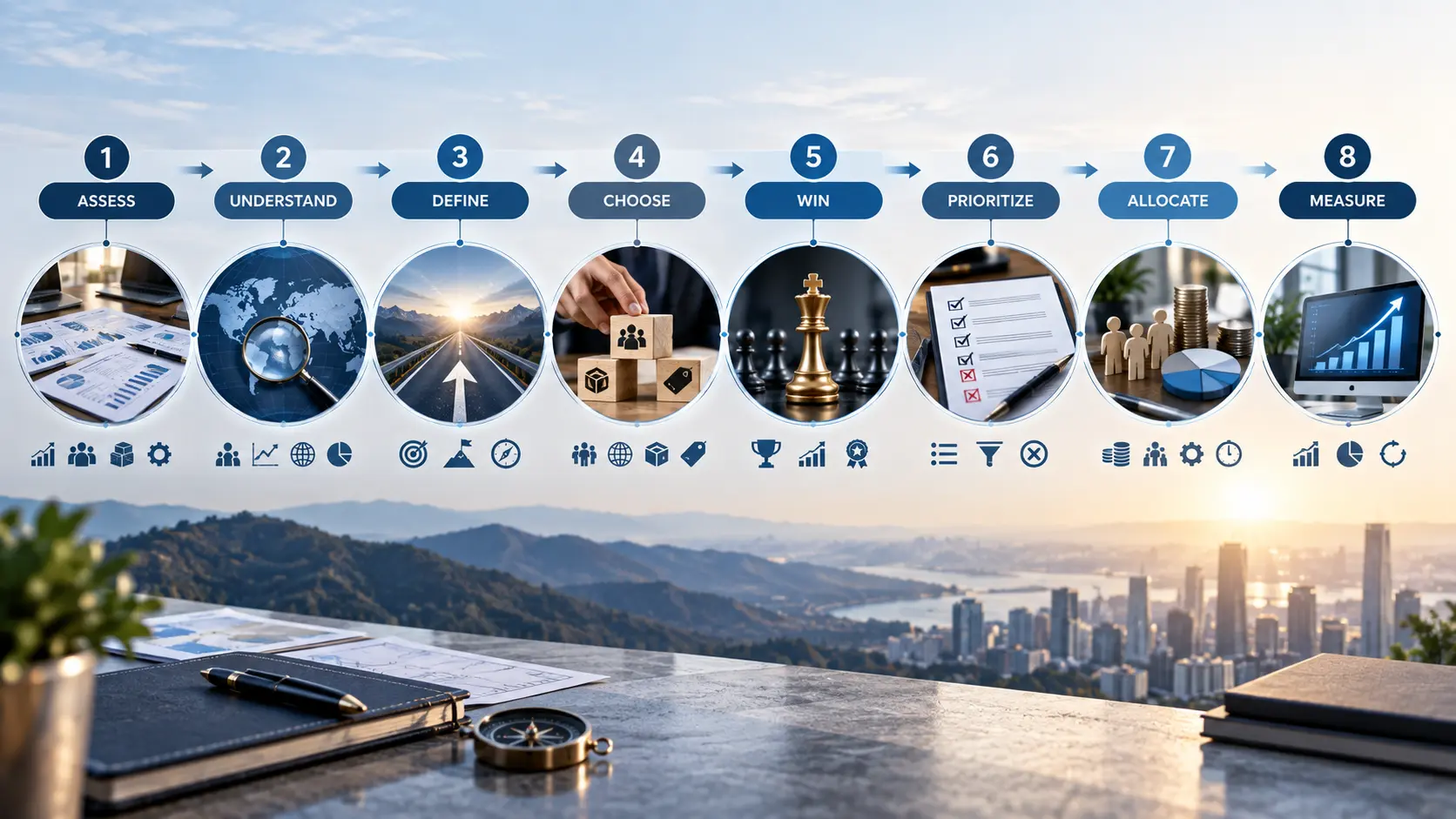
Step 1: Assess the Current Business
Take an honest look at income sources, customers, products and services, internal capabilities, cost structure and any operational restrictions holding things back. This step is often skipped, mainly because it’s less thrilling than getting directly to ideas.
Step 2: Understand the Market
Study customer needs, market trends, competitors, substitute products, emerging technology, and any regulatory factors in play. U.S. Census Bureau business data can also help put local and industry conditions in context, including information on business characteristics and geographic patterns. That matters because a strategy built for one market may not fit another.
Step 3: Define the Strategic Goal
Forget fuzzy objectives of the kind "become a market leader" - that term might mean anything and consequently signifies nothing operationally. A useful strategic goal specifies what the company wants to achieve, for whom, and ideally by when.
Step 4: Choose Where to Compete
Decide on the customer segment, geography, product category, price position and distribution model the business will focus on. This is where the earlier idea of deliberate exclusion becomes concrete.
Step 5: Decide How to Win
Answer one blunt question: why would a customer choose this business instead of an alternative? If the honest answer is "they probably wouldn't," that's useful information — better to know now than after the launch.
Step 6: Set Strategic Priorities
Pick a short list. Turning every appealing initiative into a "priority" defeats the purpose of prioritizing at all.
Step 7: Allocate Resources
Connect the chosen priorities to actual budget, people, technology, time and — often the scarcest resource of all — management attention.
Step 8: Establish Measures
Define indicators that genuinely reflect whether the business strategy is working, not just whether the team stayed busy.
Before locking in these choices, it helps to ground them in real customer and competitor evidence rather than internal opinion. A structured market research process can supply that evidence, and a clear-eyed competitive analysis fills in the picture of who else is chasing the same customer.
A Practical Business Strategy Framework
Long strategy documents are easy to write and hard to use. A simpler approach: answer six questions honestly, in order, and the outline of a workable business strategy starts to take shape on its own.
The 6-Question Strategy Framework
- Where are we now? — Current position, honestly assessed.
- Where do we want to go? — The desired future state.
- Who are we serving? — The specific target customer.
- Where will we compete? — The market and competitive arena.
- How will we create value? — Differentiation and the value proposition.
- What choices will we make to get there? — Priorities, trade-offs and resource allocation.
None of these six questions is complicated on its own. The difficulty is answering all six with the same level of clarity and sticking with the answers when a shinier opportunity shows up mid-quarter.
Business Strategy Examples
Abstract definitions only go so far. Here's how a business strategy plays out in three different, fictional but realistic U.S. business settings.
Example 1 — Local Service Business
A regional home-services company — plumbing, HVAC, the unglamorous stuff that keeps houses running — decides against competing purely on price. Instead, it positions itself around premium same-day service for customers who'll pay more to avoid waiting three days for a technician. That single choice ripples outward: pricing shifts upward, staffing has to support faster response times, and marketing stops chasing bargain-hunters and starts targeting homeowners who value speed.
Example 2 — SaaS Company
A small software company selling project-management tools could try to serve every industry at once. Instead, it narrows its focus to a single vertical — say, architecture firms — and builds features specifically for that world. Product development slows down in breadth but speeds up in depth, marketing gets sharper because the messaging speaks to one audience, and customer support becomes genuinely expert rather than generalist.
Example 3 — E-commerce Business
An online retailer selling home goods resists the temptation to expand into dozens of unrelated categories after an early sales bump. It picks a differentiated niche — sustainably sourced kitchenware, for instance — and stays there. That business strategy shapes which products get added, how the brand talks to customers, what content gets produced, and which channels are worth the acquisition spend.

Common Business Strategy Mistakes
Trying to Serve Everyone
The fastest way to stand for nothing is to try to be everything to everybody.
Confusing Goals With Strategy
"Grow revenue 20%" is a goal. It says nothing about how, and a team can hold six planning meetings, generate 47 action items, and still not have a coherent strategy behind that number.
Creating Too Many Priorities
A list of fourteen "top priorities" is, functionally, a list of zero priorities.
Ignoring Competitors
Strategy built in a vacuum tends to collide with reality the moment a competitor moves.
Building Strategy Without Resource Allocation
Choices without a budget attached rarely survive contact with the next quarterly review.
Treating Strategy as a One-Time Exercise
A strategy document from three years ago, untouched since, is closer to a historical artifact than a working tool.
Measuring Activity Instead of Results
Busy teams and productive teams are not the same thing, though they can look identical from the outside.
How to Put Business Strategy Into Action
A business strategy that stays in a document does nothing. Turning it into results generally follows a predictable path:
Translate strategic choices into specific initiatives → assign clear ownership → establish measurable objectives for each one → allocate the resources decided on earlier → communicate priorities so the whole team understands the "why," not just the "what" → review progress on a regular cadence → adjust when the evidence says the original assumptions were off.

Research discussed by Harvard Business Review highlights the importance of translating strategy into execution, including making the strategy understandable and connecting it to objectives and action. In practical terms, a well-designed strategy still needs a clear path from decisions to day-to-day work.
How Often Should a Business Strategy Be Reviewed?
There's no single universal timetable here, whatever a productivity blog might claim. Review frequency depends on industry volatility, business size, growth stage, competitive intensity, regulatory shifts, technology changes, and any major swings in performance. A fast-moving software category might warrant a strategic check-in every few months; a stable regional service business might only need a deeper review annually.
It also helps to separate two different activities that get lumped together: a strategic review, which asks whether the underlying choices still make sense, and routine operational monitoring, which tracks whether the plan is on schedule. A company doesn't necessarily need to rewrite its business strategy every quarter simply because the calendar flipped a page — but it should be honest enough to revisit the strategy when the market, the competition, or the evidence clearly shifts underneath it.
Frequently Asked Questions About Business Strategy
What is business strategy in simple terms?
It’s the series of intentional decisions a firm makes about where to compete, how to create customer value, and what to do with limited resources.
Why is business strategy important?
Because it tells a company where it's headed. It keeps money and people pointed at what counts, gets teams pulling in the same direction, and cuts down on the scattershot, reactive decisions that quietly stall growth.
What are the main elements of a business strategy?
Strategic direction, target customer, value proposition, market position, competitive advantage, strategic priorities, resource allocation, and measures of success.
What is the difference between business strategy and strategic planning?
Business strategy defines the major choices and direction; strategic planning translates those choices into specific initiatives, timelines and responsibilities.
How do small businesses create a business strategy?
The same principles apply at any size — assess the current business, understand the market, choose a specific customer and position, and allocate whatever resources are available toward a short list of priorities.
Can business strategy change over time?
Yes, and normally it should. Markets change, competitors change, a plan that was reasonable two years ago may need to be revised in light of fresh data.
What is an example of a business strategy?
A local service company decides it won't try to be the cheapest, and competes on being fast and easy to deal with instead; a SaaS company that stops chasing everyone and puts all its effort into serving one industry.
How do you know whether a business strategy is working?
By tracking the metrics of success defined during the strategy development process (not just general busyness, but whether the priorities chosen are truly delivering the results that were anticipated).
Final Takeaway
At its core, business strategy is about making deliberate choices. No company can chase every customer, every market, every product concept and every project at the same time – not without spreading itself so thin that nothing gets done very well. A clear business strategy creates a framework for deciding what deserves attention, and just as importantly, what doesn't.
If there's one place to start, it's with six honest questions: Where are we now? Where do we want to go? Who are we serving? Where will we compete? How will we create value? And what choices will actually get us there? Answer those with some discipline, and the rest of the strategy tends to follow.
Take the Next Step
A business strategy becomes useful when it helps turn broad ambitions into clear choices, priorities, and actions. If you are working through your own business direction, use the framework in this guide to identify where you are now, where you want to go, who you are serving, and which choices deserve your attention.
Ready to turn strategy into action? Continue exploring the Blueprint To Progress Business resources to build a clearer plan for your business, strengthen your decision-making, and connect strategy with practical execution.
Explore the Business Pillar