What Are AI Hallucinations?
In plain terms, an AI hallucination is a case where an AI system generates information that is inaccurate, unsupported, or flat-out invented — but presents it with the same fluency and confidence as a correct answer. The output can include a fabricated source, an invented person or event, a miscalculation, a distorted summary, or a quote nobody ever said. Sometimes the hallucinated information is outdated information presented as current fact. None of this comes with a warning label.
It helps to separate a hallucination from two things it often gets confused with: a simple mistake and an incomplete answer. An ordinary error is simply an incorrect output; it may be corrected when you provide better context, point out the problem, or ask the system to try again. An incomplete answer is different again: the AI acknowledges that it lacks enough information or otherwise makes its limits clear. A hallucination is a false or unsupported claim presented as though it were a factual answer, often without any meaningful indication of uncertainty.
NIST and some AI researchers also use the term “confabulation” for this kind of confidently presented erroneous or false content. “AI hallucination” remains the more familiar term, particularly in everyday discussions of generative AI.
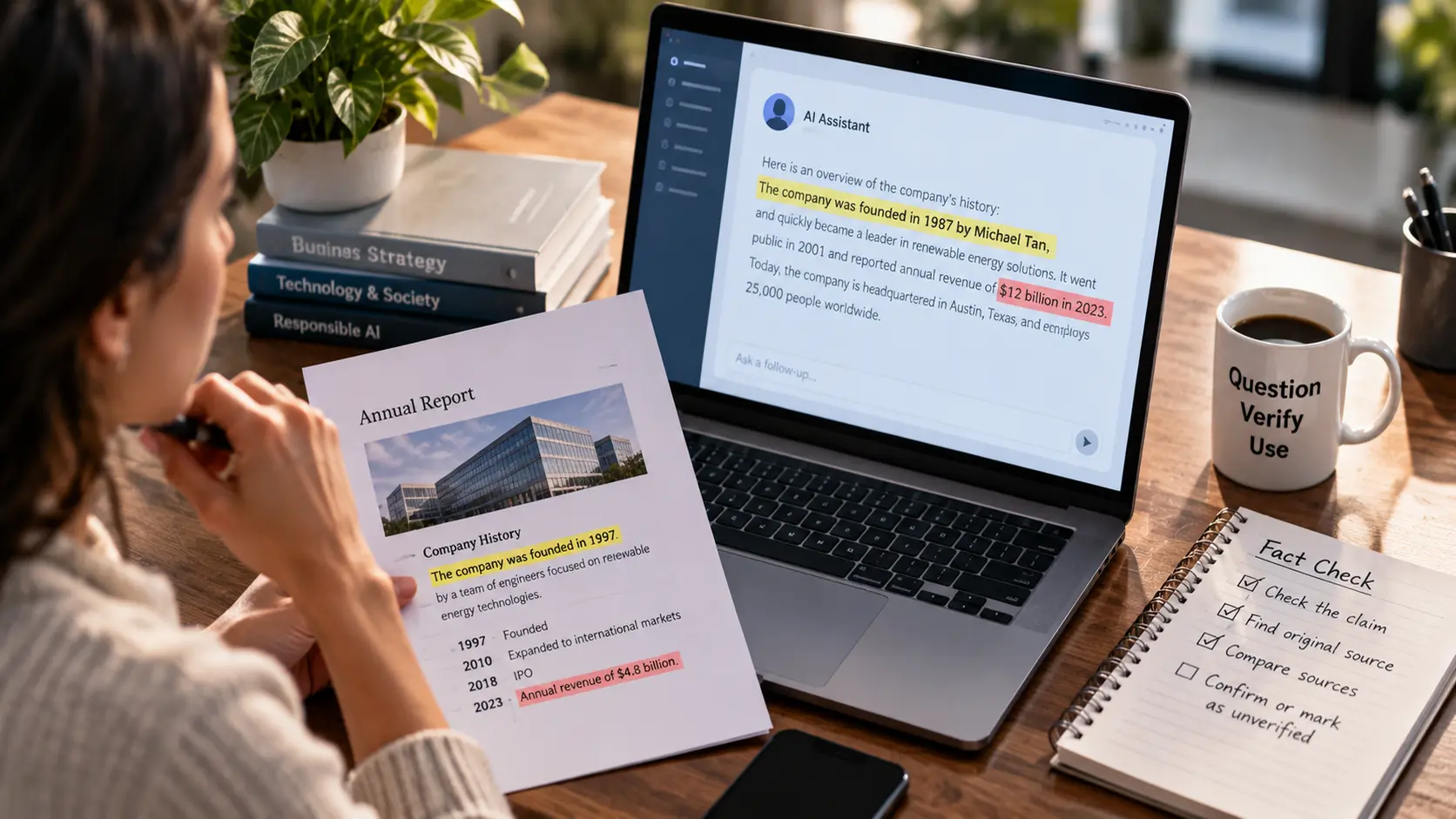
You don't need a bizarre example to understand this. Picture asking an AI assistant to summarize a real company's history. For three paragraphs it might get the founding date, the funding rounds, and the product lineup exactly right — then, in paragraph four, it names a chief financial officer who never worked there. Nothing about the sentence looks out of place. The tone doesn't shift. That's a far more realistic version of an AI hallucination than the AI-inventing-a-whole-fake-planet examples you tend to see in headlines, and it's exactly why hallucinated information is so easy to miss: it's usually surrounded by several correct facts that lend it credibility by association.
This is also why fabricated information from AI tends to slip past readers who are skimming rather than verifying. The inaccurate detail rarely announces itself. It just sits there, dressed the same as everything true around it, waiting for someone to either catch it or repeat it.
Why Do AI Hallucinations Happen?
AI Predicts and Generates; It Doesn't Automatically Know What Is True
A standalone large language model does not automatically look up and verify every claim against the outside world. It generates text by predicting likely next tokens based on patterns learned from its training and, depending on the system, any additional information or tools provided in the current interaction.
Most of the time, likely and actually true line up well enough for the answer to be useful. But probability isn't the same thing as verification. The model is generating a response from learned patterns and available context, not consulting a built-in fact-checker for every sentence. Every so often, a fluent continuation is also the wrong one.
This distinction is central to understanding AI hallucinations. A response can be grammatically perfect, logically structured, and highly specific without having been independently checked for accuracy.
Training Data Has Gaps and Imperfections
No training dataset is a perfect, current, contradiction-free encyclopedia. It can contain outdated pages, conflicting accounts of the same event, and long stretches where a topic is barely covered at all.
A well-known public figure's biography might appear thousands of times across the web, giving a model plenty of consistent information to draw from. A mid-sized regional company's leadership history might appear once, nowhere, or across two sources that disagree. When a question touches one of those thin or contradictory areas, or when the question itself is genuinely ambiguous, the model still has to produce a response — and that is where hallucinated information can emerge.
AI Can Guess When It Should Say “I Don't Know”
Here’s the surprising thing for most people: AI systems can be trained and evaluated in ways that favor answering over admitting uncertainty. According to the research on hallucinations from OpenAI, hallucinations are plausible but untrue assertions and typical training and assessment procedures can incentivize models to guess rather than reliably signal ambiguity.
It's a bit like a multiple-choice test with no penalty for wrong answers — you'd be foolish not to guess. In some circumstances, the model faces a similar incentive: producing an answer can be rewarded more consistently than admitting that the information is uncertain or unavailable.
Retrieval and Context Can Help, But They Are Not Magic
Giving an AI system access to web search, uploaded documents, or a retrieval-augmented generation setup can reduce some hallucination risks by giving the model relevant source material to work from rather than relying entirely on learned patterns. But retrieval is not a guarantee.
A model can still misunderstand the source it was given, combine information from different documents incorrectly, overlook an important qualification, or cite a real page that does not actually support the sentence beside it. Retrieved information also has to be interpreted correctly.
Better source material can improve the odds of getting a reliable answer, but it does not remove the need for verification.

For a deeper look at the mechanics behind this, our guide to how generative AI works explains how these systems generate text in the first place, and our breakdown of how large language models work covers why a model can produce a grammatically perfect, entirely plausible sentence that happens to be false.
What Do AI Hallucinations Look Like?
AI hallucinations aren't always dramatic. Most of the time they're small enough to walk right past you.
Made-up facts. An AI tells you a company "was founded in 1987" when the real date is 1997. Close enough to sound plausible, wrong enough to matter if you're writing a company history.
Fake citations and sources. Ask for a study to back up a claim, and the AI hands you an author, a title, and a journal — all formatted correctly, none of it real. This is one of the more dangerous forms of AI-generated misinformation because a fabricated citation can look completely legitimate until you actually search for it.
Invented quotes. This is especially risky when the quote is attributed to a CEO, a politician, an author, a researcher, or a historical figure — someone whose actual words carry weight, and whose fabricated words could cause real reputational damage if published.
Wrong dates and numbers. Product launch dates, revenue figures, population statistics, and historical dates are frequent targets. A single digit can be enough to turn a useful answer into a misleading one.
False confidence. Maybe the clearest tell of all. A hallucinated answer may not say "I'm not sure." Instead, it can use authoritative language such as “According to…” even when the cited source doesn't exist or doesn't support the claim. That phrasing can borrow the authority of a true source without really establishing that the source exists or supports the assertion.
Why Are AI Hallucinations So Convincing?
If AI hallucinations were sloppy or garbled, nobody would fall for them. They're not. A few things are working against you at once.
Fluent writing reads as competent. Humans are wired to associate polished, grammatically clean prose with someone who knows what they're talking about. AI writes cleanly by default, correct or not, so that instinct can misfire.
Specific details feel more credible than vague ones. A wrong answer that includes a date, a name, a number, and a citation tends to feel more trustworthy than a vague, hedged one — even though specificity has nothing to do with accuracy.
Confident tone gets mistaken for verified fact. This is worth saying plainly, because it's the crux of the whole problem: confidence is a writing characteristic, not a fact-checking mechanism. An AI system's tone does not guarantee that the underlying claim has been checked.
Confirmation bias plays a role too. People are more likely to wave through an AI answer that already matches what they expected to hear, and more likely to interrogate one that doesn't.
And automation bias closes the loop. If a computer produced it, there's a quiet assumption that it must have been checked by something, somewhere. Usually, that assumption is doing more work than the evidence.
How Can You Detect AI Hallucinations?
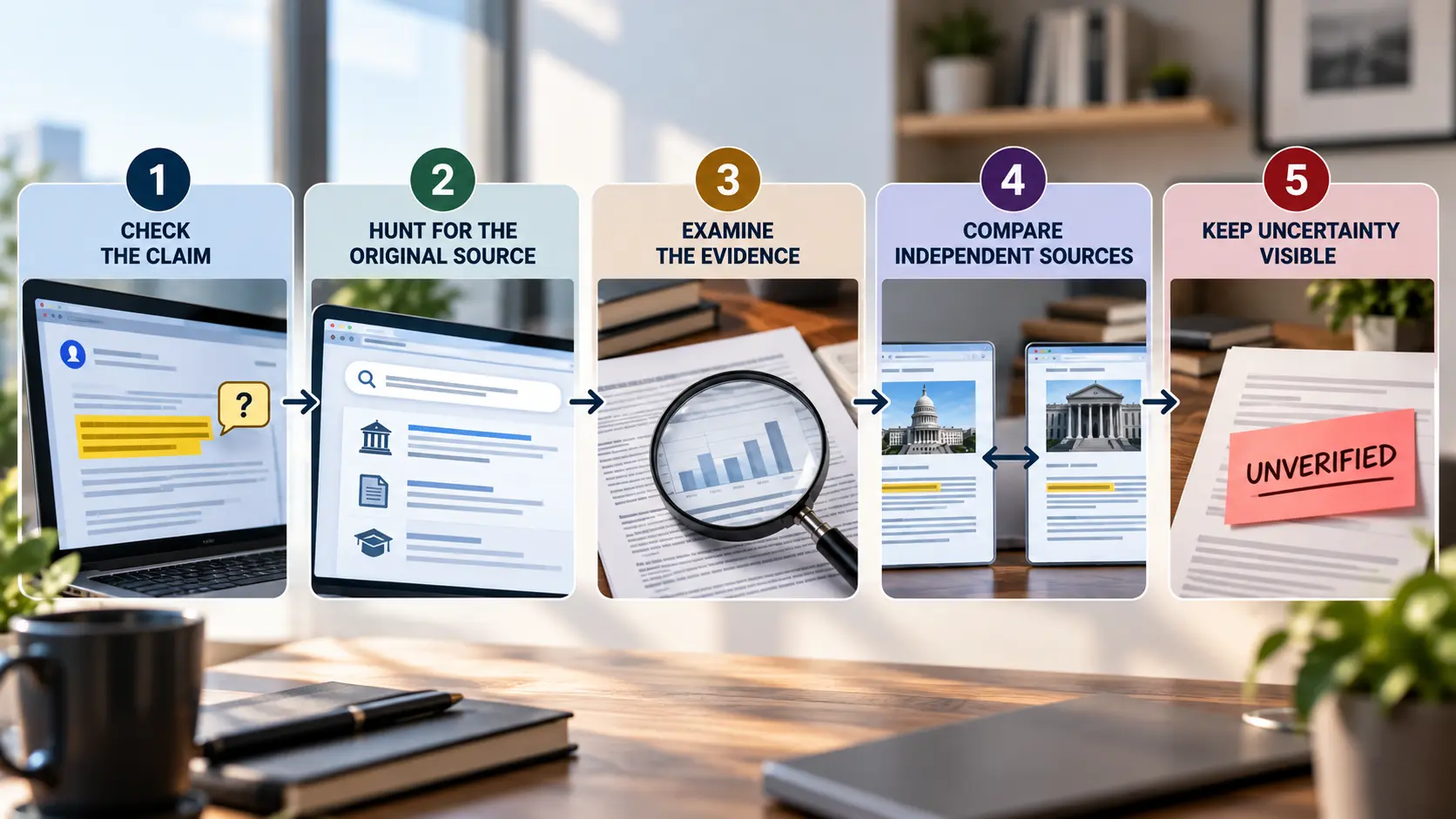
Rather than trying to "just feel out" whether an answer is trustworthy, it helps to run through the same steps every time. Call it the CHECK method.
C — Check the claim. Pin down exactly what the AI is asserting. Vague impressions are hard to verify; a specific claim (“the merger closed in March 2022”) is easy to test.
H — Hunt for the original source. Go looking for government records, company filings, academic papers, official organizational websites, or other primary documentation — not another AI summary of the topic.
E — Examine the evidence. If a source is cited, open it. Does it actually say what the AI claims it says? Citations can be misattributed, incomplete, or fabricated.
C — Compare independent sources. Don't ask a second AI whether the first one was right. That's still another AI-generated answer, not independently verified. Cross-check important claims against sources that were compiled independently of the model.
K — Keep uncertainty visible. If something genuinely can't be verified, label it as unverified rather than letting it slide into the final draft as settled fact.
How Can You Reduce AI Hallucinations?
You can't make hallucinated information disappear entirely, but you can reduce how often it shows up and, just as importantly, reduce the damage it can cause when it does.
Give the AI clear context. A vague prompt invites a broad, pattern-matched answer. The more precisely you frame the question — audience, timeframe, scope, and source requirements — the less room there is for the model to fill gaps with an unsupported guess.
Ask for sources when sources matter. This helps, but treat it as a starting point, not a finish line: a citation is not proof. The source itself still has to be checked, because the citation can be wrong or fabricated.
Provide the source material yourself. Instead of asking “What does this contract say?”, supply the actual contract and ask the AI to analyze it. That gives the system specific material to work from instead of asking it to reconstruct the answer from memory or learned patterns.
Ask the AI to separate facts from inference. Instead of mixing all the data together in one confident paragraph, the line between evidence and analysis is clarified with one simple instruction: “distinguish between what the source directly supports and your own interpretation.”
Ask it to flag uncertainty explicitly. Something like, "If this can't be verified from the material I gave you, say so rather than guessing," makes uncertainty part of the requested output rather than something the model has to decide on its own.
Break complex questions into smaller tasks. Long, multi-part questions about research, legal documents, financial data, or technical specifications give a model more opportunities to make an unnoticed mistake. Smaller, sequential questions are easier to check as you go.
Use human review for high-stakes decisions. AI can gather, draft, and summarize. For anything with real consequences — money, health, legal standing, or someone's reputation — a person should still be the one who reviews the evidence and makes the final call.
When Should You Verify AI-Generated Information?
Not every AI answer deserves the same level of scrutiny. The right amount of verification depends on what's riding on the answer.
| Type of Information | Verification Priority |
|---|---|
| Casual brainstorming | Low |
| Creative writing | Low |
| General explanations | Moderate |
| Current news | High |
| Statistics | High |
| Financial information | Very high |
| Medical information | Very high |
| Legal information | Very high |
| Professional or business decisions | High |
| Citations and research references | Very high |
None of this means AI should be avoided in the high-stakes rows. It means the cost of an error changes how carefully you check the work before you rely on it — brainstorming a birthday party theme and drafting language for a client contract simply don't call for the same level of diligence.
A useful rule is to verify claims that could materially change a decision, cost money, affect someone's reputation, or create legal, medical, or professional consequences. The more consequential the claim, the less you should rely on fluency alone.
What Should You Do When AI Gives You a Wrong Answer?
Catching a hallucination mid-project isn’t a failure – it’s part of using a system that can provide useful information without guaranteeing that every statement is correct. Here’s how to recover from it:
- Identify exactly what claim was wrong.
- Ask the AI to explain what source or information it relied on.
- Check that original source independently.
- Correct the input or context if the mistake came from an unclear prompt.
- Re-run the task with the corrected information.
- Verify the new answer too — don't assume round two is automatically clean.
- Don't let the original, incorrect answer anchor how you think about the rest of the work.
One habit worth breaking here: simply typing "are you sure?" and accepting whatever comes back next. That's not a verification step. It's just another prompt, and the AI can produce a different confident wrong answer just as easily as it produced the first one. "Are you sure?" is not a fact-checking system.
The better move is to introduce new evidence: provide the original document, identify the disputed claim, ask for supporting sources, and verify those sources independently.
AI Hallucinations in Different Real-World Situations
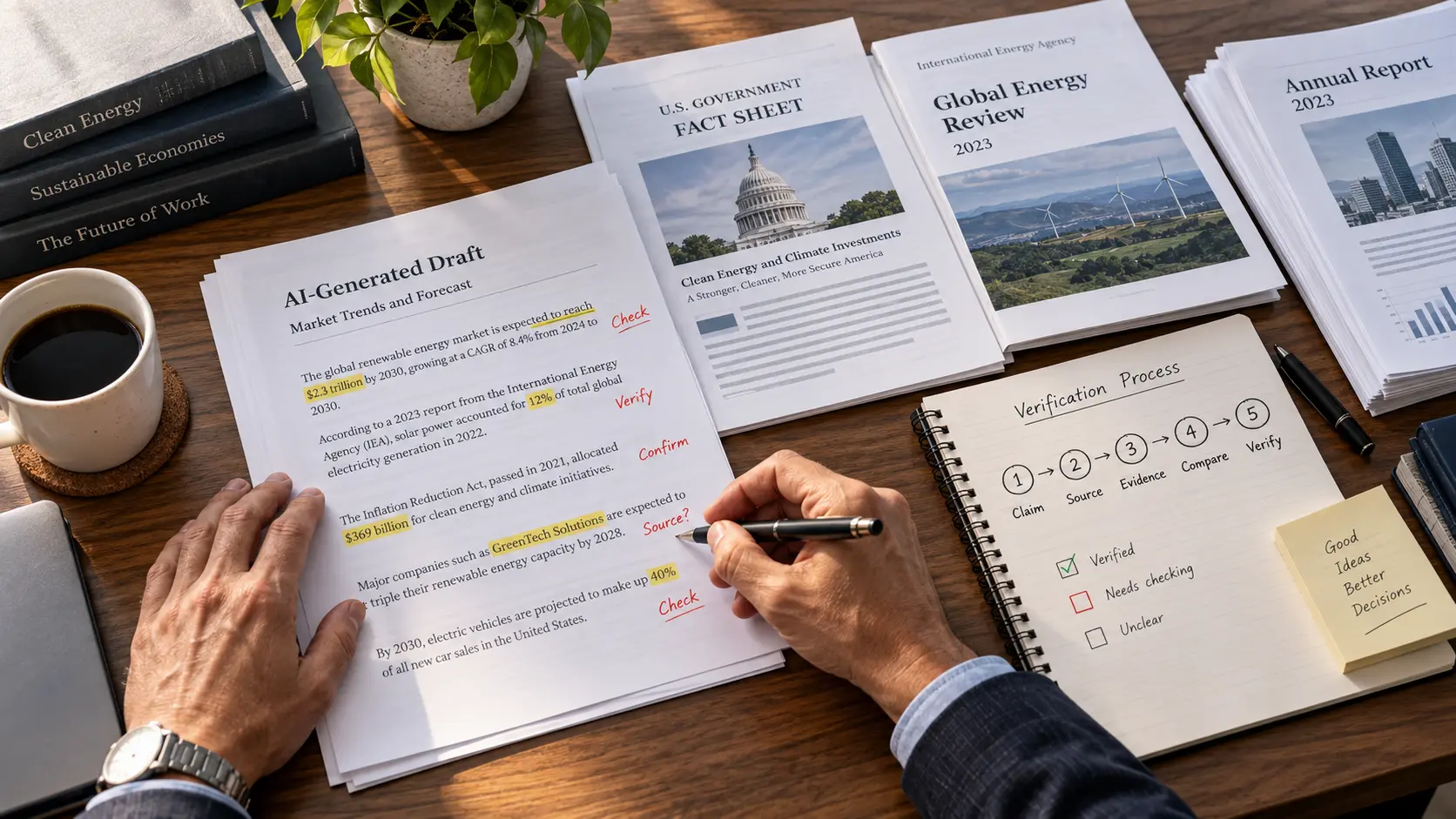
Workplace research. An analyst asks an AI tool to summarize a competitor's market share, and it returns a specific, oddly precise percentage. It looks like it came from a real report. It didn't — the AI generated a plausible-sounding number instead of flagging that it had no reliable data. The fix: trace every hard number back to an actual filing, press release, or industry report before it goes in a deck.
Writing and publishing. A freelance writer asks for a supporting quote from an industry expert and gets one that reads perfectly — right up until a quick search shows that expert never said anything like it. This is exactly why fabricated quotes are one of the fastest ways an AI hallucination turns into a real-world credibility problem, since a published fake quote is hard to fully walk back.
Business analysis. Someone asks an AI to interpret a quarterly earnings figure and it misreads which line item a percentage change actually applies to, producing a confident but incorrect financial takeaway. The lesson lines up with the reduction tips above: when the stakes are financial, provide the actual document instead of asking the AI to recall the number from memory.
Everyday questions. Someone asks about a product's current features, a public figure's current role, or a piece of recent news, and the AI answers using outdated or incomplete information as if it were current. This is a quieter, more common version of the problem — nobody gets publicly embarrassed, but plenty of people walk away with a slightly wrong picture of the world.
Across all four, the same pattern holds: something went wrong, it looked entirely believable, and a quick check against a reliable source could have caught it.
Frequently Asked Questions About AI Hallucinations
What are AI hallucinations?
AI hallucinations are confident, fluent statements from an AI system that are inaccurate, unsupported, or entirely fabricated — including invented facts, fake citations, incorrect numbers, or quotes nobody actually said.
Why do AI hallucinations happen?
They happen because language models generate likely continuations rather than automatically verifying every claim, because training data can contain gaps and contradictions, and because some training and evaluation approaches can encourage answering rather than expressing uncertainty.
Can AI hallucinations be completely eliminated?
Not with current technology. Retrieval, better prompting, source-grounded workflows, and human review can reduce some hallucination risks, but no widely used AI system has eliminated the possibility entirely.
How can you tell if AI is hallucinating?
Look for oddly specific claims with no traceable source, citations that don't check out when you search for them, and a tone of total certainty on a topic where certainty isn't really possible. Most importantly, verify consequential claims rather than trying to diagnose hallucinations from writing style alone.
Can ChatGPT hallucinate?
Yes. ChatGPT can produce incorrect or misleading information, including fabricated facts, citations, or other details. Browsing, retrieval, and other tools can improve access to supporting information, but they do not make every generated statement automatically reliable. Newer models can have lower hallucination rates, but the risk has not disappeared.
How can I reduce AI hallucinations when using AI tools?
Give clear context, provide source materials rather than relying on what the model learned, ask it to distinguish fact from inference, ask it to indicate uncertainty, and have a person review anything high-stakes.
Should I trust AI-generated citations?
Not on their own. Treat every AI-generated citation as a lead to follow up on, not a finished fact — examine the source and verify that it exists and truly backs up the claim the AI ascribed to it.
What information should I always verify when using AI?
Even if the AI sounds confident, you should verify statistics, dates, quotes, legal or medical claims, financial information, current information, and anything you want to publish or act on against a reliable source.
The Best Way to Use AI Is With Verification
AI is genuinely useful for producing first drafts, summaries, explanations, and a wide range of possibilities you might not have thought of on your own. Where it becomes risky is the moment fluent, confident writing gets mistaken for something that's already been checked. It hasn't been. That job still belongs to the person reading the output.
A simple loop covers most situations: generate, question, verify, use. Let the AI produce a draft or an answer. Question the specific claims inside it, especially the ones with dates, names, and numbers attached. Verify anything that matters against an appropriate reliable source. Only then put it to use.
Skipping straight from "generate" to "use" is where AI hallucinations turn into real mistakes — in a report, an article, a legal document, or a decision that costs money.
None of this means treating AI with suspicion at every turn. It means treating fluency for what it is: a writing quality, not a truth test.
External Resources
For research on why language models can produce plausible but false statements, see OpenAI's research on why language models hallucinate. For terminology and a broader risk-management perspective, see the NIST AI Risk Management Framework.