What Are Large Language Models? A Practical Explanation
Large language models, or LLMs, are AI systems trained on massive amounts of text so they can recognize how language fits together and generate useful responses to it. They're the engine behind many of the chatbots, writing assistants, coding helpers and research tools people now lean on at work and at home. None of this requires a computer science background to understand. Strip away the jargon, and an LLM is simply a system that has studied enormous quantities of writing and learned, with striking accuracy, what tends to come next.

What Are Large Language Models?
Large language models are AI systems that are trained on huge volumes of text — books, articles, webpages, documentation and other language data — so that they can interpret and generate human language. The “large” portion is about how much training and how big the underlying model is. Such a model can have billions of distinct parameters that determine how it responds. You might think of parameters as modifiable variables inside the model that, combined, capture the patterns it learns during training.
The "language model" part is more literal than it sounds — it's a system built specifically to model how language behaves, not to store facts the way a filing cabinet stores documents.
It helps to drop a common comparison here. Most people's first instinct is to think of an LLM as a kind of digital encyclopedia — a lookup tool with answers tucked away inside. That's not quite right, and the distinction matters. A large language model behaves less like a reference book and more like an extremely sophisticated language prediction system. It has absorbed so much text that it can anticipate, with impressive consistency, which words and ideas typically follow others in a given context. That's a fundamentally different skill than memorizing and retrieving facts, and it explains both why LLMs are so flexible and why they sometimes get things wrong.
Large language models sit inside the broader field of artificial intelligence. Many modern LLMs are also used as generative AI systems because they can generate new text and other language-based content. When you type a question or instruction into a tool built on a large language model, the system doesn't simply search a database for a pre-written answer. It processes your prompt, weighs the surrounding context, and builds a response piece by piece, drawing on the patterns it picked up during training.
Some AI applications can link a language model to search tools, databases, documents, or other external systems. In such cases, the application may be giving the model more information than it had in its original training. The core notion to keep in mind is still the same: an LLM employs linguistic patterns it has learned to develop a suitable answer to the context it is given.
How Do Large Language Models Work?
You don't need a background in computer science to follow the basic mechanics of a large language model. The procedure is split into three sequential steps: training, pattern recognition and response production.
Training on Large Amounts of Text
Before a large language model can do anything useful, it has to learn from text — a lot of it. Developers train these systems on very large collections of data that can include books, websites, documentation, code and other sources, depending on the model and its development process. The exact mix varies by model and by company, and no two large language models are trained on identical data.
What matters for our purposes is the general idea: the model processes an enormous volume of human language and, in the process, starts to internalize how language typically works — grammar, phrasing, tone, structure, and the countless small conventions that make writing readable.
Learning Patterns in Language
Here's where the real learning happens. When a language model goes through its training data, it is not merely learning statements word for word. It’s doing statistical associations — looking at which words tend to be near each other, how concepts tend to connect, how context influences meaning.
Over enough examples, the model develops a working sense of how professional emails differ from casual texts, how a legal document differs from a recipe, and how a question typically calls for a certain kind of answer.
Generating a Response
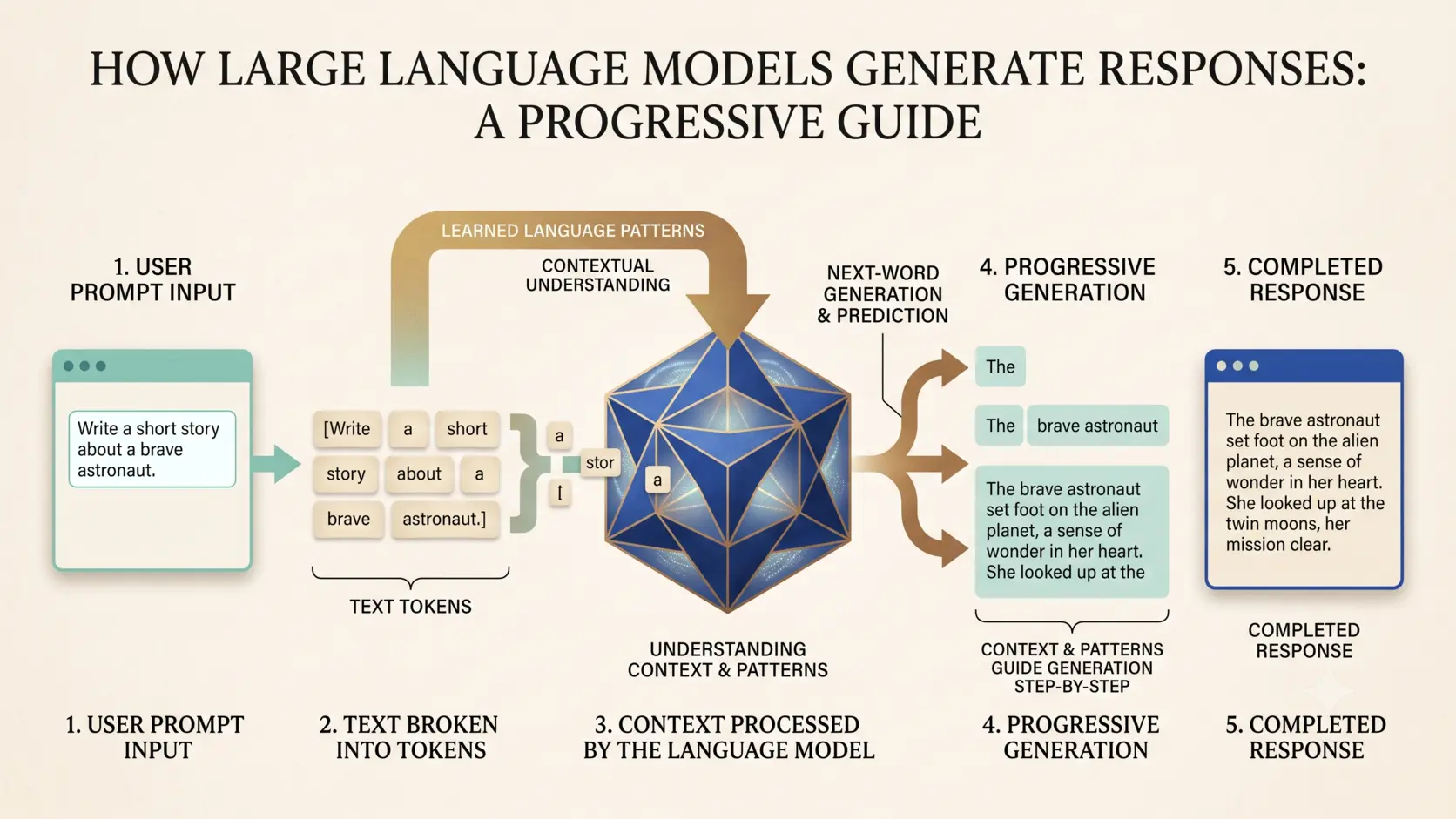
When you ask a large language model a question, it doesn't simply hunt for a matching paragraph somewhere and paste it into the reply. It gives an answer based on the patterns it learned in training, and the unique context you’ve given it in your question.
To do this, the model breaks text — both your input and its own output — into small units called tokens, which can be whole words or pieces of words. In many common language models, it then predicts the next token, then the next, then the next, building the response step by step until it has a complete answer.
You don't need to master tokens to use these tools well; it's simply useful to know the term exists, since you'll run into it elsewhere.
What Does a Large Language Model Actually Learn?
One of the biggest misconceptions beginners run into is imagining that a large language model has memorized a giant library of facts, the way a database stores rows and records. That's not really how it works.
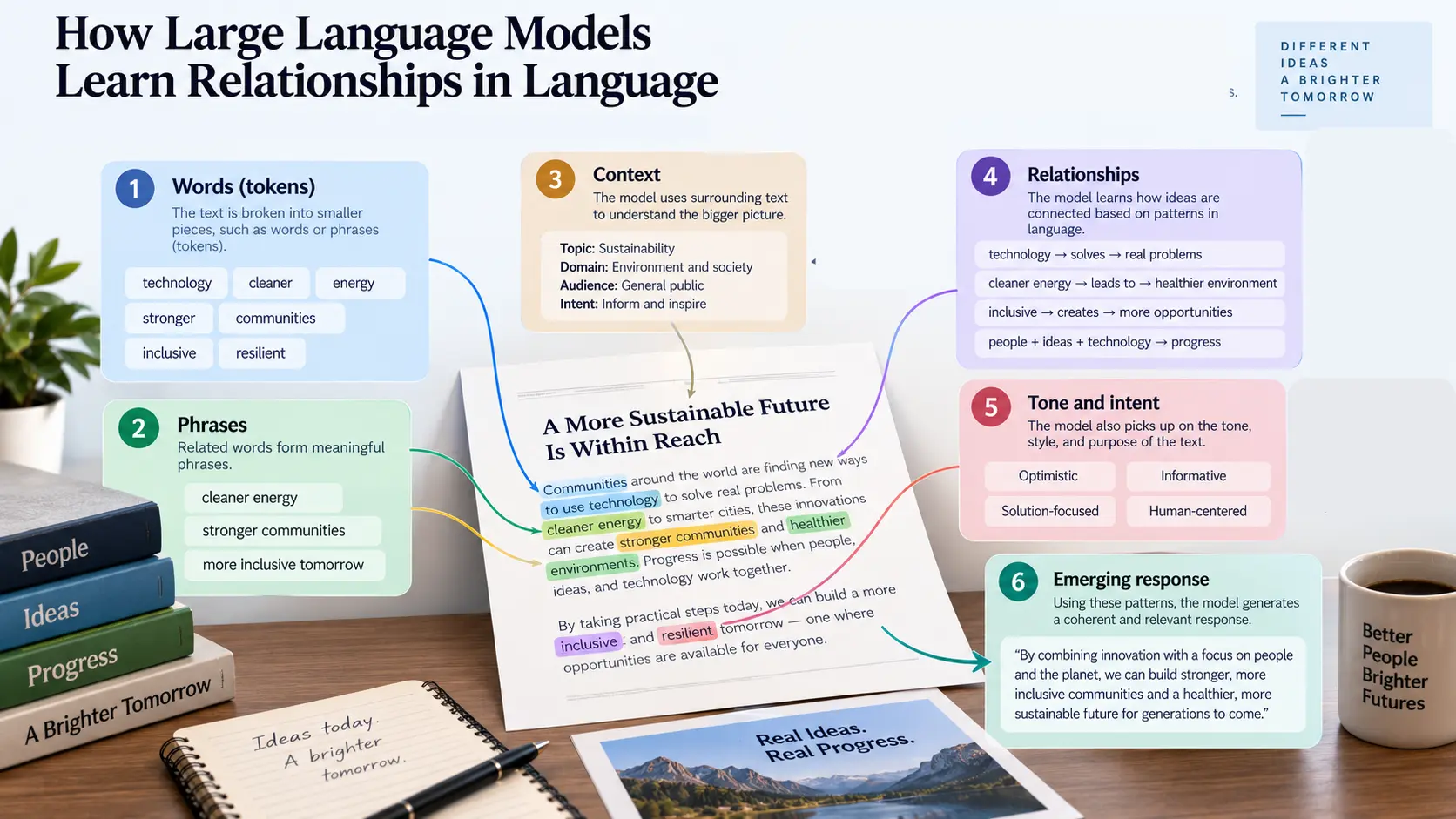
What a large language model learns is closer to a deep familiarity with patterns — how sentences are typically constructed, how ideas connect, how tone shifts between a casual message and a formal report, and how certain topics tend to be discussed.
Along the way, the model can also acquire substantial factual knowledge from its training data, but it absorbs and represents that information imperfectly rather than storing it as a conventional reference database. It has encountered facts, explanations, arguments and descriptions throughout its training, and it can reconstruct information from those learned patterns when asked — but not with the reliability of a lookup table.
This distinction leads to an important point worth sitting with: knowing how language patterns work is not the same thing as reliably knowing what is true. A large language model can produce a fluent, confident-sounding sentence that happens to be wrong, simply because fluency and accuracy are two separate skills.
Keep that distinction in mind — it becomes especially relevant later in this guide, when we get into the limitations of these systems.
Why Are Large Language Models So Good at Language?
Several things come together to make large language models unusually capable with language, and none of them require the model to understand the world exactly as a person does.
Scale is the first factor — training on enormous quantities of language gives a model exposure to a broad range of writing styles, subjects and phrasings. Diversity of training data matters too; a model exposed to legal briefs, product reviews, poetry and technical manuals has a broader base of patterns to draw from than one trained on a narrower slice of text.
Then there's context handling. A large language model doesn’t just look at your last sentence—it may use the context of the conversation and the specifics you’ve given it to inform its response. Add to it the pattern recognition skill and the ability to generate long, cohesive sequences of text and you get a system that can sound remarkably natural.
Here's a concrete example. Say you type:
“Write a polite email declining a meeting because I have a conflict.”
A large language model has encountered many examples of professional correspondence, apologetic language and scheduling-related writing during training. It doesn't need to be given a separate rule for every possible version of a polite decline. It can draw on the patterns it has learned to produce wording that fits the request.
What Can Large Language Models Do?
The practical uses of large language models span far more than casual chatbot conversations. Here's where they tend to show up in day-to-day US workplaces and personal life.
Write and Rewrite
Large language models are frequently used to draft emails, outline reports, tighten up a rambling paragraph, summarize a long update, or shift the tone of a message from blunt to diplomatic.
A manager might ask one to turn a list of bullet points into a polished project update in under a minute. The model provides a first draft; the manager still decides whether the wording accurately represents the project's status.
Summarize and Extract Information
These tools are well suited to condensing long documents, meeting notes, internal policies, research papers or customer feedback into something scannable.
Instead of immediately reading forty pages of a vendor contract, someone might ask an LLM to identify key obligations and deadlines first. That can make the document easier to review, although important contractual conclusions should still be checked against the original agreement.
Answer Questions and Explain Concepts
Large language models are commonly used for tutoring, brainstorming, and general explanation — breaking down a tricky topic in plain terms, suggesting angles for a project, or acting as a sounding board for research.
One useful feature is that the same concept can often be explained in several ways. A user can ask for a beginner explanation, a professional summary, an analogy, or a step-by-step walkthrough.
Help With Code and Structured Work
Developers use large language models to explain code they don’t understand, suggest fixes for issues, create formulas, or take complicated information and present it in a cleaner manner.
A developer might paste an unfamiliar function and ask the model to explain what it does, identify potential edge cases, and suggest tests. That can accelerate the review process, but the developer remains responsible for determining whether the proposed changes actually work.
Large Language Models vs. Traditional Software
A common assumption among beginners is that a large language model is really just a smarter search engine or a fancier database. The comparison below shows why that's not quite accurate.
| Traditional Software | Large Language Model |
|---|---|
| Usually follows explicitly defined rules | Generates output from learned patterns |
| Often produces predictable, identical outputs | Can produce different responses to the same input |
| Works well with structured, precise instructions | Can work with everyday natural language |
| Usually easier to test deterministically | Often requires additional review for many tasks |
| Frequently designed for one specific function | Can support many different language-based tasks |
None of this makes traditional software obsolete — that's not the point.
A payroll system, a hospital records database, or an airline booking engine still needs the predictability that rules-based software provides, and a large language model isn't a replacement for that kind of infrastructure.
What large language models change is how people can interact with software and information in the first place. Instead of navigating rigid menus or memorizing exact commands, you can describe what you need in plain English and receive a useful starting point.
The strongest applications often combine both approaches: traditional software handles precise operations, while an LLM provides a flexible language interface around them.
What Are the Limitations of Large Language Models?
Large language models are useful — genuinely useful — but they get things wrong, and knowing where they struggle is just as important as knowing what they're good at.
They Can Be Wrong
Because a large language model generates responses from learned patterns rather than automatically checking every claim against a verified source, it can produce statements that sound plausible but aren't accurate — a phenomenon often called "hallucination."
This might mean inventing a source that doesn't exist, misstating a date, or confidently describing something that never happened.
The important point is that the output can be fluent without being factual.
They Can Sound More Certain Than They Should
This one trips up beginners more than almost anything else.
A large language model's fluent, confident tone doesn't necessarily reflect how confident a person should be about the accuracy of what it's saying. Smooth writing and correct writing are not the same thing, and it's easy to mistake one for the other.
A polished paragraph is therefore not a substitute for verification.
They May Reflect Problems in Their Training Data
Issues such as bias, gaps, or outdated information in the data used to train a model might shape the model’s output.
A large language model also does not automatically know about events or information that emerged after the data available to it during training. Some applications address this limitation by connecting the model to current information sources, but that is an additional capability of the application rather than something every LLM automatically has.
Context Matters
A vague, underspecified prompt tends to produce a vague, underspecified answer.
Large language models respond to the information and instructions available to them, so a little extra detail in your request — audience, tone, length, purpose, constraints or relevant background — can produce a noticeably more useful result.
Human Review Still Matters
For anything involving legal, financial, medical, employment or major business decisions, output from a large language model should generally be treated as a draft, aid, or starting point rather than an unquestioned final answer.
These are areas where the cost of an error can be high enough that human judgment and verification still belong in the loop.
That's not an argument against using these tools for serious work. It's simply a reminder that the person or organization using the system remains responsible for the outcome.

How Are Large Language Models Used in Real Life?
Large language models have moved well past novelty status and into everyday routines across US workplaces, classrooms and households.
In the workplace, they show up in drafting, research, customer service, meeting summaries, internal knowledge lookup and coding support.
A project manager might paste raw meeting notes into a large language model and ask it to pull out the decisions made, the open questions, and the action items assigned to each person — a task that would otherwise require manual sorting.
In education, students and teachers use large language models to get concepts explained in a different way, generate practice questions, get feedback on a draft essay, or work through a problem step by step when a textbook explanation isn't landing.
In everyday life, people use these tools for trip planning, comparing options before a purchase, organizing a messy to-do list, planning meals around what's already in the fridge, or getting a plain-language introduction to a subject they know little about.
The common thread across all three settings is the same: large language models can take a pile of information or a clearly stated request and turn it into something more organized and usable, quickly.
Are Large Language Models the Same as Generative AI?
Not quite, although the two notions overlap frequently and the terminology may get muddled fast.
It helps to think of them as related categories.
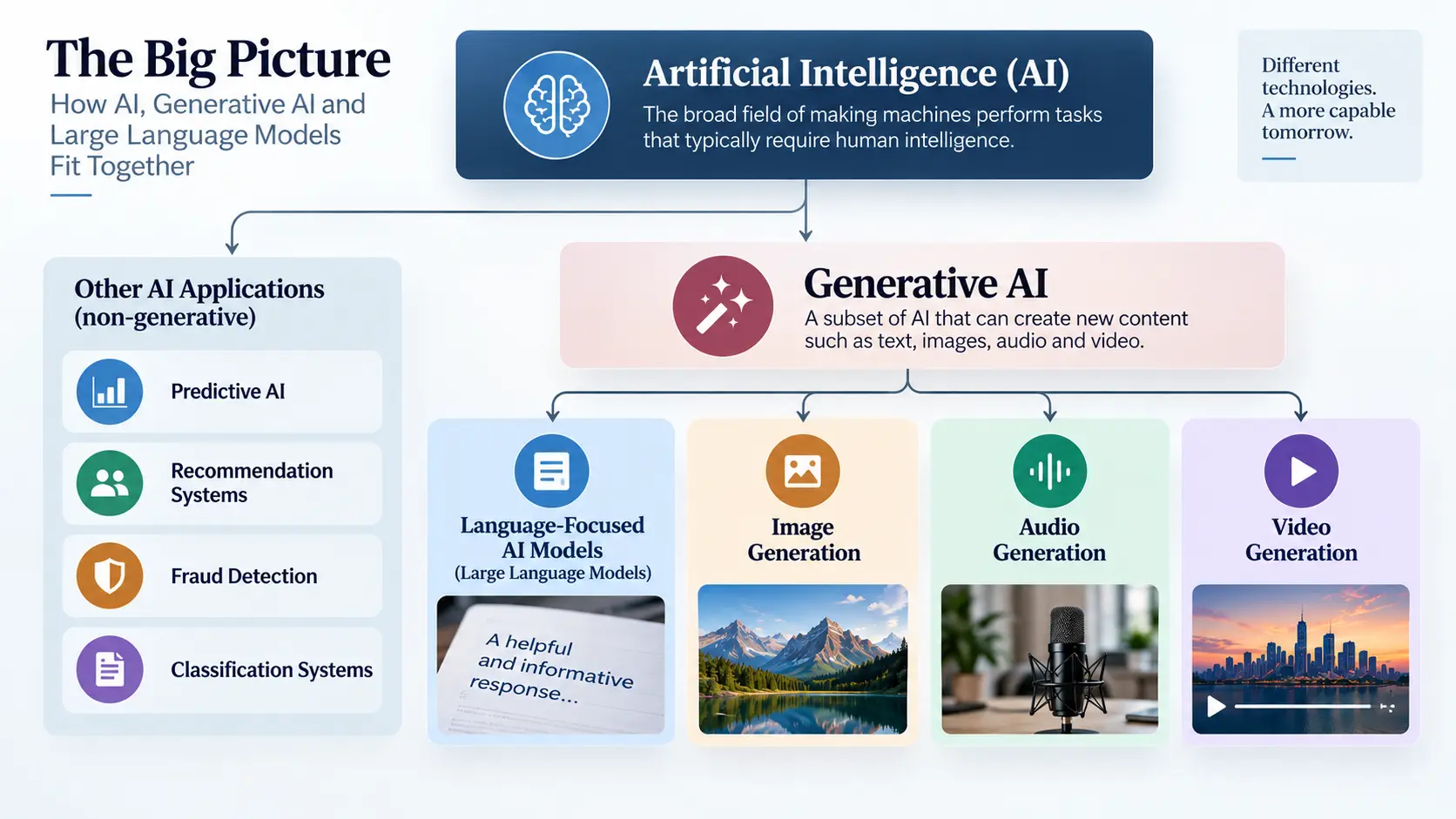
Artificial intelligence is the broad field covering systems designed to perform tasks that can involve capabilities associated with human intelligence.
Generative AI refers to AI systems designed to generate new content, such as text, images, audio, video, code, or other forms of output.
Large language models are language-focused AI models. Many modern LLMs are also generative AI models because they can generate new text, code, and other language-based content.
The relationship isn't perfectly symmetrical, and that's worth spelling out.
Many large language model applications are generative AI applications, since generating language is a central capability of these models. But the reverse doesn't hold — not every generative AI system is a large language model.
An AI system that generates images or music, for instance, is generative AI without being a traditional language model. And plenty of AI systems aren't generative in the first place; a fraud-detection algorithm or a recommendation engine is AI, but it isn't creating new content and isn't an LLM.
For a closer look at how these categories relate, see our full breakdown of AI vs. generative AI.
What Does the Future of Large Language Models Look Like?
Rather than speculating wildly, it's more useful to look at where development is heading.
Large language models are becoming increasingly capable of handling complex, multi-step tasks and working with external tools — such as search, calculators, software systems, or organizational data — instead of relying solely on information represented in their learned parameters.
Many are also becoming multimodal, meaning a single AI system can work with text alongside formats such as images and other types of input or output.
At the same time, there's a push toward smaller, more efficient models that can run faster and at lower cost, alongside deeper integration of language models into the workplace software people already use every day.
Reliability is increasingly important alongside raw capability.
The more responsibility an AI system takes on, the more important accuracy, transparency, security, privacy, evaluation, and appropriate human oversight become.
The more useful question isn't whether large language models will eventually replace every task involving language. It's where they can strip out the tedious parts of a job — the sorting, drafting and summarizing — while leaving people responsible for the judgment, context and decisions that actually matter.
Frequently Asked Questions
What are large language models in simple terms?
Large language models are AI systems trained on huge amounts of language data so they can recognize patterns in language and generate relevant responses to a prompt.
A simple way to think about an LLM is as a powerful language-pattern system that can respond to instructions written in ordinary language.
How do large language models work?
They are trained on a ton of language data and learn statistical patterns between words and concepts during that training. Then they generate replies based on those learned patterns and the context they are given.
Many common language models generate text progressively, predicting the next token as a response develops.
What is an example of a large language model?
Examples include LLM families built by groups such as OpenAI, Anthropic, Google, Meta, and other AI businesses.
Products such as ChatGPT, Claude and Gemini provide interfaces and additional capabilities built around underlying AI models. The models themselves can differ in architecture, training, capabilities, context limits and deployment options.
Is ChatGPT a large language model?
ChatGPT is better described as an AI service or conversational application powered by language models.
The underlying model does the language processing, while the ChatGPT interface provides the conversational experience and can add extra capabilities around the model.
Are large language models generative AI?
Many are.
Large language models can generate new text, code, and other language-related content, making them an important part of generative AI.
However, generative AI is broader than LLMs because it also includes systems designed to generate images, audio, video and other forms of content.
What is the difference between an LLM and AI?
AI is the general name for a set of technologies meant to accomplish activities that normally need human intelligence.
A large language model is one specific category of AI model focused on language.
In simple terms, an LLM is part of AI, but AI is much broader than LLMs.
Can large language models make mistakes?
Yes, regularly.
They can be confidently wrong, misunderstand an ambiguous prompt, produce unsupported statements, or reflect gaps and biases in their training data.
That is why human review and appropriate verification remain important for anything consequential.
What are large language models used for?
Common uses include drafting and rewriting text, summarizing documents, answering questions, explaining unfamiliar concepts, translating language, analyzing written information, and assisting with code.
They are employed in the workplace, in education, in customer-service systems and in ordinary personal duties.
External Resources
Readers interested in pursuing the subject in greater detail will find the following authoritative sources useful for technical and practical background:
- IBM — What Is a Large Language Model? — A beginner-friendly explanation of LLMs, including how they work and where they are used.
- Google Cloud — Large Language Models — Additional technical background on LLMs and their applications.
- NIST — Artificial Intelligence Risk Management Framework — Useful context for understanding AI risks, evaluation and responsible use.
- Stanford AI Index — Broader research and data on AI development, capabilities and adoption.
These resources supplement this guide rather than replace it. The goal here is to give beginners a practical mental model before they move into the deeper technical material.