You're Not Starting From Zero
When people think about changing careers, they usually picture two options: stay put, or start over completely. In practice, it's almost never that black and white.
Everything you've built up over the years — the problems you know how to solve, the people you've worked with, the systems you understand, the instincts you've developed — doesn't just evaporate because you decide to work in a different field. What actually changes is where you point those abilities.
That distinction matters.
Someone who's spent a decade managing customers, projects, budgets, or teams will often look at a job posting in a completely different field and think, "I have zero experience for this." An employer looking at the same résumé might see something else entirely: stakeholder management, problem-solving, planning, communication, commercial awareness, leadership, analytical thinking, project coordination, decision-making. The skills are there. The challenge is connecting them to a new destination.
That's really what a good career change comes down to — translating your past into a new context rather than discarding it. You can think of the whole process as five stages:
Keep → Translate → Close → Prove → Move
- Keep the capabilities and experience that still have value.
- Translate them into the language of your target career.
- Close the gaps that genuinely stand in your way.
- Prove you can actually do the new work.
- Move through whatever transition route is realistic for you.
That's a very different process from waking up one day frustrated with your job and deciding to chase something completely different. It helps to sit with a different question instead: what can I carry forward, what do I actually need to build, and what's the most realistic bridge between where I am and where I want to be?
That's the question this guide is built around.

If you're not sure whether you need a full career change or simply a better next step, see our Career Progression Plan guide for a practical framework for mapping your current position against your desired destination. This creates a direct connection between career progression and career change rather than treating them as unrelated decisions.
What Does "Career Change" Actually Mean?
People throw the phrase "career change" around loosely, and it ends up covering a lot of different situations that aren't really the same thing.
Switching employers isn't necessarily a career change. Neither is a new job title. Moving into a more senior version of the same role is progression, not change. Things get more interesting when you move into a genuinely different occupation, function, industry, or professional direction — and even then, it helps to know which kind of shift you're actually making.
Changing employers — A marketing manager moves from one tech company to another. The employer changes; the career direction stays roughly the same.
Changing functions — A marketing professional moves into sales. Same industry, but the actual nature of the work shifts.
Changing industries — A financial analyst moves from banking into healthcare. The industry changes, but a lot of the analytical and financial skills travel with them.
Changing occupations — A teacher moves into corporate learning and development. The environment looks completely different, but teaching, communication, facilitation, and curriculum design are all still valuable.
Making a major pivot — An accountant decides to become a software developer. Here the gap is much wider, so expect to need real new technical skills and evidence to back them up.
The point of laying it out this way is that career change sits on a spectrum. You don't have to leap from one extreme to the other. In most cases, the smartest move is an adjacent one — something that lets you carry real professional capital with you rather than abandoning it at the door.
Why It Feels Like Starting Over (Even When It Isn't)
If a career change were only about picking a new job title, it would be simple. The hard part is that your professional identity gets tangled up with your abilities, and untangling the two takes real effort.
You might know exactly what you're good at, but those skills can feel welded to your current job. A finance person thinks, "I'm a finance person." A marketer thinks, "I'm a marketing person." A teacher thinks, "I'm a teacher." But skills are usually far more portable than identities — we just don't experience them that way. A few reasons this happens:
Your job title does the talking. Titles are handy shorthand, but they don't tell the whole story. "Marketing Executive" says nothing about whether you can analyze data, run a project, negotiate with vendors, coordinate a dozen stakeholders, or present to senior leadership.
Job postings speak a different dialect. The target career might describe an ability you already have — just using words you've never used for it. So you read the posting and don't recognize yourself in it, even though you're already halfway there.
You fixate on what's missing. Most people read a job description and immediately catalog everything they can't do. That single habit makes the whole role feel out of reach. It helps to sort requirements more deliberately — what you already have, what could transfer with a little reframing, and what you'd genuinely need to build from scratch.
You assume another degree is the fix. Sometimes it is. Often it isn't. A career change might call for a certification, a portfolio, hands-on experience, a bridge role, or simply a stronger case for what you already bring.
You compare yourself to people who started there. It's easy to look at someone with five years in the field and think, "I'm five years behind." That's not quite right. You might be behind on occupation-specific know-how while being ahead on business experience, leadership, communication, or industry context. You're not trying to become a copy of someone who started earlier — you're trying to become credible for the work you want to do next.
Start By Taking Stock of What You Already Have
Before you ask "what should I become?" it's worth pausing to take inventory of what you're already carrying. This helps prevent you from dismissing years of experience simply because it came from a different occupation.
Try building an inventory across six areas.
1. Technical skills — capabilities tied to specific tasks or tools: data analysis, financial modeling, coding, CRM platforms, project-management software, reporting, research, design, accounting, marketing automation.
2. Professional skills — the kind that travel across almost any occupation: communication, planning, problem-solving, organization, negotiation, stakeholder management, presentation, decision-making.
3. Business knowledge — you probably understand more about how organizations run than you give yourself credit for: customers, budgets, operations, compliance, sales, procurement, vendors, internal processes, performance measurement.
4. Industry knowledge — this can be a real advantage in a career change. Someone moving from healthcare administration into healthcare technology, for instance, brings domain knowledge that a technically skilled outsider simply doesn't have.
5. Evidence — don't just list capabilities; find the moments where you actually demonstrated them. "Excellent stakeholder-management skills" is forgettable. "Coordinated five departments during a major process-improvement project" sticks.
6. Professional relationships — your existing network carries transferable value too. Former colleagues, clients, suppliers, and managers may already know people in your target field. You're not walking into the new career as a total stranger — you're walking in with a history.
Career change principle: treat your previous experience as something to assess for transferability, not something to discard.
Find Your Transferable Skills
Transferable skills are the ones that stay useful even when the job, company, or industry underneath them changes. CareerOneStop draws a line between technical skills and broader workplace skills, and offers tools like its Skills Matcher to help people map skills onto occupations where they'd apply.
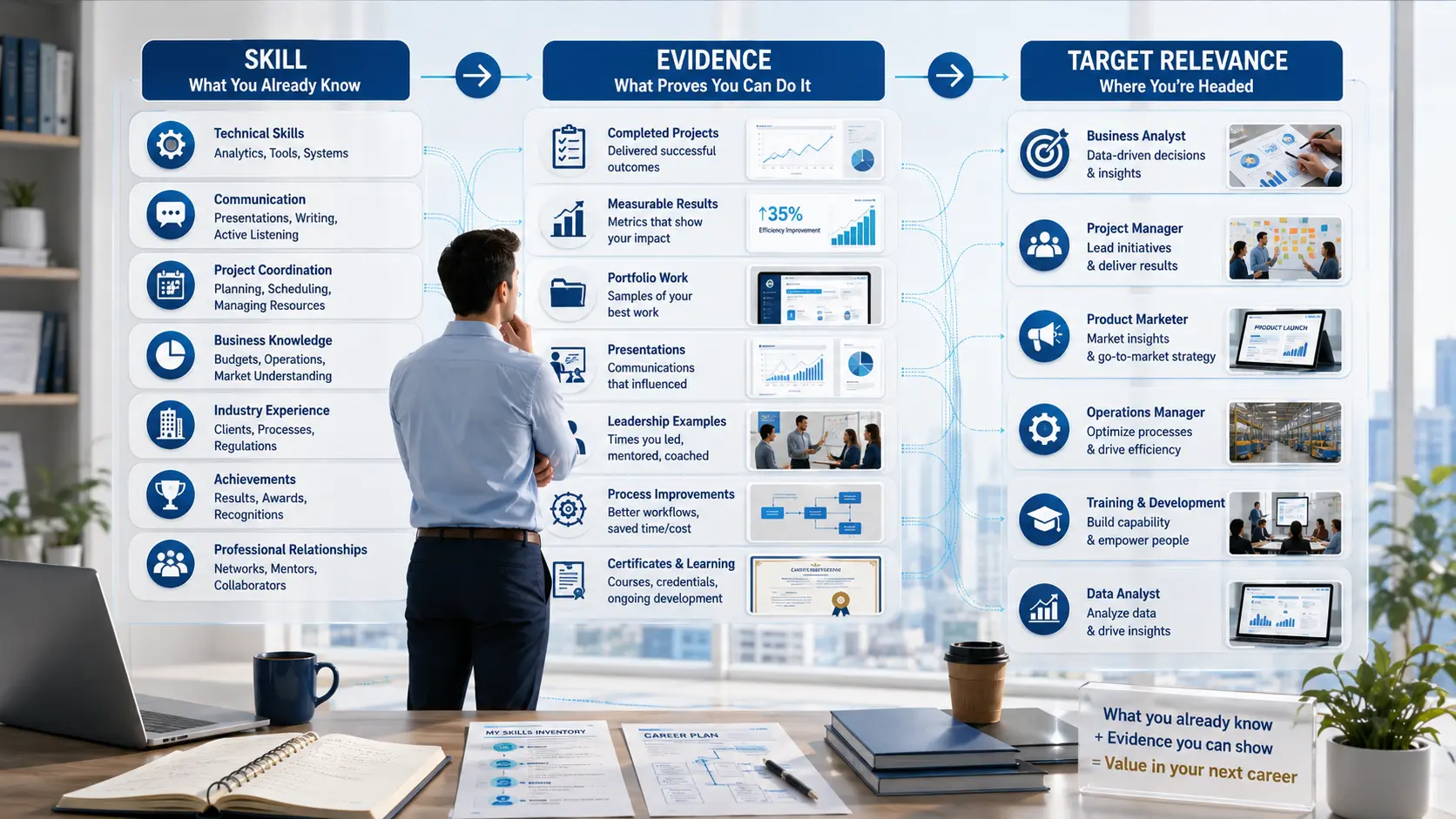
A simple way to work through this: Skill → Evidence → Target relevance.
- Project coordination → "Coordinated multiple teams, deadlines, and deliverables for a product launch" → relevant to project management, program management, operations, or implementation roles.
- Client communication → "Managed a portfolio of business clients and resolved complex service issues" → relevant to account management, customer success, consulting, or relationship-management roles.
- Data analysis → "Built monthly performance reports and identified trends that influenced management decisions" → relevant to business analysis, operations analysis, marketing analytics, or financial analysis.
That's the real difference between claiming a transferable skill and actually demonstrating one. Don't aim for a long list of soft skills — aim to find the capabilities that survive the transition, and pair each one with proof.
Choose a Target Career, Not Just an Escape Route
One of the most common mistakes in a career change is picking a destination for no better reason than "it's not this." A bad manager, a stalled salary, boredom, or a workplace that's simply worn you down can all make you want out. Those might be legitimate reasons to want something different. But none of them tell you where to go.
A better starting question is: what kind of work do I actually want to do? Not "what job title sounds impressive," but what problems do I actually enjoy solving, and what environment suits me — structured or flexible, individual or collaborative, remote or office-based, predictable or varied, specialist or generalist?
It's also worth asking what responsibilities you actually want. Sometimes what you dislike isn't the occupation at all — it's a particular level of responsibility. And it's worth being honest about trade-offs, because every career has them. A higher salary often means longer hours. More flexibility often means slower progression. Greater autonomy often means less support. A more meaningful role might demand more training. The goal was never to find a perfect career — it's to find one whose trade-offs you're actually willing to live with.
Build a Career Target Scorecard
Instead of picking one option emotionally, shortlist two or three possibilities and score them:
| Factor | Score 1–5 |
|---|---|
| Interest in the work | |
| Transferable skills | |
| Skill gap | |
| Market demand | |
| Income potential | |
| Training required | |
| Lifestyle fit | |
| Entry difficulty | |
| Long-term opportunity |
The scorecard isn't designed to produce a definitive answer. Its purpose is to expose the assumptions behind each option. The career that sounds most exciting on paper might turn out to have a huge skill gap, while a less glamorous option offers stronger overlap with what you already know, a faster entry point, better financial stability, and more realistic progression. Sometimes that second, quieter option is the smarter target.
If you're still comparing possible directions, visit the Career hub for related career-development guidance before committing to a specific transition.
Research the New Career Before You Commit
Once you have a shortlist, stop imagining the target career and actually go research it. This is where a lot of career changes quietly go off the rails — people research job titles when they should be researching the actual work.
Ask what someone in this occupation really does day to day. Which responsibilities show up again and again? Which skills come up repeatedly? What education is typically expected, and what experience actually counts as relevant? What tools or systems does the role revolve around? What does progression look like, what does the job market look like, and what are the realistic entry routes?
The U.S. Bureau of Labor Statistics' Occupational Outlook Handbook is a solid starting point here, since its occupational profiles cover duties, work environment, education and training, pay, job outlook, and related occupations.
Don't use any of this just to chase the highest salary — look at what actually sits behind the role. Which responsibilities distinguish it from your current job? What occupations commonly feed into it? You're really trying to answer one bigger question: what would make an employer believe I can succeed here?
Build a Career Change Gap Analysis
Once you know what the destination actually requires, line it up against where you currently stand. At this stage, you can stop thinking about the career change in general terms and start working on the specific gaps that could hold you back.
| Capability | Current Level | Target Requirement | Gap |
|---|---|---|---|
| Data analysis | Intermediate | Advanced | Medium |
| Presentation | Strong | Strong | Low |
| Budget management | Limited | Intermediate | Medium |
| Team leadership | Beginner | Intermediate | Medium |
| Strategic planning | Beginner | Advanced | High |
Then add a column for how you'll actually close each gap:
| Capability | Best Way to Close the Gap |
|---|---|
| Data analysis | Structured learning + practical project |
| Budget management | Own a small budget |
| Team leadership | Lead a cross-functional project |
| Strategic planning | Participate in planning cycles |
Resist the urge to sign up for a course for every single gap. Some things are better learned by doing. If leadership is your weak spot, another online course might teach you the theory — but actually leading a small project will teach you far more. If data analysis is the gap, structured learning probably does make sense, but the goal should still be producing something concrete that proves you can do it. Before choosing a course, decide what evidence an employer would actually need to see. That will tell you whether a course is even the right way to close the gap.
Build a Bridge Instead of Making a Giant Leap
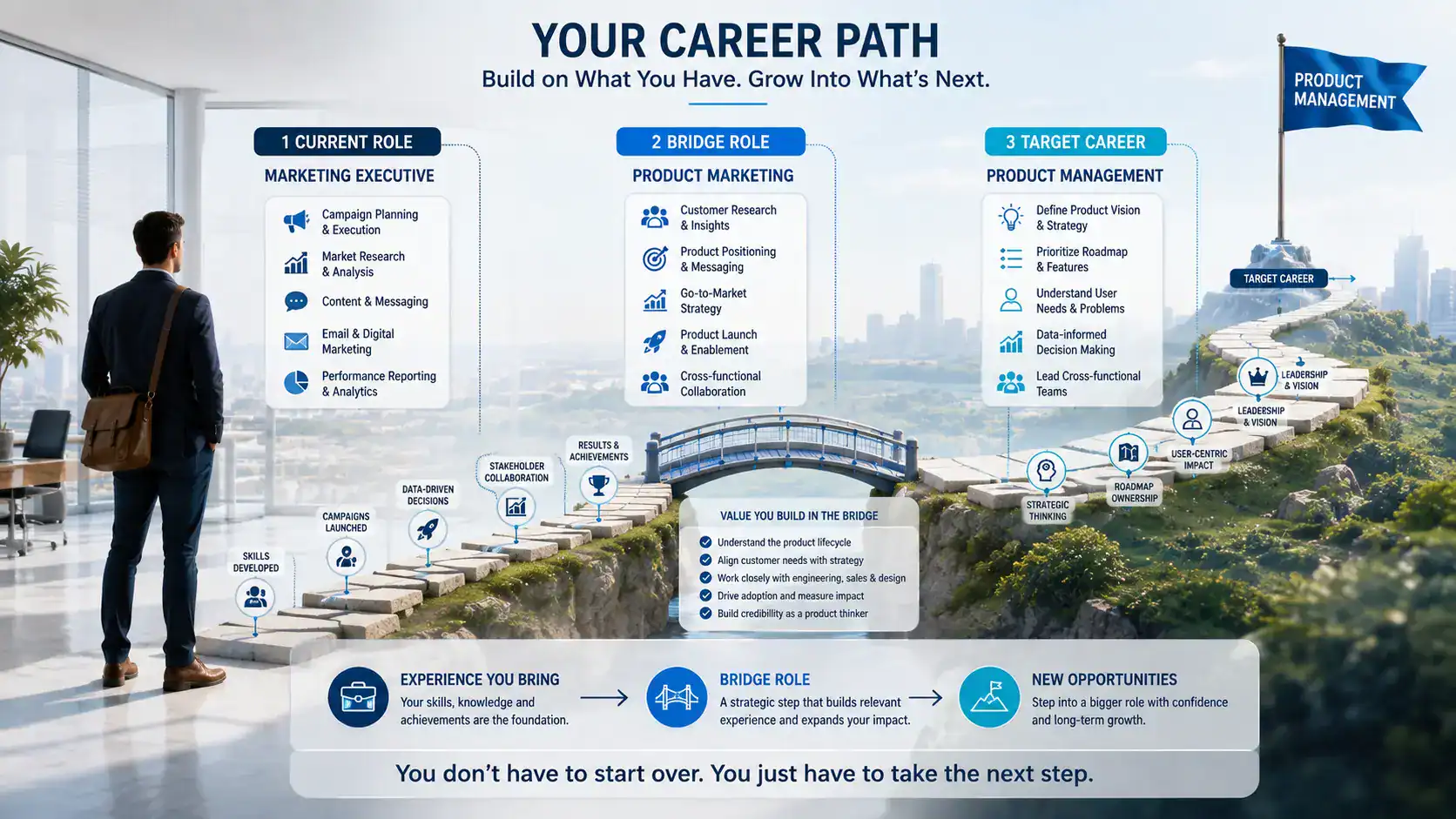
A career change doesn't have to be one enormous jump. Often the smartest move is a bridge role — something that sits between where you are and where you're headed.
Take someone moving from Marketing Executive toward Product Marketing Manager. Jumping straight there is a stretch — most hiring managers would want to see actual product experience first. A role like Product Marketing Specialist closes that gap: it still draws on the campaign and messaging skills from the old marketing job, but it puts the person inside product launches, roadmap discussions, and cross-functional planning, which is exactly where the target role lives. A year or two in that seat, with a couple of launches to point to, makes the eventual move to manager a far smaller leap than it would have been straight out of marketing.
A good bridge role usually does three things at once: it uses some of your existing skills, gives you real exposure to the target career, and produces evidence that makes the next move easier. That last part is the one people underestimate. A bridge role isn't just a temporary job — it's part of your evidence strategy.
Do You Need to Go Back to School?
Sometimes. Not automatically.
Before signing up for a degree program, figure out exactly what the target career requires. A small skills gap can often be closed through self-directed learning or a short course. A certification is worth pursuing where it's genuinely recognized or expected as part of the normal hiring path. In plenty of cases, a practical project will carry more weight with employers than another credential, and formal education becomes necessary mainly when the occupation has real licensing or professional-entry requirements attached to it. The Occupational Outlook Handbook can help you pin down typical education and training requirements, while CareerOneStop offers tools for researching occupations, training, certifications, wages, and related career paths.
Don't spend two years chasing a qualification to solve what's really a six-month gap — but don't underestimate a genuine licensing requirement either. The right answer depends entirely on where you're headed.
Create Evidence That You Can Do the New Work
There's a world of difference between interest and evidence.
"I'm interested in data analytics" is interest. "I built a dashboard using a public dataset and presented the findings" is evidence. "I want to move into project management" is interest. "I coordinated a cross-functional project involving five stakeholders, managed deadlines, and delivered on schedule" is evidence. "I want to move into content strategy" is interest. "I developed a content plan, published a series of articles, and measured organic traffic and engagement" is evidence.
Employers take on real risk when they hire someone changing careers. Your job is to shrink that risk as much as you can — through portfolio projects, internal projects, freelance work, volunteer work, case studies, certifications with practical components, documented process improvements, presentations, published work, shadowing, or temporary assignments. Experience doesn't have to start with a new job. Sometimes you have to manufacture that first piece of relevant experience yourself.
Rewrite Your Professional Story
A lot of career changers have a résumé problem that's really a positioning problem. If your résumé tells the story of your old career from start to finish, an employer in your new field may struggle to see why you belong there at all.
Your résumé needs to make three things clear: what you've done, which parts of that experience are relevant to the new field, and what evidence shows you're ready to make the move. For example:
"I've spent eight years managing client relationships and complex projects in financial services. I'm now moving into project management, where I can apply my experience coordinating stakeholders, managing deadlines, and resolving operational issues."
Compare that to: "I'm looking for a career change and would like to try project management." The first version connects the dots for the reader. The second one asks them to do the work themselves — and most won't bother. Your résumé, LinkedIn profile, and interview answers should all be telling the same story.
Use Networking to Test the Career Before You Commit
"Talk to more people" isn't really a strategy on its own — it's too vague to act on. For a career change, networking should be aimed at answering specific questions: What does your week actually look like? Which skills matter most day to day? What surprised you when you first entered the field? Which parts of your old experience actually transferred? What do employers expect from people entering this field? Which entry routes are realistic? What would make someone with my background credible to you?
CareerOneStop's guidance on changing occupations or industries specifically points people toward researching occupations, using skills tools, and running informational interviews before committing to a new field. And you don't need fifty conversations — two or three genuinely useful ones can surface assumptions that hours of solo research would never catch.
Decide Whether to Change Now, Gradually, or Later
There's no single right way to make the transition. Your circumstances should decide the route.
A direct transition can make sense when your existing skills overlap strongly with the target, realistic entry opportunities exist, your finances can absorb the shift, additional training is limited, and you already have solid evidence. Moving from one analytical role to another, for example, usually requires far less rebuilding than jumping into an entirely unrelated field.
A gradual transition means keeping your current job while quietly building toward the new one — learning a skill, completing a project, building a portfolio, networking in the field, taking on freelance work, applying for bridge roles, testing the waters. It's slower, but it lowers the financial risk considerably.
An internal transition is easy to overlook. Don't assume a career change has to mean leaving your employer. Moving internally lets you keep your organizational credibility, internal relationships, business knowledge, familiarity with company systems, and performance track record. If your company has roles in your target area, look into those before assuming you have to walk out the door.
Make the Financial Decision Before You Make the Career Decision
Career changes come with real financial consequences — temporary income reduction, training or certification costs, relocation, commuting changes, reduced seniority, shifting benefits, a longer job search, or unpaid experience-building work along the way. None of that means you shouldn't make the change. It just means you should understand what it costs before you commit.
A simple planning sheet helps:
| Question | Your Answer |
|---|---|
| Minimum monthly income required | |
| Current financial runway | |
| Training cost | |
| Expected temporary income reduction | |
| Target salary range | |
| Time available for transition | |
| Additional transition costs |
The target may still be realistic even if the original timeline isn't — in that case, preparation is part of the transition, not a reason to abandon it.
Common Career Change Mistakes
- Quitting before testing the target career, for the wrong reasons. Leaving a bad job can feel like freedom, but if you haven't researched the destination, you might just trade one problem for another — and choosing a career only because you dislike your current one isn't the same as actually moving toward something. Test the direction first wherever you can.
- Starting with a degree instead of a target role, and treating learning as the finish line. Don't buy education before you understand the problem you're solving — identify the target occupation, then the actual requirements, then the training that's genuinely necessary. And once you start learning, turn it into something tangible; watching courses isn't the same as demonstrating capability.
- Ignoring transferable skills. If you only search for exact job-title matches, you'll miss the opportunities where your existing skills are already valuable.
- Misjudging your seniority. Your old title doesn't automatically carry over into a different occupation, so you may need to accept a different one while holding onto as much responsibility and pay as possible. But don't overcorrect either — changing careers doesn't erase your experience, so look for roles where your background gives you a real edge rather than starting from zero.
- Trying to change everything at once. A new industry, occupation, city, qualification, and salary all at the same time creates a lot of unnecessary risk. If possible, keep one major part of your situation stable while changing another — for example, changing occupations before also changing employers or location.
- Using a résumé that still tells the old story, or assuming age rules you out. Your résumé needs to make the connection between your past and your future obvious. And while change at 30, 40, or 50 comes with different constraints, it doesn't erase what you've accumulated — the better question is what value from your past experience still matters here.
Build Your Career Change Plan
Now it's time to turn all of this into an actual plan. Work through the worksheet below.
| Career Change Decision | Your Answer |
|---|---|
| Current career | |
| Why I want to change | |
| Target career | |
| Why this target fits | |
| Transferable skills | |
| Strongest evidence | |
| Critical skill gaps | |
| Bridge role or opportunity | |
| Evidence I need to create | |
| Training required | |
| People I should speak with | |
| Financial runway | |
| First target date | |
| Review date |
A worksheet like this won't produce a flawless plan, but it turns uncertainty into decisions you can actually act on.
For additional practical templates, checklists and tools, explore our Career Resources section.
Your 90-Day Career Change Plan
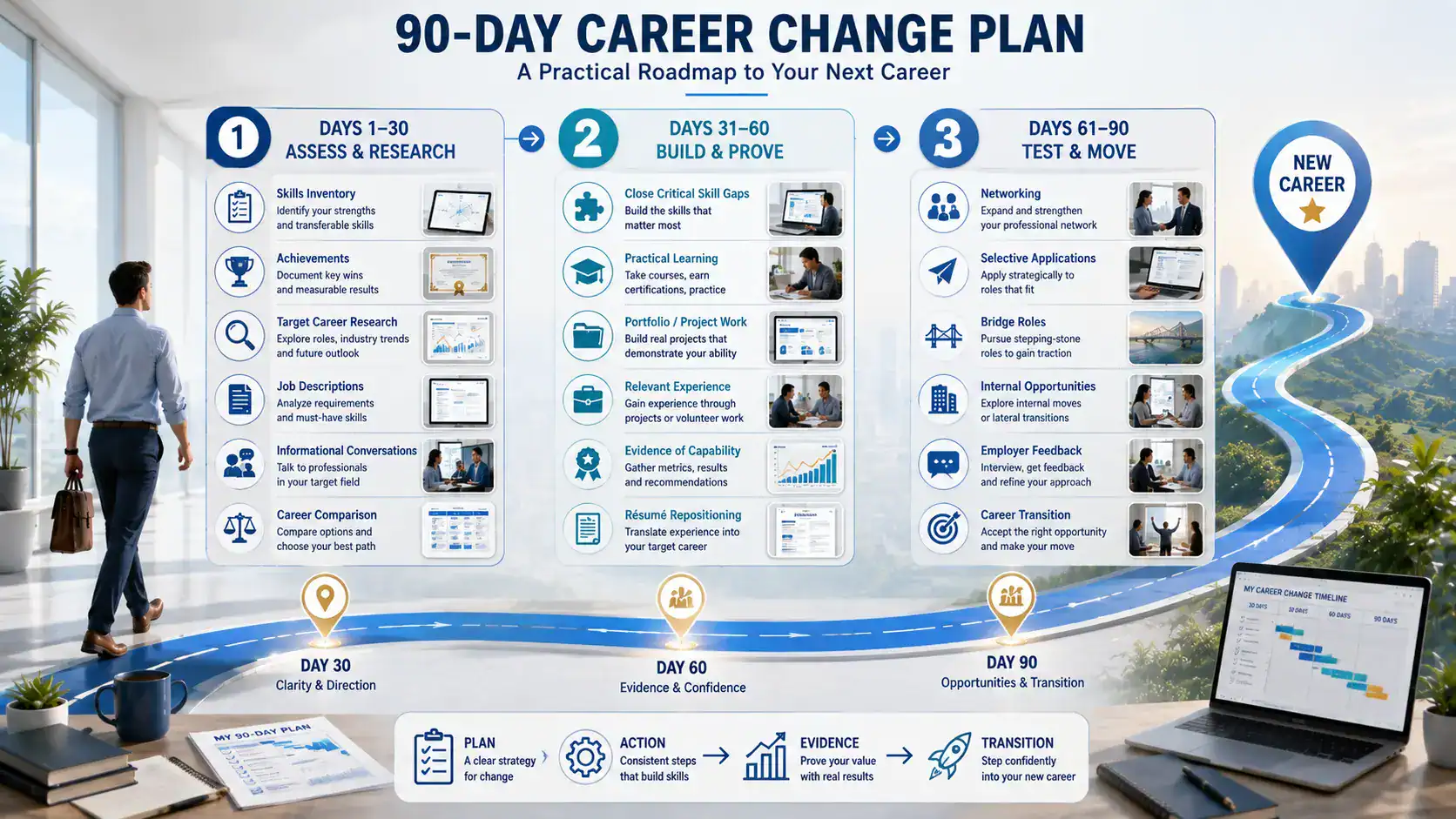
A career change gets much easier to manage once you stop treating it as one giant decision and break it into phases.
Days 1–30: Assess and Research. Inventory your skills, document your strongest achievements, identify what's transferable, shortlist two or three target careers, research their requirements, compare your options, and talk to people already working in the field. By the end of the first month, you should be able to answer: why this career, and why me?
Days 31–60: Build and Prove. Identify your most important skill gap, choose the right way to close it, complete a practical project, look for an internal or external project to take on, build portfolio evidence, rewrite your résumé, update your professional profile, and sharpen your career-change explanation. By day 60, you should have something concrete to show or talk through as proof of your new capability.
Days 61–90: Test and Move. Reach out to target employers, talk to more people in the field, apply for roles, explore bridge opportunities, test your résumé, go through interviews, keep track of objections and questions you get, and refine how you position yourself. Don't judge the whole career change on the first response you get — the market is handing you information. If employers keep asking about a particular gap, that's useful data. If they respond well to your transferable experience but push back on one specific area, now you know exactly where to focus.
When a Career Change Is the Right Decision
A career change deserves serious consideration when the problem runs deeper than a rough patch — when the work itself no longer fits your goals, your strengths are consistently underused, you've properly researched the target career, you understand the trade-offs, your transferable capabilities are clear, the critical gaps are realistically closable, you have a credible route to get there, you understand the financial implications, and you've actually tested the direction.
But it's worth pausing before making a major move if you're reacting only to one bad manager, you haven't researched the target career, you're assuming a new job will automatically fix everything, you haven't pinned down the real skills gap, you're about to spend heavily on training without knowing whether it's even required, or you have no idea how the transition affects your finances.
Sometimes the right answer isn't "change careers." It might be "change employers," or "change teams," or "change responsibilities," or simply "build the next stage of your current career." That's exactly why a career change should be treated as a decision, not an emotional reaction.
Frequently Asked Questions About Career Change
Is it possible to change careers without starting over? Yes. A career change can preserve a lot of value from your previous experience — transferable skills, industry knowledge, professional relationships, business experience, and demonstrated achievements can all carry into your next career. How big the leap feels really just depends on how different the target occupation is from your current one.
What are the most important transferable skills? There's no single universal list — it depends on the target career. That said, communication, analytical thinking, problem-solving, project coordination, stakeholder management, planning, leadership, and commercial awareness tend to be useful across a wide range of occupations. The key isn't just naming the skill — it's showing how you've actually used it.
Should I quit my job before changing careers? Not necessarily. A gradual transition lets you build skills, evidence, relationships, and financial stability while staying employed. A direct transition can make sense in some situations, but that decision should rest on your financial position, what the transition requires, and how confident you are in the target career.
Do I need another degree to change careers? Not always. Some occupations do have formal education, licensing, or qualification requirements. Others put more weight on experience, technical skills, portfolios, or demonstrated ability. Research what your target occupation actually requires before committing to a major educational investment.
How do I explain a career change to employers? Focus on the connection between your past and your future: what you've done, what capabilities you developed, why those capabilities matter in the new field, what you've done to close the gaps, and why the target career is a deliberate choice rather than a whim. A strong explanation should sound like a natural progression of decisions — not an apology for changing direction.
Can I change careers at 40 or 50? Yes, though the strategy needs to account for financial responsibilities, existing seniority, family commitments, and how much retraining is actually required. The advantage is that experienced professionals often bring substantial transferable skills, business knowledge, leadership experience, and networks with them. The more useful question is how to use what you already know to make the next move more intelligently.
How long does a career change take? There's no universal timeline. A relatively adjacent move might take months; a major occupational shift requiring substantial training can take considerably longer. Rather than picking an arbitrary deadline, break the transition into milestones — research, skill development, evidence, market testing, transition — so you have something you can actually measure.
Final Takeaway: You Are Not Starting Over
A career change can be a big decision, but it doesn't mean erasing everything you've built. Your previous experience doesn't disappear when you change direction — the skills, judgment, relationships, and understanding of how organizations work can still shape what you do next. What changes is simply the direction you point all of that.
You don't need to pretend your previous career never happened. You need to explain why the experience you gained there makes you better prepared for what comes next. That's the real difference between starting over and starting the next chapter.
If you're still deciding whether you need a full career change or simply a better direction within your existing career, the next useful step is mapping your current position against the destination you actually want to reach. See our Career Progression Plan guide for a practical framework, visit the Career hub for related career-development guidance, or explore our Career Resources for templates, checklists, and tools to turn career decisions into next steps.