CAREER PLANNING
How to Create a Career Development Plan That Actually Works
Most people don't have a career problem because they lack ambition. The harder problem is knowing what to do with that ambition.
You may know that you want a better position, higher pay, more responsibility, or even a completely different career. But a goal on its own does not tell you what to learn, what experience to gain, or what to do next.

That is where a career development plan becomes useful.
A good plan turns a broad career ambition into a series of decisions and actions:
This guide walks through that process step by step. It also includes a practical example, a career development plan template, and a U.S.-focused approach to researching occupations, education requirements, pay, and job outlook.
What Is a Career Development Plan?
A career development plan is a written framework for managing your professional growth. It connects your current position with a desired career direction and identifies the goals, skills, experience, and actions that can help you move toward it.
It can be useful at almost any stage of a career.
You might create one when you:
- want to advance in your current organization;
- are preparing for a promotion;
- need to develop new professional skills;
- are considering a different career path;
- want to move into management;
- are returning to work after a career break; or
- simply feel that your career has become directionless.
The U.S. Department of Labor describes career development as involving self-exploration, career exploration, and career planning and management.
A career development plan puts those ideas into a personal, actionable framework.
A Career Goal Is Not the Same as a Career Development Plan
Consider this goal:
Become a marketing manager.
It tells you where you would like to go, but not how to get there.
A development plan might look more like this:
| Element | Example |
|---|---|
| Current role | Marketing Coordinator |
| Target role | Marketing Manager |
| Strengths | Content, communication, campaign coordination |
| Development gaps | Leadership, analytics, budgeting |
| Experience needed | Project and campaign leadership |
| Development actions | Training and stretch assignments |
| Target timeframe | 12 months |
| Progress measures | Projects completed, skills demonstrated, manager feedback |
The second version gives you something you can actually work with.
Career Resource: Explore the Career Planning & Development hub for related guides on goals, career paths, professional growth, skills, salary and advancement.
Why Create a Career Development Plan?
A career plan is not a guarantee of promotion or higher income. Careers are affected by factors you cannot control, including organizational changes, economic conditions, hiring decisions, and changes in your industry.
Its value is that it gives you a better basis for the decisions you can control.
It Gives Your Career Direction
Without a defined direction, it is easy to accumulate experience without knowing whether that experience is taking you closer to the work you want.
A plan encourages you to ask:
- What would I like to do next?
- Which responsibilities interest me?
- Do I want to become a manager or a specialist?
- Do I want to stay in my current industry?
- What kind of work do I want more — or less — of?
You don't need to predict your entire working life. You need enough direction to make sensible next-step decisions.
It Exposes Skill Gaps
The role you want may require capabilities you don't currently demonstrate.
That gap could be technical knowledge, communication, leadership, project management, industry knowledge, education, or experience.
Once you know what is missing, you can decide how to address it.
It Turns Vague Intentions Into Actions
"Improve my leadership skills" is an intention.
"Lead one cross-functional project within the next six months and request structured feedback afterward" is an actionable development objective.
That difference matters.
It Creates Evidence of Progress
A useful plan lets you look back and answer questions such as:
- What have I learned?
- Which responsibilities have I taken on?
- What results have I produced?
- What feedback have I received?
- What can I demonstrate now that I couldn't demonstrate six months ago?
That record can also become useful when preparing for performance reviews, updating a resume, or discussing career progression with a manager.
The 6-Part Career Development Plan Framework
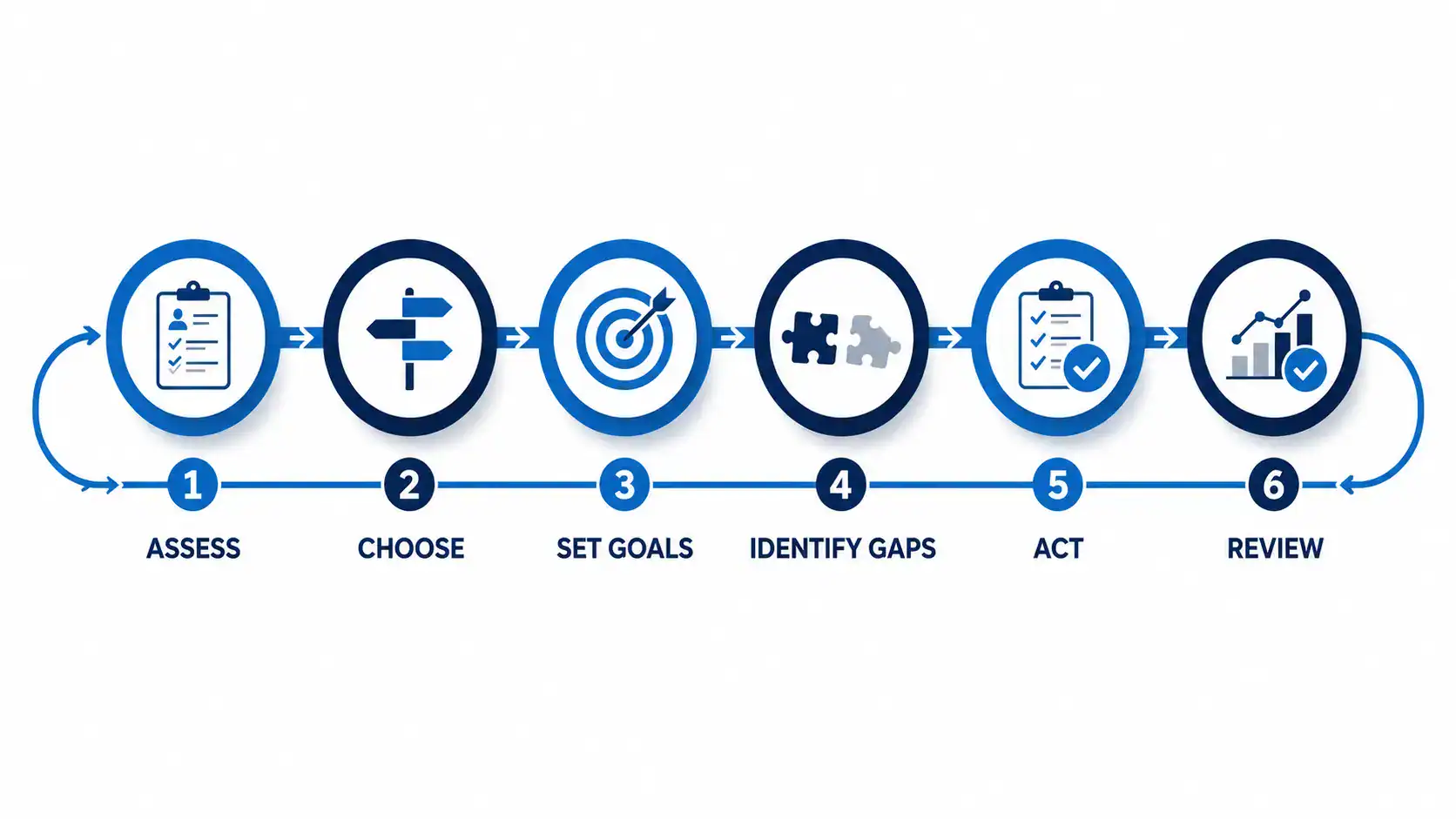
A practical career development plan can be built around six connected steps:
The important thing is not to treat these as six isolated exercises. Each step should inform the next.
1. Assess Where You Are Now
Before deciding what you need to become, take an honest look at where you are.
Start with your current role.
Look at Your Current Responsibilities
Write down:
- your job title;
- your main responsibilities;
- projects you regularly handle;
- decisions you make;
- people or teams you work with; and
- areas where you already have significant responsibility.
Identify Your Strengths
Your strengths might include:
- communication;
- analysis;
- organization;
- leadership;
- problem-solving;
- relationship building;
- technical skills;
- project management; or
- customer service.
Don't limit yourself to skills listed on a job description. Think about what other people regularly rely on you to do well.
Think About What Interests You
Ask yourself:
- What kinds of problems do I enjoy solving?
- Which parts of my job actually engage me?
- What do I find myself wanting to learn more about?
- What kind of work would I like to do more of?
- What would I rather avoid?
Be Honest About Your Constraints
A realistic plan also has to account for:
- the time you actually have;
- financial obligations;
- where you live;
- family responsibilities;
- education requirements;
- your current workload; and
- whether you're willing to relocate.
A plan that ignores all this might look great on paper and go nowhere in practice.
2. Define Where You Want to Go
Now consider your desired direction.
You don't necessarily need to identify a precise job title immediately.
Your direction might initially be:
Move from an individual contributor position into people management.
Or:
Move from marketing into data analytics.
Or:
Become a senior specialist without moving into management.
The important thing is to establish enough direction to investigate your options.
Research the Career Before Committing to It
If you're considering a new occupation, don't base your decision entirely on the job title or a salary figure you saw online.
The U.S. Bureau of Labor Statistics' Occupational Outlook Handbook provides information on hundreds of occupations, including typical duties, work environment, education and training, pay, job outlook, state and area information, and similar occupations.
The BLS Occupation Finder can also help compare occupations using factors such as entry-level education, on-the-job training, projected employment growth, projected new jobs, and median pay.
Use authoritative U.S. labor-market information when evaluating a career path rather than relying on isolated salary claims or social-media advice.
3. Set Specific Career Goals
Once you have a direction, decide what you want to accomplish.
Try not to create a list of 20 goals. A shorter list of meaningful objectives is easier to execute and review.
Short-Term Goals
These might involve the next few months:
- completing relevant training;
- improving a particular skill;
- taking on a new responsibility;
- building a portfolio project; or
- researching a target occupation.
Medium-Term Goals
These might involve six to eighteen months:
- leading a project;
- stepping into a higher-level role;
- earn a relevant credential;
- picking up experience in a new area
- or owning a bigger chunk of a business process.
Long-Term Goals
These may extend beyond 18 months:
- moving into management;
- switching professions entirely;
- becoming a senior specialist;
- building deep expertise in one area
- or working toward a leadership position.
Make Goals Measurable
Compare these two statements:
Improve my communication skills.
Deliver at least four presentations to internal audiences over the next six months and request feedback after each one.
The second gives you an action, a timeframe, and a way to evaluate progress.
The goal does not have to follow a rigid formula. It simply needs enough specificity that you can tell whether you are actually moving forward.
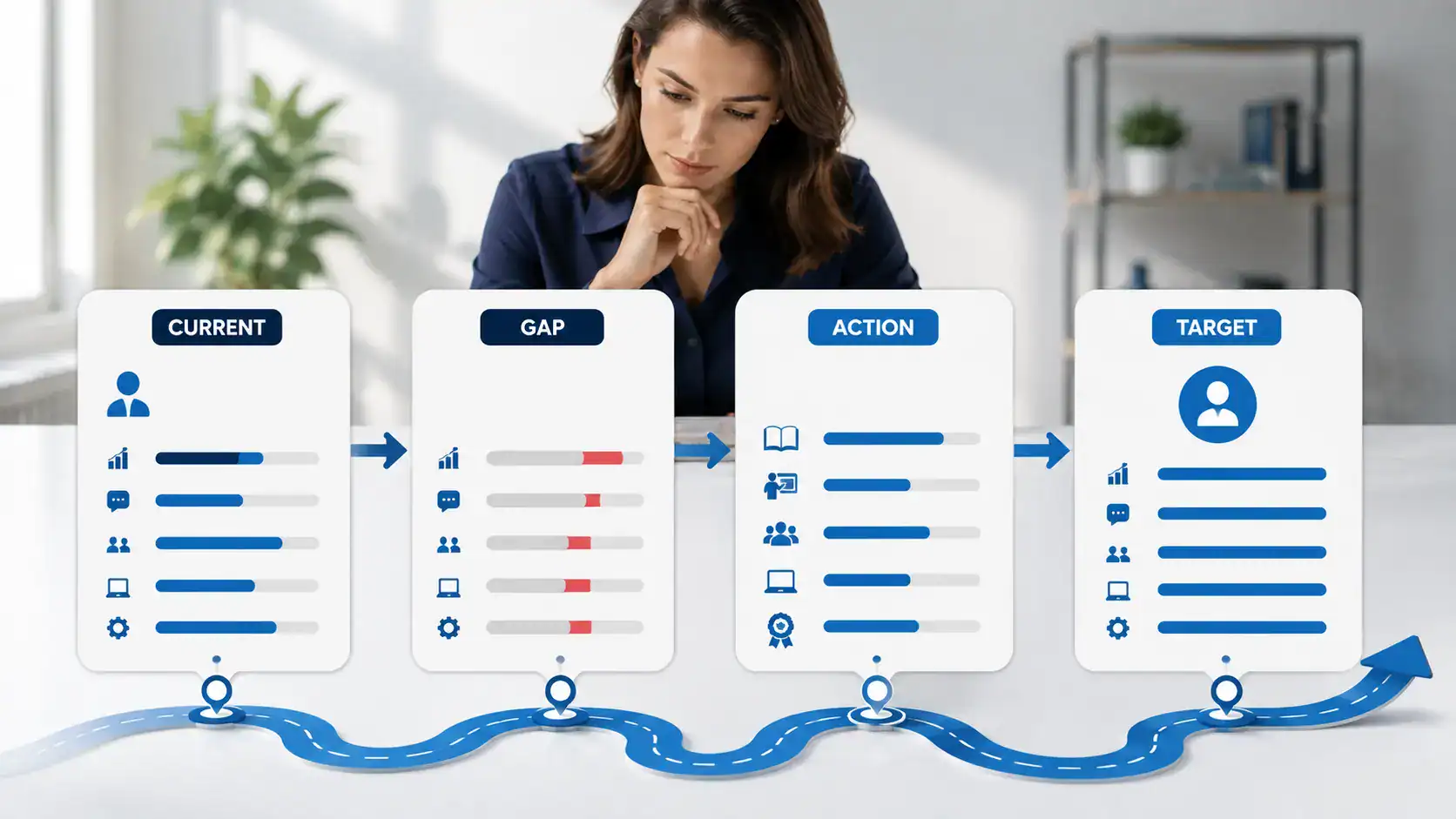
4. Identify Your Skills and Experience Gaps
This is where a career development plan starts becoming genuinely useful.
Look at your target role and ask:
What does someone in that role need to demonstrate that I cannot demonstrate yet?
The answer may involve more than formal qualifications.
You might need:
- technical skills;
- professional skills;
- leadership experience;
- project experience;
- industry knowledge;
- certifications;
- education;
- management experience; or
- stronger communication skills.
| Skill or Experience | Current Level | Target Level | Gap | Development Action |
|---|---|---|---|---|
| Communication | Intermediate | Advanced | Medium | Present at team meetings |
| Project management | Beginner | Intermediate | High | Manage a small project |
| Leadership | Beginner | Intermediate | High | Lead a cross-functional initiative |
| Data analysis | Intermediate | Advanced | Medium | Complete training + practical project |
This exercise can prevent an expensive mistake: spending time and money developing skills that have little connection to the role you actually want.
Don't automatically assume that a course is the answer. If leadership is your gap, actually leading a project, mentoring someone, or taking ownership of a difficult initiative may provide evidence that a course alone cannot.
5. Turn Your Goals Into an Action Plan
Once you've identified your gaps, decide what you will actually do about them.
For every significant goal, identify:
- the action;
- the resources required;
- the deadline;
- the evidence you will produce; and
- the measure of success.
| Goal | Action | Deadline | Measure of Success |
|---|---|---|---|
| Improve leadership | Lead a cross-functional project | 6 months | Project completed |
| Improve analytics | Complete analytics training | 3 months | Training + practical application |
| Improve communication | Deliver four presentations | 4 months | Presentations + feedback |
| Gain mentoring experience | Mentor a junior colleague | 6 months | Regular mentoring completed |
Notice the emphasis on demonstrable progress .
"Completed a course" is an activity.
"Used the skill to improve a real project" is evidence of application.
That distinction only gets more important the further up you go.
6. Set Career Development Milestones
Big career goals get a lot less overwhelming once you break them into milestones.
First 30 Days
- assess where you currently stand;
- research your target career;
- identify your skill gaps;
- set priorities; and
- choose development resources.
Days 31–60
- start training;
- practice the new skills;
- take on extra responsibilities;
- ask for feedback;
- and keep an eye out for chances to gain relevant experience.
Days 61–90
- wrap up your initial projects;
- put your new skills to use;
- document what you've achieved;
- ask for feedback again
- and adjust the plan if it needs it.
Months 4–12
- take on more complex work;
- develop a stronger record of accomplishments;
- increase responsibility;
- address remaining skill gaps; and
- evaluate readiness for the next career step.
These timeframes are not rules. Some skills and career transitions take considerably longer. The purpose of milestones is to create checkpoints, not artificial deadlines.
How to Research Your Target Career in the U.S.
If your career development plan involves moving into a new occupation, use reliable labor-market information before making major decisions.
The BLS Occupational Outlook Handbook is a strong starting point. Its profiles cover typical duties, work environment, education and training, pay, job outlook, state and area data, and similar occupations.
The BLS also explains how its data can be used during a job search to explore occupations, wages, education, training, and job outlook.
Look at the Work Itself
A job title can be misleading. Read the occupation's description and understand what people actually do during a typical workday.
Check Education and Training Requirements
Some careers can be entered with experience and on-the-job training. Others have specific educational, licensing, or certification requirements.
Examine Pay Carefully
Don’t make a career decision based on one posted salary. Median pay and actual earnings can vary by experience, responsibility, industry, performance, tenure and geographic location.
See the Job Outlook
See projected employment growth and other factors affecting future employment.
Account for geography
A career may seem attractive on a national basis; but it may be quite different in a particular state or metropolitan area.
Explore Similar Occupations
Switching careers doesn’t always mean starting from scratch. You may be able to transfer skills or experience gained elsewhere to related occupations.
Useful U.S. Career Research Tools
U.S. Bureau of Labor Statistics — Occupational Outlook Handbook
Example: A 12-Month Career Development Plan
Consider someone currently working as a Marketing Coordinator who wants to progress toward a Marketing Manager role.
This is not a prescription for how every marketing career should develop. It simply illustrates how the framework can turn a broad goal into practical steps.
Starting Point
Current role: Marketing Coordinator
Existing strengths:
- content creation;
- campaign coordination;
- written communication;
- basic analytics; and
- organization.
Desired Direction
Target: Marketing Manager
Development Gaps
- leadership;
- strategic planning;
- budget management;
- advanced analytics; and
- stakeholder management.
| Period | Objective | Action | Measure |
|---|---|---|---|
| Months 1–3 | Improve analytics | Complete relevant training and apply it to a live project | Project completed |
| Months 1–4 | Develop leadership | Lead a small cross-functional initiative | Initiative delivered |
| Months 4–6 | Improve strategic planning | Participate in campaign planning | Documented contribution |
| Months 6–9 | Increase responsibility | Own a campaign or major workstream | Results documented |
| Months 9–12 | Prepare for advancement | Discuss progression with manager | Formal development discussion |
The important feature isn't the exact 12-month timeline. It is the connection between:
How to Use Your Career Development Plan at Work
Your plan should not disappear into a document folder after you create it.
Use it in your day-to-day professional development.
Discuss It With Your Manager
A career conversation becomes more productive when you can explain:
- where you want to develop;
- which skills you are working on;
- what responsibilities you would like to take on;
- what support you need; and
- how progress could be measured.
Instead of:
"I want to move up."
You might say:
"I'd like to prepare for a senior role. I've identified project leadership and stakeholder communication as two areas I need to strengthen. I'd like to explore opportunities where I can take ownership of a project and receive feedback on my performance."
That's a much more concrete conversation.
Use It During Performance Reviews
Keep a running record of:
- completed goals;
- measurable achievements;
- projects;
- new responsibilities;
- skills developed;
- feedback; and
- results.
You will then have something more useful than a vague recollection of what you accomplished over the previous year.
Use It When Considering Internal Opportunities
Before applying for another role within your organization, compare the position's requirements with your current capabilities.
Ask:
- What do I already demonstrate?
- What can I demonstrate with additional experience?
- What gaps remain?
That can help you decide whether to apply now or spend more time preparing.
How Often Should You Review Your Career Development Plan?
Your plan should change as your career changes.
Monthly
Check your immediate progress. What did you accomplish? What remains outstanding? What should you do next?
Quarterly
Reassess your priorities, development progress, opportunities, and whether your timeline is still realistic.
Annually
Conduct a broader career review and reconsider your long-term direction, priorities, skills, and goals.
You should also revise the plan whenever a significant change occurs. A promotion, organizational restructuring, relocation, major industry shift, or change in your personal circumstances can all justify a review.
Common Career Development Plan Mistakes
1. Setting Vague Goals
"Become a better leader" isn't easy to measure. Define what becoming a better leader would actually mean in your situation.
2. Trying to Accomplish Everything at Once
A plan with too many simultaneous objectives can quickly become another source of frustration. Prioritize the areas most likely to make a meaningful difference.
3. Treating Training as the Entire Solution
Courses, certifications, and formal education can be valuable, but experience matters too. Whenever possible, combine learning with opportunities to apply it.
4. Ignoring the Requirements of Your Target Role
Before investing heavily in a development activity, determine whether it actually addresses a meaningful requirement of the career you want.
5. Setting Unrealistic Deadlines
Some professional capabilities take years to develop. A timeline should create focus—not pressure you into pretending that meaningful development can happen overnight.
6. Measuring Activity Instead of Outcomes
"Attended a workshop" is an activity. "Applied the new technique to a project and improved the result" is stronger evidence of application.
7. Creating the Plan and Never Reviewing It
A plan that isn't reviewed eventually becomes outdated. Put review dates on your calendar.
8. Treating Your First Plan as Permanent
Your career direction can change. Changing your plan is not evidence that the original plan failed. It may simply mean that you learned something new.
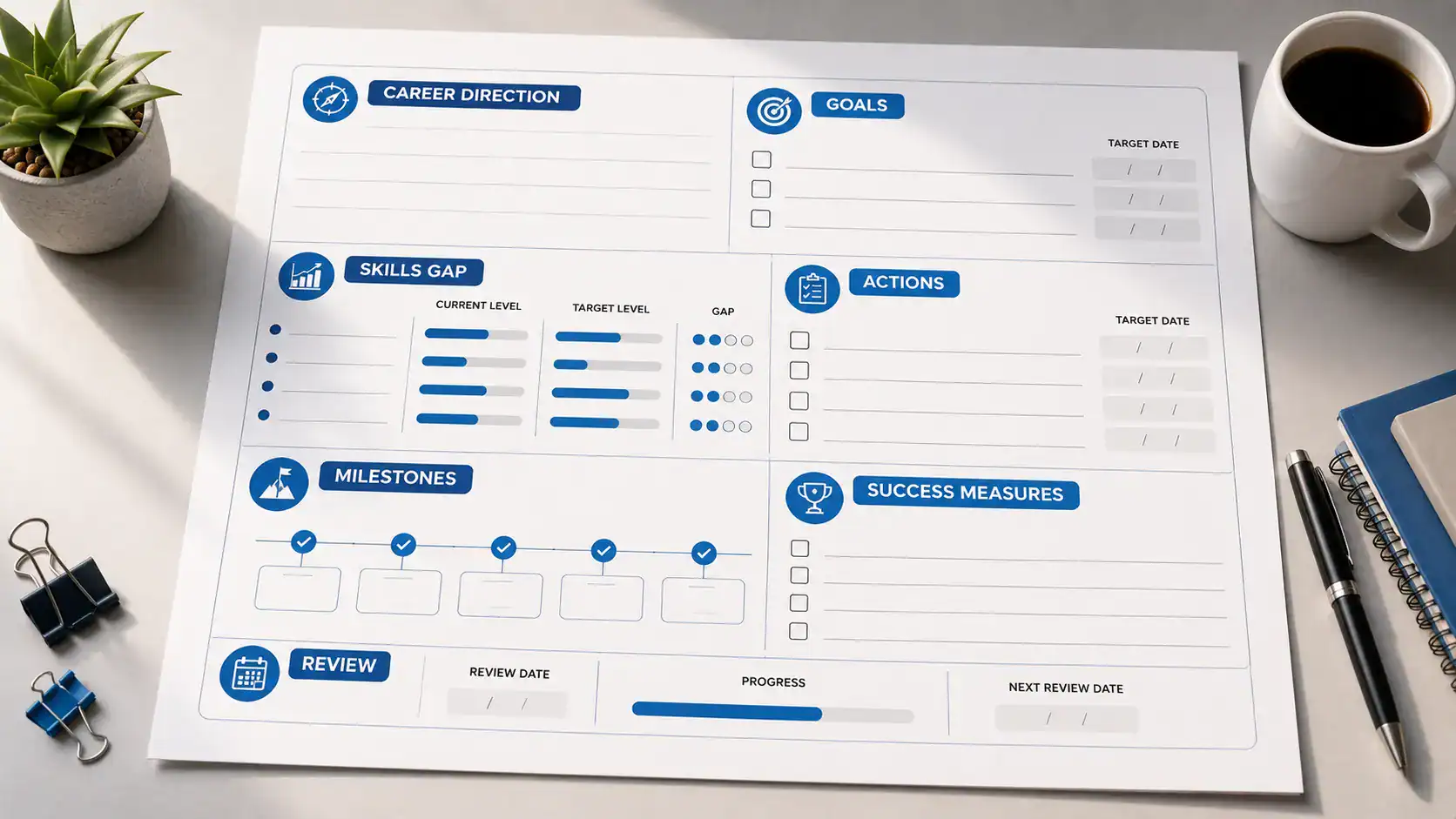
Career Development Plan Template
Use the following framework as a starting point for creating your own plan.
1. Where Am I Now?
Current role:
Current responsibilities:
Key strengths:
Recent accomplishments:
Skills I currently demonstrate:
2. Where Do I Want to Go?
Target role or career direction:
Why am I interested in this direction?
Target timeframe:
3. What Do I Need to Develop?
| Skill / Experience | Current Level | Target Level | Gap |
|---|---|---|---|
4. What Will I Do?
Goal 1
Goal:
Action:
Deadline:
Success measure:
Goal 2
Goal:
Action:
Deadline:
Success measure:
Goal 3
Goal:
Action:
Deadline:
Success measure:
5. When Will I Review It?
Monthly review:
Quarterly review:
Annual career review:
Career Development Plan FAQs
What is a career development plan?
A career development plan is a structured framework that connects your current professional position with your desired career direction and identifies the goals, skills, experience, actions, and milestones needed to make progress.
How do I create a career development plan?
Start by assessing your current position and strengths. Define a realistic career direction, establish measurable goals, identify skill and experience gaps, create specific actions, and set dates for reviewing your progress.
What should be included in a career development plan?
A useful plan generally includes your current role, career direction, strengths, development needs, goals, actions, deadlines, measures of success, and review dates.
What are examples of career development goals?
Examples include developing leadership skills, gaining project experience, improving communication, completing relevant training, building technical expertise, taking on additional responsibilities, or preparing for a future position.
How often should I update a career development plan?
Review progress monthly, reassess priorities quarterly, and conduct a broader career review at least annually. Update the plan whenever a significant change affects your career direction or priorities.
What is the difference between a career goal and a career development plan?
A career goal describes an outcome you want to achieve. A career development plan describes the path you intend to take toward that outcome, including the skills, experience, actions, and milestones involved.
Can a career development plan help with a career change?
Yes. It can help you identify transferable skills, determine what new capabilities you need, research potential occupations, and organize the steps involved in moving from your current career into a new one.
Build Your Career Development Plan One Step at a Time
You don't need to know exactly where your career will be five or ten years from now.
You do need enough clarity to make your next decisions deliberately.
Start with six questions:
- Where am I now?
- Where do I want to go?
- Which career goals will move me in that direction?
- What skills or experience am I missing?
- What will I do to close those gaps?
- How will I know that I'm making progress?
Then write the answers down.
The value of a career development plan isn't the document itself. It's the process of making your career decisions more deliberate, testing your assumptions, gaining relevant experience, and adjusting your direction when circumstances change.
If you're researching a new occupation in the United States, supplement your planning with reliable labor-market information. The BLS Occupational Outlook Handbook and Occupation Finder provide information on education, training, pay, employment, projected growth, and related occupations that can help you make a more informed comparison.
Your career may not follow the path you draw today—and that's perfectly fine.
Sources & Further Reading
- U.S. Bureau of Labor Statistics — Occupational Outlook Handbook — U.S. occupation information, including education, training, pay and job outlook.
- BLS — Occupation Finder — Compare occupations using education, projected growth, projected new jobs and median pay.
- BLS — How to Find a Job — Career, wage, education, training and job-outlook resources.
- U.S. Department of Labor — Career Development — Resources covering self-exploration, career exploration and career planning.
BLUEPRINT TO PROGRESS CAREER HUB
Keep Building Your Career Plan
Explore the full Career hub for practical guides covering career planning, employment, career development, professional skills, salary and negotiation, and career advancement.
Explore Career Guides →